Category Archives: Sources

Henn, cheese, pickles and Guinness

An Affecting Charge

The following case lately came for trial before Mr Henn QC, the new Recorder of Galway:— George Hamilton, who for twenty-five years had been in the employment of the Midland Great Western Railway Company as station-master, was indicted for stealing from a hamper some goods, the property of Sir Arthur Guinness, which were addressed to Cong, in the county Mayo. For some time a course of pilfering had been carried on, and the directors, in order to find out who were the guilty parties, employed two Dublin detectives, named Stookman and Healy, who arrived in Galway on Aug 31st, and, concealing themselves in the goods-store in empty barrels, remained on the watch all night. About one o’clock next morning they heard a noise, and observed the prisoner entering the place. Having satisfied himself that he was unseen, he took out his penknife and proceeded deliberately to cut the cords of the hamper and extract some of its contents. The detectives waited until he had taken out a bottle of vinegar, a bottle of pickles, and some cheeses, and then tied up the hamper again. They then issued from their hiding-place and seized him. He begged them for God’s sake to have mercy on his wife and family, and to leave the matter between himself and the manager, but they refused to do so, and, having called the police, gave him into custody. About twenty witnesses were examined for the prosecution, and among them the clerk of the goods store, who swore that it had been locked and the key left with the prisoner.

Mr M’Laughlin QC appealed to the sympathies of the jury, and, pointing out some alleged discrepancies in the evidence, pressed them, if they had a doubt that the prisoner took the articles with a guilty intent, to give him the benefit of it.

The Recorder, in his charge, showed that the discrepancies only proved the truth of the charge, and expressed the deep pain he felt at seeing in such a position a man who had held a respectable position, with a salary of £300 a year, and had young ladies whom he saw in court dependent upon him. He finally burst into tears.

The jury retired, and after three hours’ deliberation returned into court and stated that there was no chance of an agreement. His worship sent them back to their room, and, after being absent for another hour, they brought in a verdict of not guilty, which the Recorder stated he could not endorse, but characterised as monstrous.

The Leeds Times 12 October 1878

The Recorder, Mr Henn, was the father of T R Henn and later lived in Paradise. Sir Arthur Guinness, a stout fellow, was a descendant of this chap and had a small holiday house at Cong on Lough Corrib, where his family had many boats.
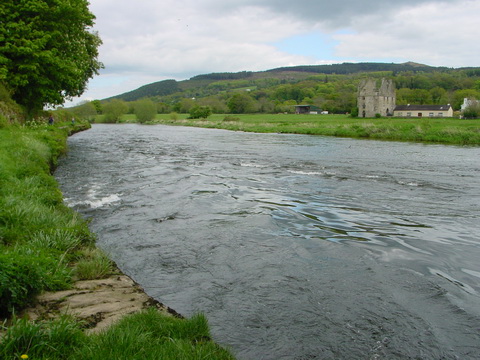
The Suir towing-path

His late Most Excellent Majesty Henry the Eighth, by the Grace of God, King of England and France, Defender of the Faith, Lord of Ireland and of the Church of England and also of Ireland in Earth Supreme Head, has many claims to fame, but the greatest is undoubtedly his Act for the Weares upon the Barrow, and other Waters in the County of Killkenny of 1537, which begins thus:

Prayen the commons of this present Parliament assembled, That where at all times necessarie boates, scowts, wherries, clarans, cottes, and other vessels, loden and bestowed with goods, merchandizes, and other stuffe, have beene used to passe and repasse thorough and in the King’s most excellent Majesty’s rivers and waters of the Barrow, the Noyre, the Suyr, and the Rie, within this land, which Rie is in the county of Kilkenny, to and from the King’s citie of Waterford, and the townes of Kilkenny, Rosse, and Clomel [sic], to and from diverse borrowe and corporate townes, and other places, being sitiated in the counties of Kyldare, Catherlagh, Wexford, Kilkenny, Waterford, and Tipperary, through which great commoditie and profit hath growen and might grow to the said citie, townes, noroughes, and other places, and to all and every the King’s true subjects adjoyning to the same waters and rivers: […]

We resume a couple of pages later:

[…] and that the said owners, their servants, marryners, boatmen, and other rulers and conveyers, and all other persons coming in ayd and help of them and every of them, at all such times as the said mariners, boatemen, and other rulers and conveyers shall thinke the same necessarie and needfull, shall have and occupie at every of their wills and pleasures, the space and breadth of seven foote or more, as need require, of plain ground, upon every part of the land, of every side of every the said rivers and waters, next adjoyning to the said rivers and waters, and that to bee where they must needs draw the said boats and other vessels afore named, with strength of horses or men, by land […].

So His late Most Excellent Majesty provided that those drawing boats, using manpower or horsepower, could use a space seven foot wide on either side of the river. From the 1750s onwards, work was done on building a towing-path along the Suir between Carrick and Clonmel; work seems to have been finished before 1789 and the towing-path continued in use until the early years of the twentieth century.

Kincor Castle below Sir Thomas's Bridge at Ferryhouse

Kincor Castle below Sir Thomas’s Bridge at Ferryhouse

Much, but not all, of the towing-path is accessible, and maintainted by South Tipperary County Council; as well as providing a walking route, it allows anglers, boaters and other leisure users to get to the river. However, some sections are impassable, so that it is not possible to walk the whole length of this extremely scenic route between Clonmel and Carrick.

South Tipperary County Council is now considering declaring public roads on the towing-path and thus taking it in charge.

South Tipperary County Council's newspaper ad about declaring public roads on the Suir towing-path

South Tipperary County Council’s newspaper ad about declaring public roads on the Suir towing-path

The Council’s documents are here. I think that this is a good idea and I have written to the Council (and to local newspapers) to declare my support.


The fear of Baal’s Bridge

In May 1895 the fear induced by the prospect of a passage under Baal’s Bridge, on the Abbey River in Limerick, as revealed in the commercial court in London before Mr Justice Mathew and reported by the Freeman’s Journal of 20 May 1895.

Arthur George Mumford of Colchester, Essex, was described as an agent, but was actually a marine engineer and manufacturer of steam engines. He owned a 25-ton steam yacht called Gipsy, which he decided to sell through Messrs Cox & King, the well-known yachting agents (their 1913 catalogue is here).

The buyer was Ambrose Hall, the man responsible for the statue of Patrick Sarsfield. A former mayor of Limerick, he was an alderman and a “house and land commission agent”; his address was given as Mignon House, Limerick, which I have not so far found.

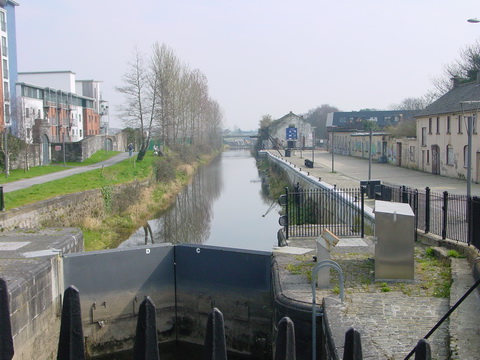
Hall bought the boat for £500; it was to be delivered to him at Limerick. The original plan was to sail it around the coast of Ireland and up the Shannon estuary, but bad weather in late 1894 caused Cox & King to suggest taking it to Dublin and then down the Grand Canal and the Shannon to Limerick. Hall agreed; the boat left Dublin in January 1895. It reached Killaloe on 19 January and Limerick “a day or two afterwards”, where it was moored in the canal harbour.

25 Grand Canal Harbour Limerick March 2007 01_resize

Canal harbour, Limerick in March 2007

Hall refused to accept the boat in the canal, saying that it should have been delivered to Limerick dock, a short distance downstream. Mumford and Cox & King sued him and the National Bank.

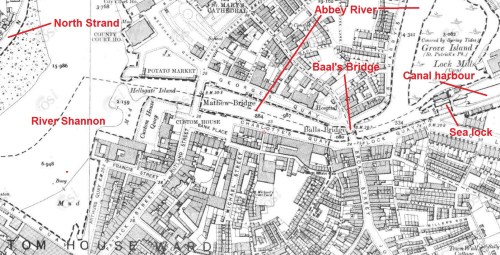
Hall and Baal

Ordnance Survey ~1900

Hall, an alderman and a former mayor, who had lived at North Strand, presumably knew the river and its difficulties.

Baal's Bridge 20091128 1_resize

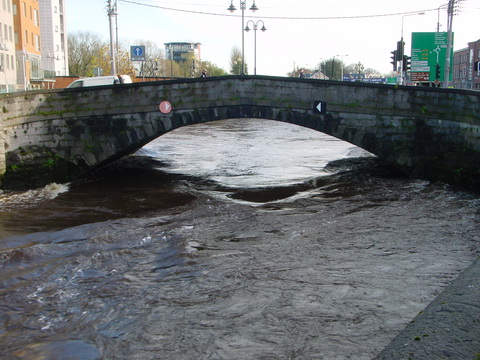
Baal’s Bridge looking upstream towards the canal harbour in the floods of 2009

Navigation arch at Mathew Bridge 20091122_resize

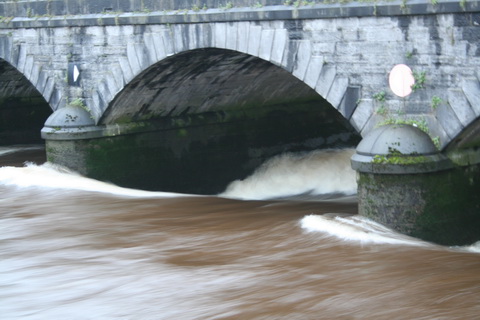
The navigation arch at Mathew Bridge looking downstream in the floods of 2009

It was contended by the defendant that to get the vessel from the canal into the estuary of the Shannon there was a considerable risk involved. The passage was only a few hundred yards, but it was stated it could only be effected at certain states of the tide when it would be possible to get through Ballsbridge.

The judge sensibly suggested that it should be possible to insure the boat for the journey; the plaintiffs agreed to deliver it; Hall agreed to accept delivery and to pay £15 for the cost of the caretaker who had been looking after the boat since 23 January; the case was settled.

Clearly Ambrose Hall didn’t know Pat Lysaght.

My OSI logo and permit number for website

The 120′ Irish steam-powered narrow boat

Read about it here.

Still only two

For most people, I imagine, the high point of the week is the publication by the Revenue Commissioners of the updated list of those holding Marked Fuel Trader’s Licences [.xls rather than .xlsx this week]. Alas, although the list is now up to 178 pages, there are still (as far as I can see) only two licensed traders along the Shannon. None south of Killinure and no more IBRA members, unless my eyes deceive me.

A load of old bollards

Our London Correspondent reports that the latest and most fashionable souvenir to go on sale there is a reproduction cast-iron “paperweight/doorstop/bookend based on the mooring bollards of Regents Canal”. Available in black or fluorescent red, these items were designed by a designer who was being worked with by another chap who was commissioned by a Creative Agency. The result is a “desirable antidote to the overly-commercial, tacky souvenirs” available elsewhere, it says here.

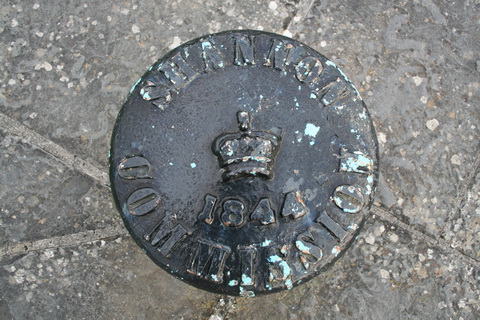
Shannon Commission bollard 1844_resize

A bollard at Meelick

Well, that’s nice. Maybe Waterways Ireland could commission the same creative types to design a range of reproductions of Irish waterways bollards; folk could be encouraged to collect the entire set.

But one minor drawback does strike me. The artistic merits of these reproduction bollards are of course obvious, but as souvenirs they have one minor drawback. A souvenir is something you buy, while on holiday, to take home to someone else. Nowadays, the steamer services are not what they once were and many folk travel on these new-fangled flying-machines. But according to that nice Mr O’Leary, who operates some such machines, you may take only 10 kg of cabin baggage. These bollards, though, weigh about 1.5 kg each, which rather limits the number of bollards you can carry as souvenirs.

Canal Boat No 279

There is a mystery about Canal Boat No 279, which sank in the entrance to Spencer Dock, on the Royal Canal, in December 1873. Actually, there are several mysteries, and readers’ comments, information and suggestions would be welcome. Read the story here.

Canal boat sunk on the Liffey

In a comment here I wondered what a canal boat was doing as far up the Liffey as Grattan Bridge in 1873. Here is a report from the Freeman’s Journal of 10 March 1875 that may provide a possible explanation.

THE LATE WRECK IN THE RIVER LIFFEY:— The porter-laden canal boat which was swamped on Monday by being borne by the flood in the river against the southern abutments, at the western side of Grattan-bridge, still remains in the place where she sank. Though she came with great force against the structure, she did not inflict the slightest injury upon it. Measures will be at once taken for floating the sunken vessel, which does not in any way interfere with the river traffic, as the centre arches are quite clear. All the porter which was on board the canal boat when she went down has been secured.

Remember that Guinness built its wharf on the Liffey in 1873 but did not start building its own fleet of barges for the Liffey until 1877. It did, however, have “a few small tugs” that were used to draw laden boats.

Guinness had easy access to the Grand Canal Harbour at James’s Street, so it seems unlikely to me that Grand Canal boats would risk the Liffey passage to supply pubs along the Grand, the Barrow and the lower Shannon. It therefore seems more likely that the boats were either Royal Canal boats or were being used to supply ships in the port.

Newcomen Bridge again

Last month I wrote about the lock at Newcomen Bridge on the Royal Canal:

Industrial Heritage Ireland has created a page giving the history of the railway crossing at Newcomen Bridge. However, it would be nice to have some documentary evidence about the resiting of the lock — and about the headroom under the bridge before the lock was moved.

Here it is, from the Freeman’s Journal of 12 April 1873, in an article about the new Spencer Docks:

Above the new metal bridge there is a basin for Canal boats, with a quayage of 450 feet at either side and a depth of six feet. In connection with the new works, the lowering of Newcomen-bridge on the Clontarf-road must be alluded to. To effect this the old lock had to be moved higher up, and the old bridge replaced by one suited for the requirements of the tramway traffic. The arch of the bridge crossing the Canal was lowered five feet, and a new girder iron bridge crosses the railway at the same level. The Main Drainage Board wisely took advantage of the opportunity of the Canal being drained to make a main sewer under the canal and the railway above Newcomen-bridge at the low level required.

Happy, Mick?

Grand Canal: propulsion

This is a point that I do not recall seeing before. It arises in a short report from the Freeman’s Journal of 17 July 1876.

SAVED FROM DROWNING. — On Saturday evening a man named Patrick Fitzsimons, while employed with others in getting a canal boat through the lock of the Portobello-bridge, fell into the basin and sank. He rose to the surface in about a minute, and was apparently exhausted, for, after a vain attempt to hold on by the projecting ledge of the boat, he went down again. There now seemed to be great danger of the man’s life being lost, but some of his companions held out one of their long “sweep” oars towards the place where he sank, and when he came up the third time he succeeded in grasping the oar and holding on till he was taken out of the water. He was then in a very weak state, and it appeared very plainly that when he fell into the basin he was not in the best condition to protect himself from accident.

I suspect that the last phrase means that he was drunk. But what is more interesting, at least to me, is that a canal boat was equipped with oars. I do not recall having read that anywhere. But we know little about the design, equipment and operation of nineteenth century canal boats. Oars would certainly be useful for moving around basins and on rivers like the Liffey, but how were the oars pivoted and how many men did it take to row a loaded canal boat?