
We were thrilled to receive awards from the Railway and Canal Historical Society for “Waterways and Means”. We were awarded Waterways book of the year, as well as overall book of the year. His association with the RCHS meant a lot to Brian, who exchanged information regularly with their members. He led a field trip for them around Killaloe and the Shannon estuary a number of years ago, as well as speaking at their annual Clinker lecture. They published his book on the Royal Canal at the time of the lecture.
The following is their press release from the awards ceremony:
PRESS RELEASE from the Railway & Canal Historical Society
On 27 May the Society announced the results of its 2023 Transport History Book Awards. Now in their 20th year, these Awards were initiated by the Society in 2004 to encourage the writing and publication of well-researched, interesting, and readable books in the field of transport history. Their continuation has been ensured for the foreseeable future by a generous legacy left to the Society by the late David St John Thomas, author, and co-founder of the publishing house David & Charles.
The winner of the Canal & Waterways category and the overall Book of the Year 2023 was:
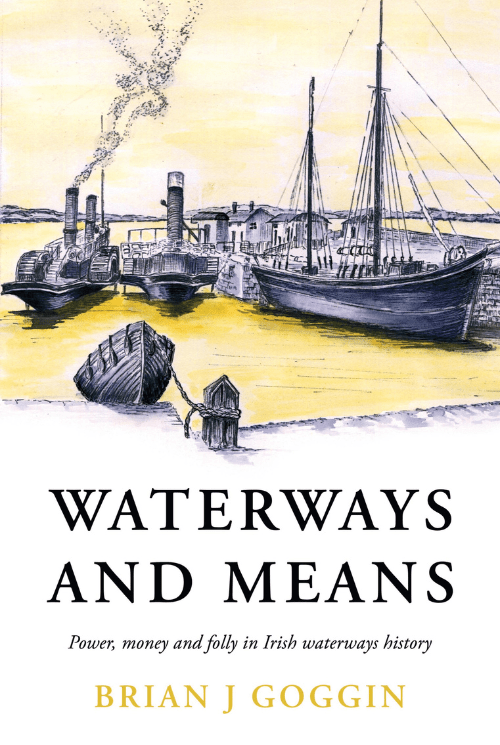
Waterways and Means – Power, Money and Folly in Irish Waterways History by Brian Goggin
Brian Goggin was diagnosed with terminal cancer in the summer of 2020. During his time remaining he assembled a collection of articles from his website and elsewhere which could be published posthumously. His family completed the task and this volume is the result. It is gratifying to learn that the website now forms part of the Irish National Archive.
Brian adopts a broad definition of ‘waterway’ – any body of water, natural, adapted or constructed which is used for the transport of people or goods. He also points out that waterways can be viewed from different perspectives, for example, as obstacles to land communication, as convenient rubbish dumps or even as unofficial swimming facilities. They had many unrecorded uses and users. Other writers have tended to concentrate on the ‘official’, documented waterways. Brian identifies gaps in the literature, particularly in the areas of political and economic factors, and in this book attempts to fill some of them whilst identifying further areas that he thought should merit attention.
Focussing on the late 18th and early 19th centuries, around half the book explores the history of navigation on the Shannon Estuary and Limerick Navigation, including steamer services on the estuary, use of steam tugs on the loughs and the traffic in agricultural produce sent mainly to Liverpool and described in Brian’s 2014 RCHS Clinker Lecture ‘Steam, the Shannon and the Great British Breakfast’. The remainder of the book is a series of essays, arranged thematically, exploring some of the little researched areas identified by the author, some of them quaintly referred to as ‘rabbit holes’ by his editors – fascinating diversions discovered in the course of his research. These include subjects such as navigations that were never completed, waterways built to drain land but found useful for transport purposes, internal canal systems on Irish estates and an account of unofficial bathing in the Dublin canals. There is little documentation for many of these subjects but, nevertheless, Brian found sufficient material to tell their story – the extensive endnotes list more than 1500 references. He suggests that waterways historians could work profitably with local historians to dig deeper into these matters.
The specially commissioned maps are particularly helpful in supporting an understanding of the text. The reproduction of the photographs is perhaps not fully up to the best contemporary standards, and the book lacks an index. These are minor criticisms, however. Readers will encounter a mixture of scholarly articles and story-telling. To borrow a term usually applied to fiction, this is a book of short stories, some on unexpected topics, which can be dipped into and revisited. It deserves a wide audience both for its coverage of Irish waterways history and for its novel and innovative approach.
Full details of the Book Awards, including the judges’ report and list of previous winners, can be found on the Society’s website http://www.rchs.org.uk

 Irish waterways history