Tag Archives: canal

All SEWn up?

Last week the Clones Regeneration Partnership Chairman called for politicians to support Craggy Island’s Canal to Clones. That’s the scheme being pushed by the Department of Community, Equality and Gaeltacht Affairs (which funds the Partnership’s Project Coordinator).

Then Brian Cassells, former President of the Inland Waterways Association of Ireland, joined the campaign, with an article in the Northern Standard. Happily, its Comments section is working (it was my fault that my comment was posted twice: I tried to edit it but ended up with two almost identical versions).

Brian says:

The phenomenal success of the Shannon/Erne waterway is largely down to the far sighted vision of the late Charles Haughey who had the dream of what has become an enormous tourist success.

I have argued that the success of the SEW is often over-stated and that much of the prosperity of the region is attributable to the businesses set up by Sean Quinn.

But there is another point that the Clones Canal’s fans overlook. According to askaboutireland.ie,

The £30 million funding [for the Shannon–Erne Waterway] came mainly from the European Union Regional Development Fund, the International Fund for Ireland and the E.S.B.

I have not been able to find any exact breakdown of who contributed how much, but it does seem that some large proportion of the costs was not paid by the taxpayers of either Ireland or Northern Ireland. That makes for a much better return on whatever amount of capital they employed.

This time, though, that’s not going to apply. The days of free Euroloot are over, and I haven’t heard that either the IFI or the ESB will be contributing.

Maybe the good people in Craggy Island are relying on winning the lottery?


The Erne to Lough Oughter

How they got the dredgers past the distillery in 1857. No pics, alas, but it’s worth using the links to the OSI maps.

Let joy be unconfined

I was really worried today. Yesterday was the deadline for Craggy Island, the Department of Community, Equality and Gaeltacht Affairs, to respond to my Freedom of Information Request for info on funding of the Clones (formerly Ulster) Canal, the insane project being pushed by Craggy Island. So I expected the response in today’s post.

I have been maintaining that Craggy Island hasn’t got the money and doesn’t know where it’s going to get it. But if they granted my FOI request, and showed funding streams providing lots of lovely lolly going into a hole in the ground over the next several years, I’d look a bit of an idiot. It wouldn’t take much to shut me up, though: just a tiny bit of evidence (a memo from the Department of Finance, say, or a budget or projected cashflow) that the money was available.

So imagine my joy when I got a four-page letter, an eight-page schedule of documents (showing, for most of them, why I couldn’t see them) and a pile of miscellaneous crap –ministerial speeches and suchlike — that I was allowed to see.

My faith is reinforced. They haven’t got the money. But I’m going to help, by appealing the decision and thus contributing even more to the departmental coffers.

Something in the water?

Readers may have realised that I don’t think much of the proposal to restore or rebuild the Ulster Canal. But I have to admit that it is not the most insane canal restoration proposal to have been made in the last few years. Even the restoration of the Strabane Canal doesn’t merit that accolade.

No: the outright winner has to be the Erne Canal proposal. Happily, despite support from Mary Coughlan, TD for the area and Tánaiste (deputy prime minister), the proposal doesn’t seem to have got anywhere.

What do all three of these proposals have in common?

Northsouthery, that’s what.

The Clones dudes

The Comments section on the Clones Regeneration Partnership blog is still not working, so my posting still hasn’t appeared. They seem to be using the free version of WordPress; maybe I should offer to help them ….

Anyway, they have been busy posting new stuff of their own to the blog. The Chairman of the Partnership has written a long post about the importance of the Irish taxpayer’s spending at least €35 million on the Clones Canal and urging the electors of Monaghan to demand that their representatives support the thing. In fact, he wants them to ensure that the entire Ulster Canal is reopened, all the way to Lough Neagh.

Wishing won’t make it so. I have written many pages explaining (a) why this is a bad idea and (b) why it’s most unlikely to happen (Ulster says no) and there is no point in my repeating them here. I’ll just note that I feel sorry for the good people of Clones: they have been misled by the campaign, conducted by the Department of Community, Equality and Gaeltacht Affairs, to impose a bit of northsouthery on Northern Ireland.

From the point of view of Clones folk, spending €35 million on a canal to Clones may make sense. The canal itself is likely to be pretty well useless, but the pubs of the area are likely to benefit from the beer money of the construction workers. That, though, doesn’t mean that this is a good deal for the Irish taxpayer: in fact it’s a rotten deal.

Risks of investing in waterways businesses

But even if it does happen, the good people of Clones should be wary of committing any of their own money to setting up businesses. Towards the bottom of this page you’ll see photos of the Sliabh-an-Iarainn Sunset and the Gertie, trip-boats that operated on the Shannon–Erne Waterway for some time; neither now operates there. And here are two small boats, which were hired out by the day from Ballinamore.
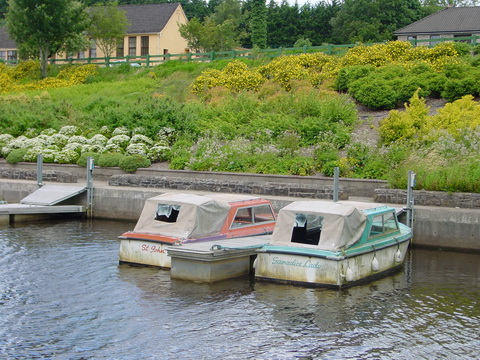
Former day-hire boats at Ballinamore

If you don’t think you can recoup your investment back in three years, forget it.

The Chairman says

The restoration of the Ulster Canal would bring direct economic benefits to the towns and villages in close proximity throughout the Ulster Canal corridor. It would provide the economic engine for a whole region to regenerate, as has been shown from the experience of the restoration of the Ballinamore/Ballyconnel Canal, where populations in those areas adjoining that Canal have grown for the first time in many years.

The benefits won’t be any greater because of being spread more widely (and thus thinly). This seems like an attempt at drumming up support from outside Clones.

The economic benefits cannot be understated.

I think he means “cannot be overstated” or perhaps “should not be understated”: they have been consistently overstated, for many years, by the canal’s proponents. It’s the sort of “ah sure it’ll be grand” thinking that has ruined the Irish economy: an unwillingness to accept, or even to think about, anything other than the most optimistic scenario. You decide on what you want to do; then you look for some evidence you can quote to support your decision — and you ignore all evidence to the contrary, or suggest that sceptics should commit suicide.

Remember, this project has been consistently backed by the Fianna Fáil government, the one that brought you ghost estates, empty office blocks, uncompleted retail developments, vacant hotels and an enormous amount of debt that citizens will be paying off for years to come. But for some reason they think a canal, built when the boat-hire industry is contracting, is a good investment ….

Welcome new readers

I suspect that the Clones Project Coordinator, Gerry Darby, has been reading this site, because he has today posted a page headed See cost benefit analysis of Ulster Canal by Marion Shields. Gerry (whose position is funded by the Department of Community, Equality and Gaelteacht Affairs — the very people pushing the Ulster Canal project) may have been following in my footsteps, because many months ago I tried to see if there had been any cost-benefit analysis of the proposal. There should have been one, according to one Brian Cowen, former Minister for Finance, but I couldn’t find one.

I did find Marion Shiels’s piece. It may be necessary to explain, to persons unfamiliar with the traditional usages of the College of the Holy and Undivided Trinity of Queen Elizabeth near Dublin, that a Senior Sophister, which is what Marion Shiels was at the time, is a final-year undergraduate student. Her piece, in other words, is not the work of a professional, and does not purport to be such.

But the other point to be made about the document is that it is not in fact a cost-benefit analysis: more a discussion of such analysis. Note, for instance, that there are very few figures, especially for benefits, yet

The guiding principle is to list all parties affected by an intervention and place a monetary value of the effect it has on their welfare as it would be valued by them.

Statements like “Hence, the revenue that could be expected from these fleets is enormous ….” don’t constitute analysis of benefits.

If there is a proper cost-benefit analysis out there, I’d like to see it.

And, of course, I’d like to know where Gerry’s funders intend to get the money to pay for the Clones Canal.

 

Old photos of Parteen Villa Weir and barges

Thanks to Sam and Brian Grubb, I have been able to put up some photos, taken in 1930, of Parteen Villa Weir. The scanning of the photos was done at such high resolution that it is possible to see several vessels moored in the headrace below the weir.

Waterways restoration? No thanks

An article in the Irish Times about railway restoration has prompted me to set out my views on waterways restoration. Essentially, I don’t believe public funds should be spent on projects that won’t provide a decent return, but I do favour small-scale conservation, opening up walking and cycling routes along waterways and marketing them to industrial heritage enthusiasts (and others).


No news is good news … perhaps

Extracts from the Joint Communiqué issued after the 11th Plenary Meeting of the North South Ministerial Council on 21 January 2011:

3. Ministers discussed a range of common challenges and shared views on the economy, the banks and NAMA. They recognised the constraints on budgets in both jurisdictions and the ongoing discussions between the two Finance Ministers to identify potential cost savings through co-operation and sharing were welcomed. There was a desire to maximise access to EU funding and
resources.

6. Ministers noted the Progress Report on the ten NSMC meetings which have been held since the last Plenary meeting in July 2010 and welcomed the mutually beneficial co-operation taken forward including that:

[…] The restoration of the Royal Canal to reconnect it to the Shannon has  been completed and a preferred route for the Clones to Upper Lough Erne section of the Ulster Canal has been identified.

No exciting announcement there, so the bulldozers have not yet been set rolling on the Clones Canal. Phew. Maybe we’ve had to choose between the canal to Clones and the road to Londonderry/Derry and the road has won ….

Guten Abend, meine Damen und Herren

I regret that I do not know German, so I’m relying on Google Translate, but I thought I’d greet those who have been visiting this site from German-language sites in the past week, mostly to read about the (Ulster) Canal to Clones.

It is good that German visitors are interested in the canal, because I suspect that the German taxpayer will be paying for it. The Greeks may have to borrow to bridge the gap between their taxes (too low) and their public spending, including pay and pensions (too high). Ireland has that problem too, as well as a banking problem, but it is also borrowing to invest … in a canal. A canal that will never meet its running costs, never mind recouping the construction cost, and that will not generate enough external benefits to justify the spending.

Arthur Young wrote this about Irish canals in 1780:

There is such a want of public spirit, of candour and of care for the interests of posterity in such a conduct, that it cannot be branded with an expression too harsh, or a condemnation too pointed: nor less deserving of severity is it, if flowing from political and secret motives of burthening the public revenues to make private factions the more important.

Other news

My comment has still not appeared on the Clones Regeneration Partnership blog.

Cost-benefit analysis

Here is an extract from what Mr Cowen, then Minister for Finance, said in Dáil Éireann (Volume 631) on 15 February 2007 about the National Development Plan:

Value for money is also a central theme in the delivery of the planned investment. Most of the capital projects, notably in the key area of transport, are being delivered on or below budget and, in some instances, ahead of schedule. Building on this performance, all expenditure under the National Development Plan 2007-2013 will be subject, as appropriate, to a robust value for money framework.

Among the key elements of this framework are that all projects will be subject to project appraisal, all capital projects over €30 million will require a full cost benefit analysis, the introduction of new procurement arrangements which will deliver greater cost certainty and evaluations under the value for money and policy reviews will be published and submitted to the relevant select committees of the Oireachtas.

In the coming period, my Department will be elaborating on the monitoring process to be put in place to measure progress under the plan. We envisage a streamlined, focused ap proach whereby progress can be readily assessed by reference to relevant financial and physical indicators. We will avoid the bureaucratic, committee-laden reporting process under previous plans, which was a source of dissatisfaction as expressed in the consultation process. The emphasis will be on efficient delivery and transparent reporting. A key new feature is the formal submission of an annual report on plan progress to the Houses of the Oireachtas.

The Clones Canal, stated to cost €35 million, clearly falls into the category of projects for which a full cost benefit analysis is required.

So where is it?