Category Archives: Operations

Let joy be unconfined

I was really worried today. Yesterday was the deadline for Craggy Island, the Department of Community, Equality and Gaeltacht Affairs, to respond to my Freedom of Information Request for info on funding of the Clones (formerly Ulster) Canal, the insane project being pushed by Craggy Island. So I expected the response in today’s post.

I have been maintaining that Craggy Island hasn’t got the money and doesn’t know where it’s going to get it. But if they granted my FOI request, and showed funding streams providing lots of lovely lolly going into a hole in the ground over the next several years, I’d look a bit of an idiot. It wouldn’t take much to shut me up, though: just a tiny bit of evidence (a memo from the Department of Finance, say, or a budget or projected cashflow) that the money was available.

So imagine my joy when I got a four-page letter, an eight-page schedule of documents (showing, for most of them, why I couldn’t see them) and a pile of miscellaneous crap –ministerial speeches and suchlike — that I was allowed to see.

My faith is reinforced. They haven’t got the money. But I’m going to help, by appealing the decision and thus contributing even more to the departmental coffers.
Something in the water?

Readers may have realised that I don’t think much of the proposal to restore or rebuild the Ulster Canal. But I have to admit that it is not the most insane canal restoration proposal to have been made in the last few years. Even the restoration of the Strabane Canal doesn’t merit that accolade.

No: the outright winner has to be the Erne Canal proposal. Happily, despite support from Mary Coughlan, TD for the area and Tánaiste (deputy prime minister), the proposal doesn’t seem to have got anywhere.

What do all three of these proposals have in common?

Northsouthery, that’s what.

A medieval priory and its lessons for Irish waterways history

See The Stones of Athassel here.

Old photos of Parteen Villa Weir and barges

Thanks to Sam and Brian Grubb, I have been able to put up some photos, taken in 1930, of Parteen Villa Weir. The scanning of the photos was done at such high resolution that it is possible to see several vessels moored in the headrace below the weir.

No news is good news … perhaps

Extracts from the Joint Communiqué issued after the 11th Plenary Meeting of the North South Ministerial Council on 21 January 2011:

3. Ministers discussed a range of common challenges and shared views on the economy, the banks and NAMA. They recognised the constraints on budgets in both jurisdictions and the ongoing discussions between the two Finance Ministers to identify potential cost savings through co-operation and sharing were welcomed. There was a desire to maximise access to EU funding and
resources.

6. Ministers noted the Progress Report on the ten NSMC meetings which have been held since the last Plenary meeting in July 2010 and welcomed the mutually beneficial co-operation taken forward including that:

[…] The restoration of the Royal Canal to reconnect it to the Shannon has  been completed and a preferred route for the Clones to Upper Lough Erne section of the Ulster Canal has been identified.

No exciting announcement there, so the bulldozers have not yet been set rolling on the Clones Canal. Phew. Maybe we’ve had to choose between the canal to Clones and the road to Londonderry/Derry and the road has won ….

Ephemera 12: WI staffing

The Sunday Tribune of 9 January 2011 reports that Waterways Ireland’s staff increased from 355 last year to 367 this year. It says that the Department of Community, Equality and Gaeltacht Affairs (to which Waterways Ireland reports in the southern state), or rather its minister, was “among the worst offenders when it comes to increasing staff numbers in the agencies under his remit.”


Old boats

I’ve set up a new page on which I intend to collect pics showing older Irish inland (and estuarial) working boats. I’ve started it off with a copy of the posting (below) about Portobello and a photo of a yawl at Clonmel; this is a page that will have material added as I come across it.

Nineteenth-century Irish canal boats

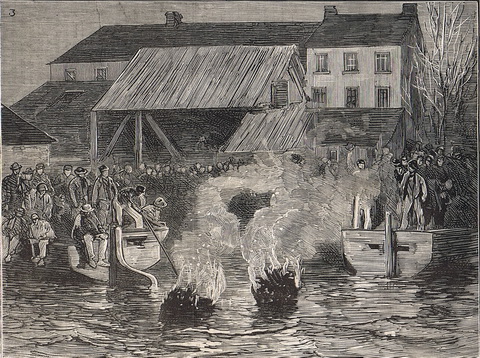
Illustrations of early Irish inland waterways vessels are relatively scarce. The drawing below shows the sterns of two of them.

Portobello Harbour 1882

This is from The Graphic of May 13, 1882, and shows the lighting of tar-barrels in Portobello Harbour, on the Grand Canal in Dublin, to celebrate the release from prison of Charles Stewart Parnell and two colleagues.

The layout of the harbour in around 1900 can be seen on the OSI Historic 25″ map. Where were the vessels tied? What are the buildings in the background? What can be said about the vessels? Presumably wooden horse-drawn barges, but they look rather narrow to me. Comments welcome.

The harbour itself is, alas, no more.


Ephemera 10: the pontoons at Ballina

Do my eyes deceive me?

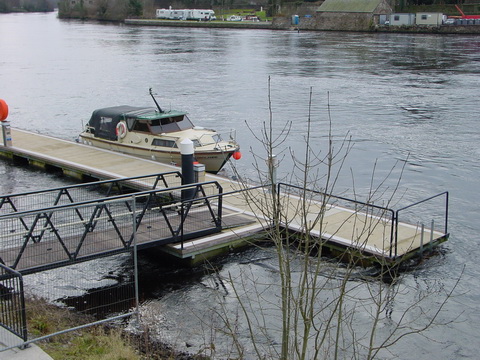
The still-unopened mooring pontoons below the bridge at Ballina (bottom of Lough Derg) seem to have sprouted an extension.

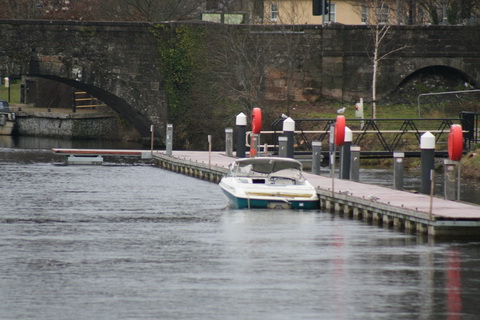
Here is what they looked like in 2009.

The upstream end of the Ballina pontoons in February 2009

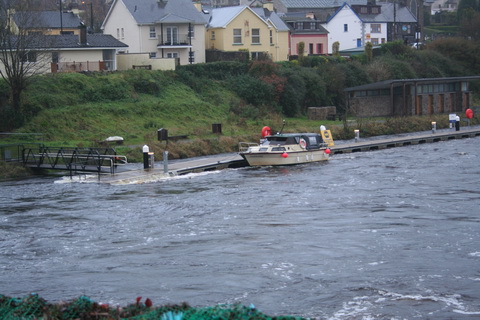
Here they are in the floods of November 2009.

The upstream end of the Ballina pontoons in the floods of November 2009

And here they are in January 2011, seen from downriver.

The upstream end of the Ballina pontoons in January 2011

Well I never.


Ephemera 9: the flash lock at Killaloe

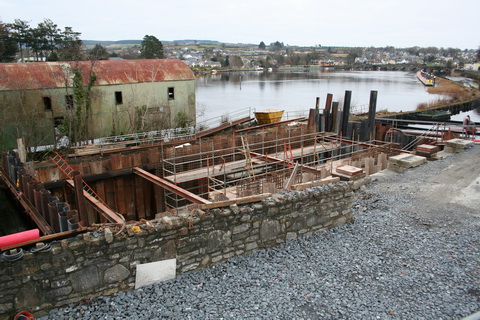
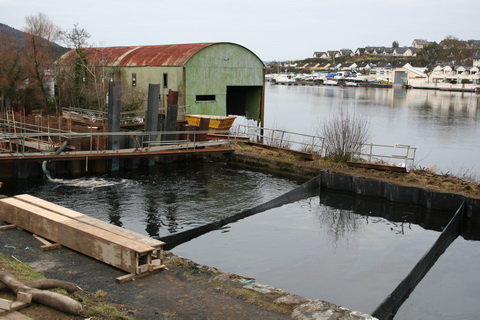
As part of its new mooring scheme at Killaloe, Waterways Ireland has commissioned contractors (L&M Keating Ltd) to carry out various works including the installation of a lock at the upper end of the canal, beside the Phoenix boathouse and just downstream from the Pierhead. The lock is to control access to the canal; presumably the stop planks in the existing lock chamber will be removed, allowing boats to pass down under the bridge.

The lock under construction

As I understand it, this lock is to have a single pair of gates. Boats wishing to pass through will tie up temporarily and use a squawk-box (or similar technological marvel) to communicate with the bridge-keeper at Portumna, who will cause the gates to be opened and then, presumably, closed after the boat has passed through. This system will prevent the use of the canal by cads and bounders using jetskis, speedboats and other excrescences.

Stanked off and pumped out

However, the water through Killaloe Bridge has a gradient or slope, especially in flood and when Ardnacrusha power station is running. The canal above the lock will be at the higher level; the canal below the lock will be fed from the bottom end, where it rejoins the river. So is there not likely to be a difference in height at the lock? Is this the equivalent of a flash lock?

I’m sure there is an engineering answer to this; I would welcome enlightenment.