Category Archives: Ashore

No news is good news … perhaps

Extracts from the Joint Communiqué issued after the 11th Plenary Meeting of the North South Ministerial Council on 21 January 2011:

3. Ministers discussed a range of common challenges and shared views on the economy, the banks and NAMA. They recognised the constraints on budgets in both jurisdictions and the ongoing discussions between the two Finance Ministers to identify potential cost savings through co-operation and sharing were welcomed. There was a desire to maximise access to EU funding and
resources.

6. Ministers noted the Progress Report on the ten NSMC meetings which have been held since the last Plenary meeting in July 2010 and welcomed the mutually beneficial co-operation taken forward including that:

[…] The restoration of the Royal Canal to reconnect it to the Shannon has  been completed and a preferred route for the Clones to Upper Lough Erne section of the Ulster Canal has been identified.

No exciting announcement there, so the bulldozers have not yet been set rolling on the Clones Canal. Phew. Maybe we’ve had to choose between the canal to Clones and the road to Londonderry/Derry and the road has won ….
Guten Abend, meine Damen und Herren

I regret that I do not know German, so I’m relying on Google Translate, but I thought I’d greet those who have been visiting this site from German-language sites in the past week, mostly to read about the (Ulster) Canal to Clones.

It is good that German visitors are interested in the canal, because I suspect that the German taxpayer will be paying for it. The Greeks may have to borrow to bridge the gap between their taxes (too low) and their public spending, including pay and pensions (too high). Ireland has that problem too, as well as a banking problem, but it is also borrowing to invest … in a canal. A canal that will never meet its running costs, never mind recouping the construction cost, and that will not generate enough external benefits to justify the spending.

Arthur Young wrote this about Irish canals in 1780:

There is such a want of public spirit, of candour and of care for the interests of posterity in such a conduct, that it cannot be branded with an expression too harsh, or a condemnation too pointed: nor less deserving of severity is it, if flowing from political and secret motives of burthening the public revenues to make private factions the more important.

Other news

My comment has still not appeared on the Clones Regeneration Partnership blog.

Cost-benefit analysis

Here is an extract from what Mr Cowen, then Minister for Finance, said in Dáil Éireann (Volume 631) on 15 February 2007 about the National Development Plan:

Value for money is also a central theme in the delivery of the planned investment. Most of the capital projects, notably in the key area of transport, are being delivered on or below budget and, in some instances, ahead of schedule. Building on this performance, all expenditure under the National Development Plan 2007-2013 will be subject, as appropriate, to a robust value for money framework.

Among the key elements of this framework are that all projects will be subject to project appraisal, all capital projects over €30 million will require a full cost benefit analysis, the introduction of new procurement arrangements which will deliver greater cost certainty and evaluations under the value for money and policy reviews will be published and submitted to the relevant select committees of the Oireachtas.

In the coming period, my Department will be elaborating on the monitoring process to be put in place to measure progress under the plan. We envisage a streamlined, focused ap proach whereby progress can be readily assessed by reference to relevant financial and physical indicators. We will avoid the bureaucratic, committee-laden reporting process under previous plans, which was a source of dissatisfaction as expressed in the consultation process. The emphasis will be on efficient delivery and transparent reporting. A key new feature is the formal submission of an annual report on plan progress to the Houses of the Oireachtas.

The Clones Canal, stated to cost €35 million, clearly falls into the category of projects for which a full cost benefit analysis is required.

So where is it?


Ephemera 15: consultation

The most recent version of Waterways Ireland’s plan for the Ulster Canal has a section (3.1 in the contents list, 3.3 in the document) on “Engaging with the Public”. It says:

The development of this Restoration Plan and accompanying SEA and AA are iterative processes that  enable both environmental authorities and the general public to get involved early on in the process in order to give submissions and comments before any final decisions are adopted.

To fully engage with the public the draft Restoration Plan and associated SEA and AA were:
– put on public display,
– sent to the prescribed regulators and environmental authorities; and
– written submissions were invited on both the Environmental Reports and draft Plan.

Waterways Ireland also took the proactive step of placing all documentation associated with every step of the Restoration Plan and SEA process on their website: http://www.waterwaysireland.org

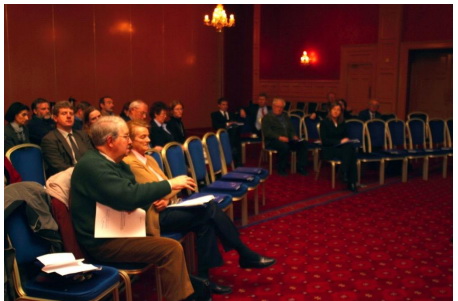
That doesn’t mention any public meetings, but there is an illustration of such a meeting, with earnest members of the public being consulted.

Folk being consulted

Hmm. Looks like Mike and Rosaleen Miller at the back on the left: no doubt visiting from France. But that red decor looks familiar ….

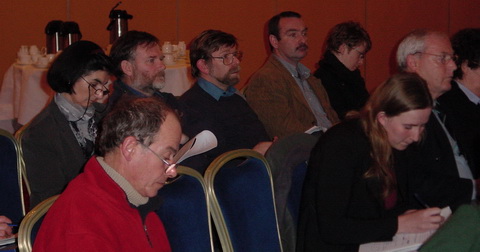
My photo of the same event

WI consultation meeting about its marketing strategy: Shannon Oaks Hotel, Portumna, 27 January 2003.


Ephemera 14: Ulster Canal: departmental bullshit

I have created a new page covering correspondence with the Department of Community Equality and Gaeltacht Affairs in January 2011. I have accordingly removed postings Ephemera 11 and Ephemera 13; the correspondence with the department is now on the new page.

I don’t know why the Irish government finds it so difficult to provide a straight answer to a straight question (well, actually, I can guess, but let’s be polite). But if funding were available, the government would be issuing press releases to beat the band, especially with an election coming up. So I deduce that there is no money, although I wouldn’t be at all surprised to find a press release or two making some vague announcement or lauding the start of some low-cost activity.

But I won’t believe in the restoration or rebuilding of the Ulster Canal until I see evidence that real money has been allocated to cover the cost.


Ephemera 12: WI staffing

The Sunday Tribune of 9 January 2011 reports that Waterways Ireland’s staff increased from 355 last year to 367 this year. It says that the Department of Community, Equality and Gaeltacht Affairs (to which Waterways Ireland reports in the southern state), or rather its minister, was “among the worst offenders when it comes to increasing staff numbers in the agencies under his remit.”


Suir railway

If George Stephenson, Father of Railways, had had his way, you would have been able to travel from Carrick-on-Suir to Waterford by river – but in a railway carriage. Read about it here.

Nineteenth-century Irish canal boats

Illustrations of early Irish inland waterways vessels are relatively scarce. The drawing below shows the sterns of two of them.

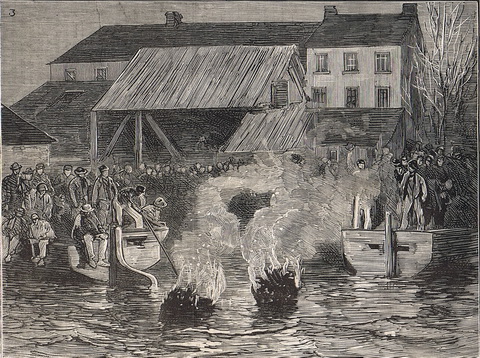
Portobello Harbour 1882

This is from The Graphic of May 13, 1882, and shows the lighting of tar-barrels in Portobello Harbour, on the Grand Canal in Dublin, to celebrate the release from prison of Charles Stewart Parnell and two colleagues.

The layout of the harbour in around 1900 can be seen on the OSI Historic 25″ map. Where were the vessels tied? What are the buildings in the background? What can be said about the vessels? Presumably wooden horse-drawn barges, but they look rather narrow to me. Comments welcome.

The harbour itself is, alas, no more.


Ephemera 10: the pontoons at Ballina

Do my eyes deceive me?

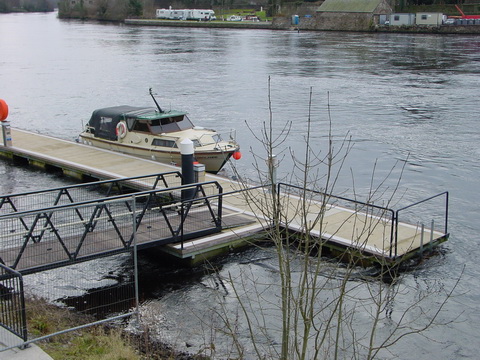
The still-unopened mooring pontoons below the bridge at Ballina (bottom of Lough Derg) seem to have sprouted an extension.

Here is what they looked like in 2009.

The upstream end of the Ballina pontoons in February 2009

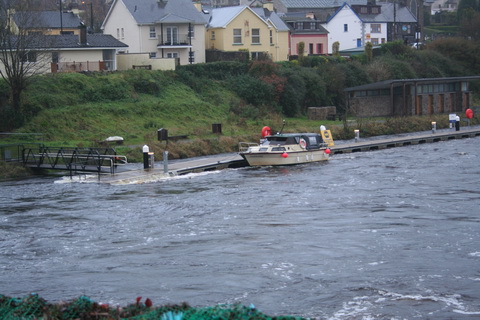
Here they are in the floods of November 2009.

The upstream end of the Ballina pontoons in the floods of November 2009

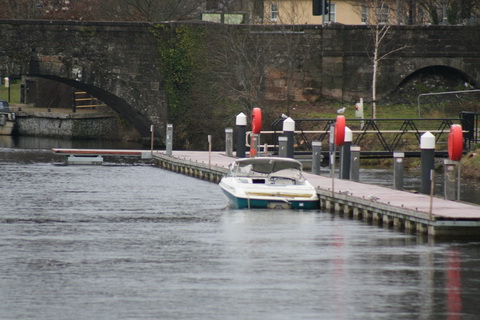
And here they are in January 2011, seen from downriver.

The upstream end of the Ballina pontoons in January 2011

Well I never.


Ephemera 9: the flash lock at Killaloe

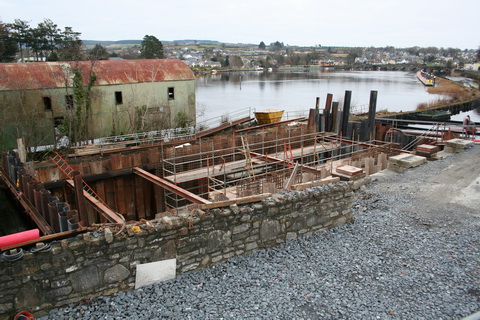
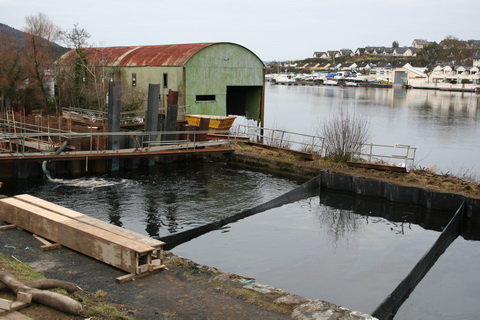
As part of its new mooring scheme at Killaloe, Waterways Ireland has commissioned contractors (L&M Keating Ltd) to carry out various works including the installation of a lock at the upper end of the canal, beside the Phoenix boathouse and just downstream from the Pierhead. The lock is to control access to the canal; presumably the stop planks in the existing lock chamber will be removed, allowing boats to pass down under the bridge.

The lock under construction

As I understand it, this lock is to have a single pair of gates. Boats wishing to pass through will tie up temporarily and use a squawk-box (or similar technological marvel) to communicate with the bridge-keeper at Portumna, who will cause the gates to be opened and then, presumably, closed after the boat has passed through. This system will prevent the use of the canal by cads and bounders using jetskis, speedboats and other excrescences.

Stanked off and pumped out

However, the water through Killaloe Bridge has a gradient or slope, especially in flood and when Ardnacrusha power station is running. The canal above the lock will be at the higher level; the canal below the lock will be fed from the bottom end, where it rejoins the river. So is there not likely to be a difference in height at the lock? Is this the equivalent of a flash lock?

I’m sure there is an engineering answer to this; I would welcome enlightenment.