Category Archives: Irish inland waterways vessels

The Broadstone pontoon

On my page about the Broadstone Line of the Royal Canal, I say this:

In 1845, the Midland Great Western Railway Company (MGWR) bought the Royal Canal. Doing so allowed it to run its lines beside the canal, which it did most of the way to Mullingar, without having to conduct lengthy negotiations about wayleaves with individual landowners. The company built a terminus at the Broadstone, with a pontoon bridge (which was moved out of the way when boats entered or left the harbour) to provide passengers with access to the station.

I have found a picture of the arrangement. Here it is.

The Broadstone, from The Tourist's Illustrated Hand-Book for Ireland 3rd ed David Bryce, London 1854

The pontoon looks rather solid, but there is a canal-boat heading for it and the canal clearly continues on the far side.

I have added the pic to the Broadstone page.

Steamer for sale (171 years ago)

The ad for the sale of the Shannon Estuary steamer Dover Castle in 1840.

RIBs on canals

According to the Sunday Business Post:

Army and Garda sub-aqua unit divers and armed personnel carrying ribs (rigid-hulled inflatable boats) will also be placed at strategic points along the Liffey and Dublin’s canals to ensure that there are no attempts to mount any attack from the water.

RIBS on canals? Well, that should be useful.

Er … they have heard of locks, have they? I mean, no matter how fast either the terrs or the Army and Garda folk zoom along the canal by Mespil Road, for instance, they’re still going to spend ten to fifteen minutes getting through the lock. And maybe the same clearing their props.

I do hope the terrs are not planning on launching attacks from the Royal: they won’t be able to see out from the bottom of the canal along most of the way.

Perhaps they could all be made honorary participants in the IWAI Dublin Rally, which will be on at the time.

Update 5 May 2011: Waterways Ireland says (Marine Notice 45/2011) that:

[…] there will be restrictions on boat movements on Level C5 of the Grand Canal Circular Line between Leeson Street Bridge and Charlemont Bridge, Dublin over the next two weeks. Dublin City Council are currently constructing a boardwalk at this location as part of its wider ‘Premium Cycle Route’ project to improve cycling facilities in the city and along the Grand Canal route. Due to unforeseen delays, and in order to facilitate completion of the boardwalk, it will be necessary to reduce the water level in Level C5 during the period of Monday 9th May 2011 to Thursday 19th May 2011. Waterways Ireland requests that any vessels wishing to pass through level C5 during this period should contact the Eastern Regional Office on 01 868 0148 well in advance to make the necessary arrangements.

I hope that WI has brought this to the attention of potential terrorists intending to zoom along the Grand Canal to attack HMtheQ and to the brave and noble police and army folk, in their RIBs, who will be trying to stop them.

Canals and labour history

The building and the use of Irish inland waterways, by navvies and boatmen respectively, will be discussed at the May Day Labour History School, to be held at Athy Community Arts Centre on Saturday 30 April 2011. The events of the day (copied from here):

12pm-4.00pm: photographic exhibition commemorating the workers who built the canals and the boatmen who transported the goods throughout the canal network.

2pm-2.15pm: Official Opening of the Festival by the Mayor of Athy

2.15pm-4.00pm: series of talks examining the socio-economic and cultural impact that the opening of the canals had on provincial life. The typical life of the early navvies and boatmen will be brought to life, and the struggle for improvement in conditions leading to early Trade Union formation will also be explored.

8.00pm: A concert of Labour and Workers’ songs, featuring two of Dublin’s well-known balladeers, Tom Crean and Jimmy Kelly. The concert will be preceded by a Wine Reception at 7.30pm.

More details of the weekend here or here (PDF). I wouldn’t bother trying the SIPTU site: I couldn’t find the info there.

2²B or not 2²B?

Approaching Dromineer

Barge sinks on Lough Derg

Killaloe Coast Guard story here.

Rowing to Dublin …

… to visit King Dan.

In prison.

From Kerry, via the Grand Canal.

Need a project?

Waterways Ireland intends to remove some sunken boats from the Grand Canal at Shannon Harbour. The wooden boats will be broken up and sent to landfill; the steel and GRP boats will be sold off. Perhaps, if anyone were interested (and rich) enough, WI would sell one of the wooden boats to be restored.

I can’t find the notice on WI’s own website; here it is on the Afloat site.

Here are pics of the wooden boats.

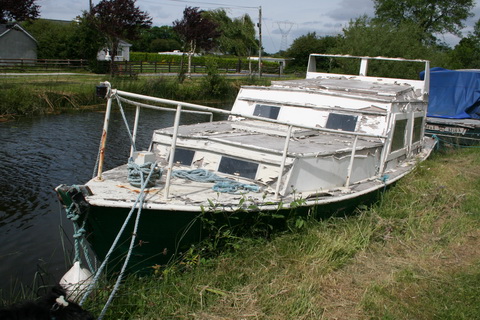
Béal na Bláth, 7m wooden cruiser

Béal na Bláth in June 2009

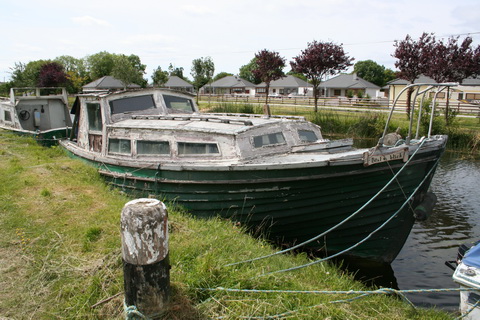
No Name

Described as “Wooden Cabin Cruiser (Green) South Bank East of Griffith Bridge 7m”. Could this be the one they mean?

Unidentified green-hulled cruiser in June 2009

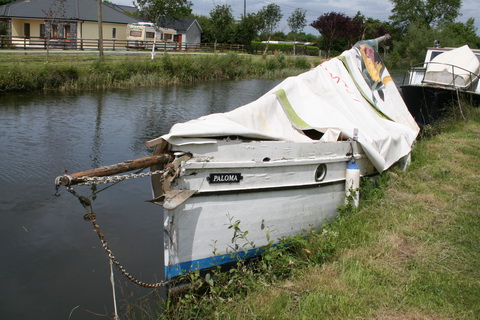
Paloma

Paloma under way in 2003

Paloma in Shannon Harbour in June 2009

More about Paloma here.

Clontarf to Clondra II

Maark Gleeson of Clontarf Yacht & Boat Club has kindly given me details of the Club’s recent trip along the Royal, with notes on the time taken and some useful advice, especially about the tides in Dublin.

Clontarf to Clondra

The Clontarf Yacht & Boat Club, recreating the Club’s 1925 trip, entered the Royal Canal sea lock from the Liffey on Saturday morning, 16 April 2011; some boats have reached Abbeyshrule this evening, and they hope to reach Clondra tomorrow evening, which will be four days from the Liffey.

That’s very fast: for Blanchardstown to/from Clondra, IWAI Dublin Branch estimated 5 days X 8 hours and I estimated 6 days X 7 hours, plus another day from the Liffey to Blanchardstown (12th Lock). I understand that CYBC has been doing very long days; I’ll get details later. In the meantime, well done CYBC.