Category Archives: Politics

DCAL disclosures

You will be pleased to learn that, on 28 May 2010, Arthur Scott (Director of the Culture Division) and Rosalie Flanagan (Permanent Secretary) of the Department of Culture, Arts and Leisure each received from Waterways Ireland a waterways mug and a book on the Royal Canal, total value £20 each. Later in the year, however, Rosalie Flanagan declined an invitation, estimated to be worth £8, to the opening of the Royal Canal on 1 October 2010.

Mrs Flanagan and husband are members of the Belfast Boat Club but do not hold any position on the Club’s Committees or Council. Orla Bateson, Head of DCAL’s Research & Statistics Branch, is a committee member of Intercity Paddlers, a Belfast canoe club.


Monitoring Waterways Ireland

The Department of Culture, Arts and Leisure is the Northern Ireland department that shares with the Department of Arts, Heritage and the Gaeltacht the responsibility for two north–south bodies, one of which is Waterways Ireland. DCAL’s organisation is described here. And on this page, you can find the minutes of departmental board meetings.

In the minutes of the meeting held on 14 December 2011, we read:

6.0       N/S Bodies Governance (Arthur Scott) (DB 90-11)

6.1       Arthur Scott spoke to paper DB 90-11 which highlights the key differences between the DCAL Sponsorship Manual and the Financial Memorandum for N/S [North/South] Bodies and the challenges this presents for DCAL officials in seeking to draw appropriate levels of assurance for the DCAL Accounting Officer (AO).  The Board were asked to note the key actions being taken to address these challenges.  These included:

6.1.1   Ongoing work with Department of Arts, Heritage and the Gaeltacht (DAHG) to change the focus / nature of Waterways Ireland (WI) monitoring meetings.

6.1.2   Introduction of additional meetings between sponsor departments and the N/S Bodies to gain a better understanding of key issues and to be able to probe officials from the bodies about these.

6.1.3   A commitment by both AO’s to attend meetings about priority issues.

6.1.4   Briefing Ministers about key issues ahead of N/S Ministerial Council meetings.

6.2       The Board discussed governance and accountability arrangements and whether the Sponsorship Manual should apply the same way to N/S Bodies as it does with DCAL’s ALBs [arms-length bodies, I presume].  The Board agreed that the ALB Sponsorship Manual for DCAL, as it stands, should not apply to N/S Bodies.  Instead, a separate document is required with a starting point being the Financial Memorandum.

Action: Sinead McCartan to remove references to N/S Bodies from Sponsorship Manual.

6.3       Rosalie Flanagan said she would meet with her counterpart in DAHG, Joe Hamill, to discuss the Financial Memorandum and how DAHG draw their required assurances from it.

And in those for the following meeting, held on 21 January 2012, we read:

11.0    Quarterly Assurance Statements (Sinead McCartan – DB 7-12) […]

11.3    In relation to the delayed progress on the risk assessment exercise for N/S Bodies as highlighted on the Corporate Services Division QAS, Rosalie Flanagan confirmed that she has met with counterparts in the South and it is proposed that a new governance framework will be prepared for Ministers’ consideration.

Action:  Arthur Scott to incorporate the findings of the N/S risk assessment into the development of a new governance framework.

It seems that DCAL is pushing for tighter control over Waterways Ireland. If DAHG published its minutes [if it does, I can’t find them], we might be able to see what it feels about the matter.



A waterway for everyone in the audience

My attention has been drawn to this Dáil written question by Joan Burton TD (Dublin West, Labour) and the answer by Éamon Ó Cuív TD (Minister, Department of Community, Rural and Gaeltacht Affairs; Galway West, Fianna Fail).

The layout on the kildarestreet site is not perfect, so I reproduce some of the list here:

The following are the details requested by the Deputy in respect of non-navigable stretches of canals that are within the control of Waterways Ireland and are being or could be restored:

Grand Canal

  • Kilbeggan Branch (8.2 miles long) in Co. Offaly and Co. Westmeath
  • Part of Naas & Corbally Branch (Corbally Extension) (4.4 miles long) in Co. Kildare
  • Barrow Line Part of Mountmellick Branch (0.25 miles long) in Co. Kildare (remaining 11 miles filled in).

Royal Canal

  • Part of Royal Canal (11 miles long) in Co. Longford, currently under restoration
  • Longford Branch (3 miles long) in Co. Longford.

The Royal Canal main line is currently under restoration and the remaining work necessary to return it to full navigation between Dublin and the Shannon is due for completion in 2010.

Ulster Canal

  • 46 miles long in Co. Cavan, Co. Monaghan, Co. Fermanagh and Co. Armagh.

Approval has been given to Waterways Ireland to restore the stretch between Lough Erne and Clones. Present indications are that this stretch could be re-opened by 2013.

And (perhaps because the economy was so successful) we could have waterways everywhere:

It is intended, subject to availability of resources, to carry out feasibility studies and preliminary designs in relation to the Longford Branch, the Kilbeggan Branch and the Corbally Extension, along with extensions to Annagh Upper near Dowra on the Shannon Navigation and to Lough Oughter on the Erne System with a view to possible re-opening. Consideration will also be given to the carrying out of preliminary analysis and assessment of the Mountmellick Branch, as well as the Boyne Navigation (which is primarily a river navigation) and the extension towards Mohill on the Rinn River, as future possibilities for restoration.

“The Irish economy entered severe recession in 2008,” according to Wikipedia’s useful summary of the financial crisis, but Craggy Island (nach maireann, comme on dit) still hoped to drag Ireland into the Canal Age.


Lough Derg water

The lake level seems to be down about a foot. Two rumours purport to account for this: either (a) the powers-that-be want us to get used to a new, lower level, so that we won’t notice when Dublin starts extracting water, or (b) the ESB is generating as much electricity as it can before it starts getting charged for water. Such charges would be covered by the same European Commission reasoned opinion as that mentioned here that might see Waterways Ireland being charged to fill the Grand, Royal and SEW.

Or, of course, it could just be that there hasn’t been much rain. According to Met Éireann’s seasonal summary for winter 2012 [two-page PDF]:

Majority of rainfall totals were below normal for winter across the southern half of the country and in some parts of the east. Rainfall totals were below average in the majority of these parts during December and January, while all stations reported dry conditions in February. Most stations the east and south reported a below average number of wetdays (days with 1 mm or more) and the driest winter since 2006 (6 years).

Ardnacrusha usually runs fewer turbines in summer.

How much Dáil time …

… is wasted in asking and answering questions over and over again? I’d have thought that Caoimhghín Ó Caoláin TD (Cavan-Monaghan, Sinn Fein) would have realised that the government has discovered neither oil nor a crock of gold and that there is no money for a canal to Clones. The task of finding some is to be delegated to an “inter-agency group”, poor dears. I’d have thought it might be better to give the job to people with experience of unconventional fund-raising; there must be some such people around.

Hey, Brendan …

… once you’ve recruited the staff for your new government economic and evaluation service, could you send a few of them round to the DAHG to examine the Clones Canal proposal?

How unlike the home life …

… of our own Dear Queen:

As I say, this is how Spain works, you have to ask the right person the exactly right question, and make sure you don’t get sidetracked. Otherwise you will learn nothing apart from a lot of useless and most likely thoroughly misleading information.

From Edward Hugh’s article on Spanish debt on A Fistful of Euros. How gratifying that the Irish system is so much more open, transparent and accountable.


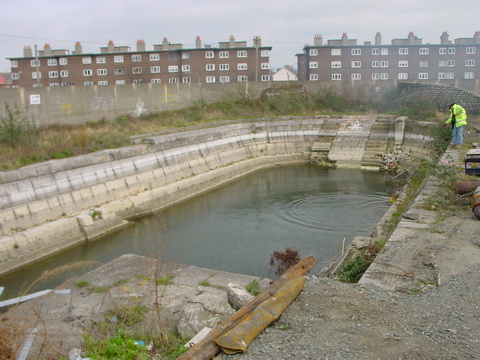
NAMA, DDDA and the Grand Canal Basin graving dock

One of the graving docks


Interesting contextual material from Nama Wine Lake here. IWAI Dublin Branch page on the graving docks here.

This week’s big shout out …

… [I do hope I’m using the idiom correctly: I gather it’s the latest phrase the young folk use to applaud some worthy person or initiative] for Ian Jack in the Grauniad, for his piece on Huddersfield, where one pushes one’s boat through canals broad and narrow. whereof there is much to be learned (and fine things to be seen) on the Pennine Waterways website.

Stalybridge, mentioned in the article, is where “It’s a long way to Tipperary” was composed and first sung.

Public sector cutbacks

The Department of Arts, Heritage and the Gaeltacht, which is ultimately in charge of waterways, has published an organisation chart [one-page PDF]. It shows that the department has a minister and a minister of state and a secretary general.

At the next level down there are five main divisions:

  • Corporate Affairs
  • Arts, Film, Music, Cultural Institutions
  • Heritage
  • Gaeilge, Gaeltacht & Islands
  • Central Translation Unit & Placenames.

Each of the first three is headed by an assistant secretary; the fourth has a Director of Irish and the fifth a plain director. The department is spread between offices in Galway, Killarney, Wexford and four locations in Dublin.

So where, I hear you ask, are waterways looked after? We have to come down to the next level, the principal officers, to find out. And there, we find that Corporate Affairs has three POs, one of whom is responsible for

HR, Strategic Planning, Corporate Governance, N/S Co-ordination & Waterways Irl.

That’s quite a lot of things for one person to be responsible for.