
Category Archives: Sources

The DAHG view of waterways

The Department of Public Expenditure and Reform (whom god preserve) has published the capital expenditure submissions made to it recently by other government departments, all of them pleading to be spared the axe. That made by the Department of Arts, Heritage and the Gaeltacht can be downloaded here (PDF). Note the various blacked-out sections ….

The department did not want any cut in the capital allocation to Waterways Ireland:

Expenditure reduced by 45% in recent years and no scope for further reductions, given existing commitments and ongoing capital maintenance requirements.

However, departments were required to show how they would cope with a 30% cut. DAHG said that one of its priorities was

… the contribution that programmes make to North-South Co-operation

which would mean

Maintaining sufficient support for Waterways Ireland, the largest of the North/South Implementation Bodies, to deliver on the shared objective of improving the attractiveness of the waterways for recreational tourism, North and South.

If it had to cut by 30%, DAHG would cut WI’s capital allocation to €5 million; in the event it was cut to €4.5 million.

There is a very interesting descriptive section later in the document. It shows, first, that WI’s capital allocation was €11.25 million in 2008, €8.675 million in 2009, €7.8 million in 2010 and €6 million in 2011. At €4.5 million for 2012, it is 60% down on 2008. Waterways are not flavour of the month any more.

Objective conflict

The document then gives a “High Level Objective” …

To maintain, develop and foster North/South co-operation and to support Waterways Ireland, the North/South Waterways Body.

… followed by a section headed “Consistency with Programme for Government”:

Apart from its unique contribution to North/South Co-operation, Waterways Ireland contributes significantly to tourism development across the island and its operations are very much in line with commitments in the Programme for Government:

“We will target available resources at developing and co-coordinating niche tourism products and activity packages that are attractive to international visitors focusing on food, sports, culture, ecotourism, activity breaks, water-based recreation and festivals. Event tourism will be prioritised to continue to bring major fairs and events to Ireland.”

The next heading after that (I presume these headings are standard for all departments) is “Contribution to Economic Recovery” (of which more below).

The interesting thing here is that there is no connection whatsoever between the high-level objective and either the programme for government or the contribution to economic recovery. The two sets of points exist in completely different universes; even DAHG itself makes no attempt to show that northsouthery can help the economy or vice versa.

So why is DAHG sticking to a high-level objective that is completely irrelevant to the policies and concerns of the current government? Will waterways northsouthery join the Restoration of One of the National Languages and the Draining of the Shannon, not to mention the Takeover of the Fourth Green Field, as one of those nationalist objectives held dear by small numbers of devotees but ignored by all rightminded citizens?

Uneconomic activities

The disconnect between the high-level objective and the other desiderata is in itself a weakness, but it also suggests that DAHG is not keeping up with the programme. Northsouthery may have been good for waterways in the recent past, but nowadays your Unique Selling Proposition has to be economic. Stimulating growth, jobs or tourism good; pretty well anything else is irrelevant.

DAHG might have realised that if it had considered the rest of the headings; adopting a non-economic high-level objective, and failing to link that objective to economic matters, gives a bad impression (to DPER) from the start.

DAHG might have recovered some ground if it had shown how the waterways benefit the economy, but it made a very weak case under the heading “Contribution to Economic Recovery”:

The development and restoration of inland waterways is an important catalyst for the development of tourism and leisure opportunities, rural development and the protection of our heritage infrastructure. The Tourism and Recreation Sectors are one of the largest and important indigenous industries in Ireland and Northern Ireland. These sectors provide and generate significant levels of employment and earnings and have brought economic activity to areas on the island where little or no other economic activity exists. The tourism and recreational development and investment along the waterways bring activity to the very heart of the island and the communities along the waterway corridors.

From 2000-2010 there have been 10,115 metres of new moorings built, 8,020 metres in the South and 2,095 metres in the North. There are approximately 13,000 boats on the Waterways – 8,000 in the South and 5,000 in the North. There is approximately €20m from hire boats and €60m – €80m from private boats generated each year. In 2010 over €9 million in tourism revenue was generated.

Oh dear. The first para is waffle. The second has four sentences, the first of which inserts a statistic that seems to have been chosen at random and that is, at best, an input measure. The second sentence gives numbers whose significance is not shown. The third and fourth give output measures (without sources) but don’t relate them to the inputs.

What is really needed is something to show whether spending on waterways is good value: something comparing inputs and outputs or, if you prefer, costs and benefits. The only comparison the reader can make here is that, in 2010, €7.8 million of capital spending produced €9 million in “tourism revenue”, whatever that is; the gimlet-eyed scrutineers of DPER will no doubt have added WI’s current spending allocation to the capital and decided that waterways were not the most productive use of scarce capital resources.

They haven’t gone away, you know

The next section, “Savings Options”, is even more depressing. The first three paras are background information that belongs elsewhere, but they seem to be intended to provide a lead-in for the fourth:

In 2007, the North South Ministerial Council (NSMC) gave Waterways Ireland an additional responsibility for the reconstruction of the Ulster Canal from Upper Lough Erne to Clones and, following restoration, for its management, maintenance and development principally for recreational purposes. The then Government committed to funding the project in full, at an estimated cost of €35m. This position remains unchanged and was noted in papers presented at the recent NSMC Plenary meeting in Dublin.

That para seems to be intended to warn us that, as soon as the garlic of economic pressure is removed, the undead canal will arise from its grave and seize state funding. Note, by the way, that the “estimated cost” figure given is far too low; why is DAHG using a figure that is €10 million lower than Waterways Ireland gives?

Come to Ireland for a pump-out

The final paragraph of the section suggests that DAHG has lost touch with reality:

The Waterways Ireland Capital Programme 2012-2016 focuses on improving the attractiveness of the waterways for tourism. The primary actions relate to the provision of visitor services, such as pump-outs, service blocks and other facilities designed to provide an attraction for tourists, including car parking and play areas.

Much as I admire WI’s pump-outs and shower blocks, I can’t believe that they will be sufficient in themselves to attract many high-spending tourists from abroad. After all, several other countries have such facilities. I have been critical of some aspects of WI’s marketing strategy, but it’s considerably more sophisticated than relying on pump-outs and car parks to attract well-to-do tourists. Haven’t the DAHG bods read the strategy?

The return of the son of the ghost of the Clones canal

There is a final section: three paragraphs about the Ulster Canal.

The Ulster canal project initial phase is a major cross border initiative for the state. The Ulster Canal in total is 93 km long and extends from Lough Neagh to Upper Lough Erne. It runs through counties Armagh, Monaghan and Fermanagh. It was originally opened in 1841 to link the northern navigation systems to the western and southern systems via Lough Erne and the Ballinamore and Ballyconnell Canal. [No it wasn’t. bjg] Due to operational and financial difficulties the canal struggled to be viable and was finally abandoned in 1931.

As canal reopening progressed in the 1980s and 90’s, and following the success of the reopening of the Shannon Erne Canal, a number of studies were carried out into the reopening of the Ulster Canal. The outcome of these studies was that at the North/South Ministerial Council (NSMC) Plenary meeting in July 2007, the Council agreed, in the light of the Irish Government’s offer to cover the full capital costs of the project, to proceed with the restoration of the section of the Ulster Canal between Clones and Upper Lough Erne a distance of some 13km.

This flagship north south co-operation project will focus on attracting boating traffic from the Erne system in Northern Ireland and the Shannon System, via the Shannon – Erne, to a new destination at Clones. It is anticipated that this will lead to regeneration of the economy of Clones and its hinterland. This project will provide employment during its construction and will lead to fuller employment in the Clones area once completed. The full capital cost is estimated to be €35m. Waterways Ireland is currently taking the project through the preliminary design and planning stages and then letting the contract as a design and build project. It is expected that the project will take 6 years.

[New readers can find the antidote to this rubbish here.]

Happily, DPER didn’t fall for this, and even if the Clones Canal got all of WI’s capital allocation for six years it wouldn’t cover the cost. But it seems to me that at this stage DAHG, with its obsession with northsouthery and in particular with the Clones Canal, is a threat to the future of the waterways. At a time when the waterways need a strong economic justification (assuming one exists) for capital and current spending, DAHG’s submission suggests that it is away with the fairies: completely out of touch with both the economic realities and the government’s priorities. Its submission to DPER can only have damaged its credibility, and the outcome was an even greater cut in the capital allocation to Waterways Ireland.
 

What is missing?

Jimmy Deenihan TD, Minister for Arts, Heritage and the Gaeltacht, in the Dáil debate on Financial Resolution No. 13: General on 7 December 2011:

Turning to North-South co-operation, I am committed to developing such co-operation within the broader arts, heritage and commemorative activities of my Department, as well as through the funding of the North-South bodies that come under the aegis of my Department. Provision of €42.718 million has been made in 2012 to support the two North-South implementation bodies, An Foras Teanga, comprising Foras na Gaeilge and the Ulster Scots Agency, and Waterways Ireland. These budgets will be subject to the approval of the North-South Ministerial Council in due course. It is envisaged savings will be achieved through efficiencies and increased focus on front-line services. The Minister of State will speak about An Foras Teanga but for Waterways Ireland the proposed breakdown for the 2012 allocation for this area is a provision of €22.59 million in current funding and capital funding of €4.5 million. This allocation will facilitate the ongoing maintenance and restoration of Ireland’s inland waterways, thereby increasing recreational access along routes and waterways. This expenditure will also assist in attracting increased numbers of overseas visitors and in stimulating business and regeneration in these areas.

I wonder what “commemorative” means in this context.

Royal Canal steamers

According to Lewis’s Topographical Dictionary (1837),

The principal trade is in wool, for which this is the greatest mart in the county, its central situation and facility of communication with the Shannon and with Dublin having rendered it the commercial centre of a wide extent of country. The City of Dublin Steam Company commenced operations here in 1830: a steamer plies twice a week between this town and Shannon Harbour, where it meets the Limerick steamer and Grand Canal boat for Dublin.

It is interesting that the steamer went west and south (37 miles, 21 locks to the Shannon, then river, lake and river to Shannon Harbour), rather than directly eastward (52 miles, 25 locks) to Dublin, but its route would have enabled it to serve Longford, Tarmonbarry, Lanesborough and Athlone. Lewis, however, does not mention steamer services at any of those places other than Athlone.

More research required ….

SS John Randolph

The SS John Randolph, described as “America’s first successful iron ship in commerce”, is commemorated by a historical marker in Savannah, Georgia, USA.

The John Randolph was one of the first six iron vessels built by Lairds of Birkenhead (later merged into Cammell Laird). The other five were built for use on the River Shannon.

RoI budget part 1: expenditure on waterways

When Waterways Ireland spends on capital investment in either RoI or NI, the total cost is paid by the jurisdiction in which the expenditure occurs (apart from the decision by the RoI government to pay the total cost of a canal from Lough Erne to Clones, where about half of the route lies in NI).

For current spending, Waterways Ireland gets 85% of its grant income (which is itself accounts for the vast bulk of its total income) from the RoI Department of Arts, Heritage and the Gaeltacht and the balance from the NI Department of Culture, Arts and Leisure.

The RoI government expenditure plans were announced on Monday 5 December 2011. The Comprehensive Expenditure Report 2012–2014 section on the Department of Arts, Heritage and the Gaeltacht mentions waterways, or matters affecting them, in several places.

Key Outcomes of the Comprehensive Review of Expenditure

As I noted here, waterways are the lowesst priority within the department. It intends to focus on eight activities, and Waterways Ireland and An Foras Teanga are covered in the final point:

  • supporting Waterways Ireland and An Foras Teanga within the context of the implementation of the Good Friday/ St Andrew’s Agreements.

An Foras Teanga covers Foras na Gaeilge and Tha Boord o Ulster-Scotch/The Ulster Scots Agency.

Expenditure and Numbers Ceilings

No mention of waterways, but the department says that steps to be taken in 2012 will save €6 million in each year of 2012, 2013 and 2014, with further savings of €10 million to be made in 2013 and €22 million in 2014. The department’s “total allocations for gross current expenditure” are to be reduced from €232 million in 2012 to €218 million in 2013 and €205 million in 2014. I can’t quite make the numbers match, but never mind.

Estimates 2012: summary of measures

The measures are summarised under five headings, one of which — North-South Co-operation — covers Waterways Ireland and An Foras Teanga. The department expects to save €2.2 million here, but says:

Any savings, in excess of the agreed 3% per annum efficiency savings, for the North/South Implementation Bodies will require the approval of the North/South Ministerial Council. It is envisaged that savings will be achieved through efficiencies and a focus on front-line services.

The 2011 estimate for current expenditure for WI and AFT was €40 982 000; a cut of €2.2 million is about 5.4% of that amount.

Indicative savings areas 2013–2014 to remain within Expenditure Ceilings

This section shows €1 million more saved in each of 2013 and 2014 but says:

Savings, in excess of the agreed 3% per annum efficiency savings,  for the North/South Implementation Bodies will require the approval of the North/South Ministerial Council.

It is not clear whether, in the figures for 2012 and in those for 2013 and 2014, the amounts of €2.2 million, €1 million and €1 million are to be in addition to the “3% per annum efficiency savings” or whether the amounts shown include the 3%.

The introduction to the section on Indicative Savings Areas says:

Reducing overall expenditure in 2013-2014, as required by the expenditure ceilings, will be a significant challenge and require ongoing critical analysis by the Department. The Department’s funding is largely focused on supports to sustain the arts and our cultural institutions, to protect our natural and built heritage and to promote our native language. However, much of this current expenditure is also of strategic importance in sustaining and growing cultural tourism and is making a significant contribution to economic recovery and enhancing our national reputation. All areas of spending will be subject to continued evaluation to ensure that scarce resources are directed towards areas of greatest impact and value-for-money.

This is standard civil service please-spare-our-budget stuff.

2012 Estimates for Supply Services

This section no longer provides a breakdown between An Foras Teanga and Waterways Ireland. In the 2011 Estimates, AFT got roughly 40% and WI roughly 60% of the money for current expenditure; AFT required no capital funding so WI got the whole lot under that heading. I will assume that the same ratios apply for 2012 but, if anyone knows better, I will be happy to amend this.

Current spending (WI)

2010 Estimates: €25 585 000

2011 Estimates: € 24 335 000

2012 Estimates: €22 929 600 (60% of €38 216 000)

Capital spending (WI)

2008 Estimates: €11 000 000

2009 Estimates: €10 300 000

2010 Estimates: €8 000 000

2011 Estimates: €6 000 000 (or €6 002 000)

2012 Estimates: €4 500 000 (or €4 502 000) (100%)

A footnote says that the allocations to northsouthery are subject to the approval of the North–South Ministerial Council.


Waterways Ireland disposals of property

When I heard that the North–South Ministerial Council had, at its fourteenth Waterways meeting on 12 October 2011, approved certain disposals of property by Waterways Ireland, I assumed that WI was probably flogging off property to fund capital projects. The reality is rather less exciting, and I am grateful to the Department of Arts, Heritage and the Gaeltacht for enlightening me by supplying this list of those properties:

(i) granting of an easement to Kildare County Council for services across the Grand Canal at Clonaghlis, Ardclough, Co. Kildare, as part of the Ardclough Flood Alleviation Scheme

(ii) granting of a 5 year lease to Thomas C Whelan and Brendan Whelan for an area of Shannon waterway measuring approximately 240.70 sq m and jetty (2 berths) at Gings Pub, Cortober, Carrick on Shannon

(iii) granting of an easement for services to Kildare County Council to facilitate a Grand Canal crossing at Boston, Co. Kildare as part of the Castlewarden to Ballygoran Pipeline & Reservoir Scheme

(iv) granting of an easement for services to Kildare County Council, to facilitate a Royal Canal crossing at Confey, Leixlip as part of the North Leixlip Sewerage Scheme

(v) granting of an easement for services to Kildare County Council to facilitate a Royal Canal crossing east of Pike Bridge, Donaghmore, Maynooth, Co. Kildare as part of the Ballygoran to Collinstown Watermain Scheme

(vi) granting of easements to Westmeath County Council to provide two sewerage pipes and two storm overflow discharges across the Shannon at Athlone as part of the Athlone Sewerage Scheme

(vii) granting of a 99 year lease to Córas Iompair Éireann for the proposed construction of a road bridge, crossing the Royal Canal at Ratoath Road, Dublin

(viii) granting of an easement to Dublin City Council for utility ducts installed in the towpath of the Grand Canal at Harcourt Terrace and Leeson Street, Dublin

(ix) granting of a licence to Dublin City Council to upgrade the towpath at Charlemont Place for use as a cycle trackway.

As I noted in my posting about waste collection, WI staff have to deal with a whole lot of issues that are not directly relevant to boating, with the result that whole areas of their work are not apparent to, and thus not appreciated by, outside observers. I am glad to be able to cast light on this small corner of WI activities.


Lough Derg 1839

Drawings now uploaded. Much more activity in these than in the Lough Ree equivalents, with steamers towing barges, turf boats, the surveyors’ cutter and other excitements.


Round towers on islands …

their true origins revealed (up to a point, Lord Copper).

What’s my number?

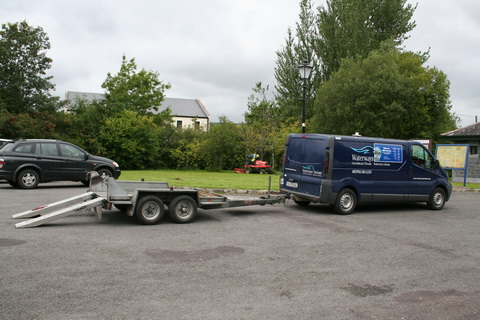
Grass-cutting team's van at Ballyconnell ...

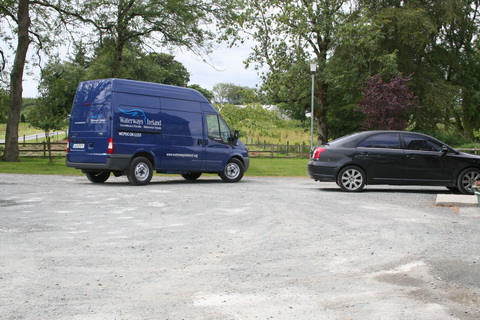
... and van at Riversdale

Notice that both vehicles have the same number on their sides:

WCPDC-08-1153

What is it?

It’s Waterways Ireland’s Waste Collection Permit number, issued by Dublin City Council to Waterways Ireland at its Enniskillen address, but handled by the Environment Officer in WI’s Scarriff office. The permit allows WI staff to pick up rubbish along their waterways in counties Carlow, Cavan, Clare, Fingal, Galway, Kildare, Kilkenny, Laois, Leitrim, Limerick, Longford, Meath, Monaghan, North Tipperary, Offaly, Roscommon, South Dublin and Westmeath and in Dublin and Limerick cities. It will expire on 17 June 2014, so the link above may stop working after that.

Note that WI is not permitted to pick up dogshit (if that’s what “animal by-products” are) or batteries.

WI has 92 vehicles authorised to pick up waste.

Isn’t that interesting? What a lot of stuff WI staff have to know about and what a lot of regulations they have to comply with.


Triangular quaternions

The indefatigable Mary Mulvihill has produced a podcast guide to a Royal Canal walk, from Dunsink to Broombridge. The podcast is free to download as an MP3 file.

Its production was supported by Maths Week Ireland and the Irish Research Council for Science, Engineering & Technology (IRCSET); it follows the annual walk to commemorate the achievement of Sir William Rowan Hamilton, who in 1843 invented a new type of algebra, quaternions, and wrote the equation on the bridge.

bjg