Tag Archives: Clare

User surveys

Last Saturday, I had just checked that the nineteen members of the Inland Waterways Protection Society, and accompanying walkers from O’Briensbridge Community Group, IWAI Lough Derg Branch and elsewhere, had successfully crossed the Shannon at Plassey, using the University of Limerick’s road-bridge instead of the Black Bridge, which is still closed after last year’s floods.

I was walking back to my car, so that I could drive to meet the group at Gillogue and ensure that they were getting their sandwiches at the Lame Duck, when I was accosted by a woman in a car. It was pouring rain and my dogs were getting impatient, but I listened politely while she asked if I would participate in a survey. “For whom?” I asked. “For Waterways Ireland,” she said. So I thought I’d better play along.

The survey was conducted as she sat in her car, dry, but obstructing the traffic, while I stood outside in the rain, keeping an anxious eye on the dogs. I was not inclined to prolong the time spent answering questions.

Now, I was told recently (after submitting an FOI request) that the towing-path and bridge at Plassey were leased by the Department of Finance to Limerick County Council, so it’s not entirely clear what Waterways Ireland has to do with the current management of that stretch or why it wanted user views. Did the interviewer choose that stretch as a bit of Limerick in which she could see water while staying in her car?

I was asked what I thought of the facilities “toilets and so forth”, and pointed out that there weren’t any. I struggled to convey the fact that, although I was walking before I was accosted, I disliked the activity intensely (especially in the rain) and that, although I visit Plassey several times a year, it is because I am interested in industrial archaeology, not because I want exercise. And there didn’t seem to be a way of conveying that I had organised for about twenty-five other people to walk the towing-path, but that I wasn’t myself participating.

Then I was asked if I had heard of Waterways Ireland and if I knew what they did ….

The 2004 survey is available from WI’s website here. But I wonder whether WI commissioned any surveys between 2004 and 2010 and, if so, where they are to be found.
From the hearts of cranes

Several ports on the Shannon Navigation have old cranes (or parts thereof), most of them nicely painted. Their age may not be apparent, but it is possible that they date back to the days of the Shannon Commissioners in the 1840s; at least one of them may be even older than that.

This page shows photographs of those cranes I know of, and discusses their possible ages. But there is much that remains unknown, and readers may be able to cast light on some of the mysteries.

The Lartigue: the Listowel & Ballybunion Railway

The Listowel & Ballybunion Railway operated between 1888 and 1924, using perhaps the most eccentric railway technology ever invented: the monorail developed by Charles Lartigue.

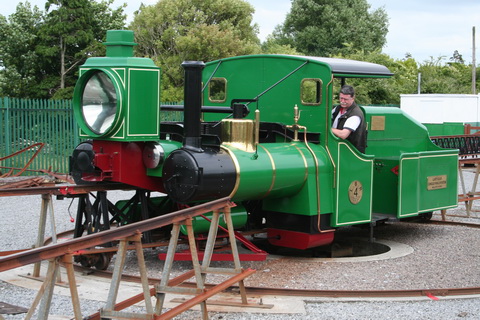
Very little original material was left after the railway closed, but a short section of railway has been recreated in the town of Listowel, Co Kerry, with a single locomotive (now diesel rather than steam) and two carriages. However, it shows the more exciting features of the original: the ingenious turntables and switches. There is also a small display of models, photographs and artefacts, and a showing of three short films, with some original newsreel footage of the railway in operation. The volunteer staff are knowledgeable and happy to chat and, all in all, it makes for a very entertaining few hours for anyone interested in transport or engineering.

Listowel is close to Ballybunion on the south side of the Shannon Estuary; anyone visiting the industrial heritage artefacts of the Lower Shannon Industrial Heritage Park could easily build in a visit to the Lartigue – and then take the ferry from Tarbert to Killimer and visit the West Clare Railway.

Read about the Lartigue here.

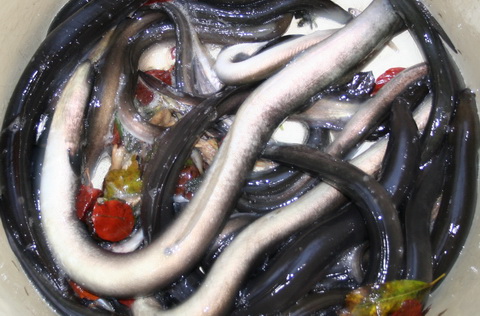
Anguilla anguilla: the ESB eel fishery

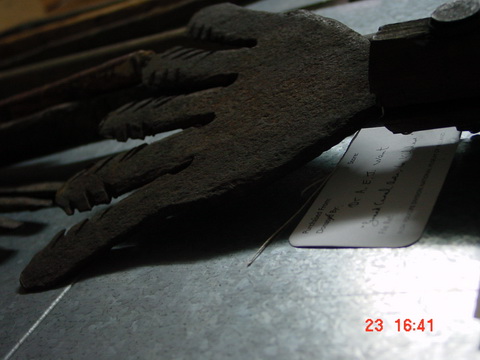
This photo shows an eel spear from the National Folklife Collection‘s overflow material, stored in the former “reformatory” at Daingean, on the Grand Canal in Co Offaly. There were many spears there, with different designs from different rivers. This one, to judge from the label underneath it, came from the extraordinarily prolific and observant Dr A E J Went.

If you look at pretty well any Irish river on the 1840s Ordnance Survey map (here’s the Shannon at Killaloe; switch to Historic 6″ if necessary), or indeed on the 1900s map (same URL but switch to Historic 25″), you’ll find evidence of eel weirs. Ireland’s shortest canal was built to allow the eel-boats of Anthony Mackey’s fleet to reach the trains at Banagher.

But the European eel is a “critically endangered species” and all eel fishing has been banned in Ireland. As far as I know, though, the Lough Neagh fishery, in Northern Ireland, continues.

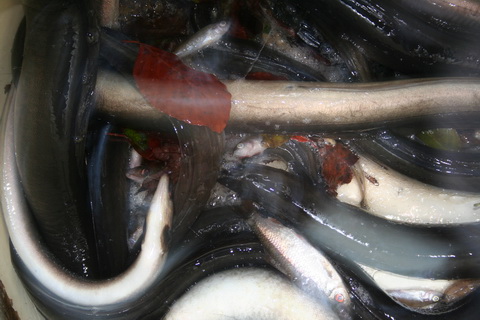
The Electricity Supply Board (ESB) is in charge of the eel fishery on the River Shannon. It has nets and a storage unit (packing station) at Killaloe and, until recently, it also had nets at Clonlara on the headrace supplying the power station at Ardnacrusha; the Clonlara nets have just been removed. This page is about the Clonlara and Killaloe operations, but includes a look at an eel survey conducted for the ESB in 2008, before eel fishing was banned in Ireland. The aim now is to make it easy for eels to reach the sea to reproduce, and that sometimes involves “trap and transport”: catching the eels and moving them past obstacles, whether on their way to the sea or, for the young glass eels, on their way upriver.

The photos on this page are a tribute to what was an important activity on the Shannon. I hope that the European eel stocks can recover.

Knock knock …

Knock in Co Mayo is well known, having its own airport; Knock in Co Clare is less well known, though it has its own port. Here is a short account of its history, with some photographs, but more information would be welcome.

From the Pierhead

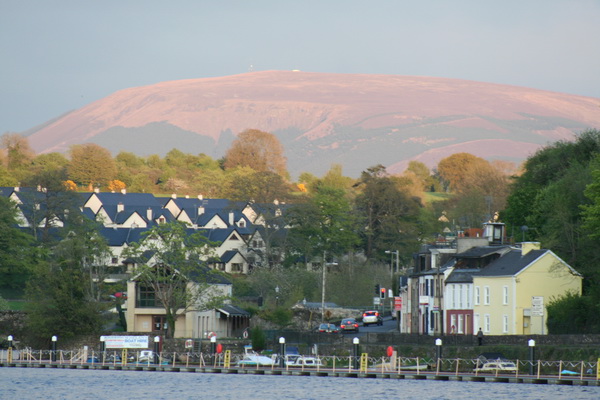
Ballina and Killaloe May 2010

Three German officers …

… didn’t cross the Rine, which is a river in County Clare, flowing into the estuary of the River Fergus which, in turn, joins the estuary of the River Shannon. The Rine is also known as the Quin and the Ardsollus and its downstream end is called Latoon Creek, no doubt because it flows by the townlands of Latoon North (which is to the east) and Latoon South (to the west). There is a quay there, hidden under one of the three road-bridges that cross the Latoon side by side. Sea-manure (seaweed used for fertiliser) was landed there and Samuel Lewis tells us that fifty-ton lighters were used, but more information is needed about their operations.

Read about it here.