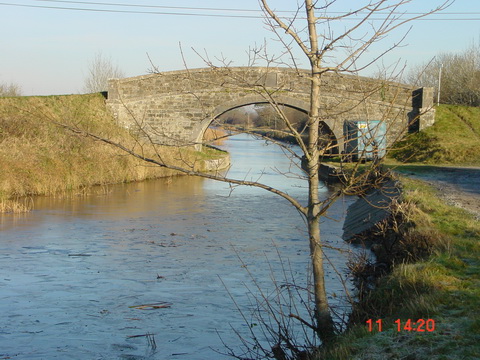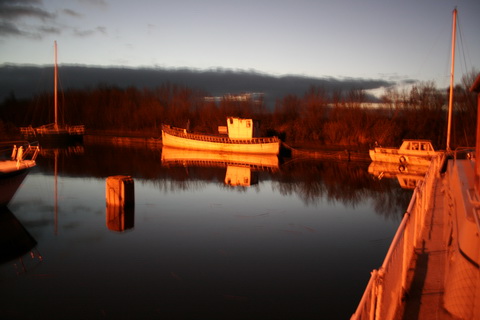
Dromaan at night (December 2011)
Dromaan at night (December 2011)
Posted in Extant waterways, Ireland, Irish waterways general, Natural heritage, Scenery, Shannon, waterways, Weather
Tagged boats, Clare, Dromaan, Ireland, Lough Derg, night, Shannon, weather
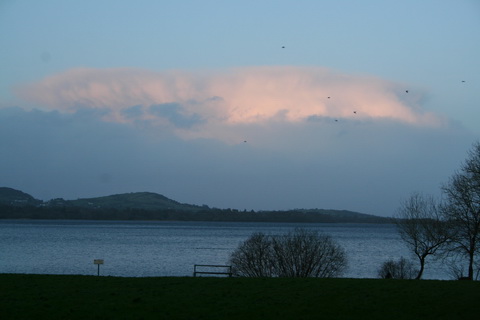
From Twomilegate December 2011
Posted in Ashore, Extant waterways, Ireland, Irish waterways general, Natural heritage, Scenery, Shannon, waterways, Weather
Tagged birds, Ireland, Lough Derg, Shannon, sky, Twomilegate, waterways, winter
The Department of Public Expenditure and Reform (whom god preserve) has published the capital expenditure submissions made to it recently by other government departments, all of them pleading to be spared the axe. That made by the Department of Arts, Heritage and the Gaeltacht can be downloaded here (PDF). Note the various blacked-out sections ….
The department did not want any cut in the capital allocation to Waterways Ireland:
Expenditure reduced by 45% in recent years and no scope for further reductions, given existing commitments and ongoing capital maintenance requirements.
However, departments were required to show how they would cope with a 30% cut. DAHG said that one of its priorities was
… the contribution that programmes make to North-South Co-operation
which would mean
Maintaining sufficient support for Waterways Ireland, the largest of the North/South Implementation Bodies, to deliver on the shared objective of improving the attractiveness of the waterways for recreational tourism, North and South.
If it had to cut by 30%, DAHG would cut WI’s capital allocation to €5 million; in the event it was cut to €4.5 million.
There is a very interesting descriptive section later in the document. It shows, first, that WI’s capital allocation was €11.25 million in 2008, €8.675 million in 2009, €7.8 million in 2010 and €6 million in 2011. At €4.5 million for 2012, it is 60% down on 2008. Waterways are not flavour of the month any more.
The document then gives a “High Level Objective” …
To maintain, develop and foster North/South co-operation and to support Waterways Ireland, the North/South Waterways Body.
… followed by a section headed “Consistency with Programme for Government”:
Apart from its unique contribution to North/South Co-operation, Waterways Ireland contributes significantly to tourism development across the island and its operations are very much in line with commitments in the Programme for Government:
“We will target available resources at developing and co-coordinating niche tourism products and activity packages that are attractive to international visitors focusing on food, sports, culture, ecotourism, activity breaks, water-based recreation and festivals. Event tourism will be prioritised to continue to bring major fairs and events to Ireland.”
The next heading after that (I presume these headings are standard for all departments) is “Contribution to Economic Recovery” (of which more below).
The interesting thing here is that there is no connection whatsoever between the high-level objective and either the programme for government or the contribution to economic recovery. The two sets of points exist in completely different universes; even DAHG itself makes no attempt to show that northsouthery can help the economy or vice versa.
So why is DAHG sticking to a high-level objective that is completely irrelevant to the policies and concerns of the current government? Will waterways northsouthery join the Restoration of One of the National Languages and the Draining of the Shannon, not to mention the Takeover of the Fourth Green Field, as one of those nationalist objectives held dear by small numbers of devotees but ignored by all rightminded citizens?
The disconnect between the high-level objective and the other desiderata is in itself a weakness, but it also suggests that DAHG is not keeping up with the programme. Northsouthery may have been good for waterways in the recent past, but nowadays your Unique Selling Proposition has to be economic. Stimulating growth, jobs or tourism good; pretty well anything else is irrelevant.
DAHG might have realised that if it had considered the rest of the headings; adopting a non-economic high-level objective, and failing to link that objective to economic matters, gives a bad impression (to DPER) from the start.
DAHG might have recovered some ground if it had shown how the waterways benefit the economy, but it made a very weak case under the heading “Contribution to Economic Recovery”:
The development and restoration of inland waterways is an important catalyst for the development of tourism and leisure opportunities, rural development and the protection of our heritage infrastructure. The Tourism and Recreation Sectors are one of the largest and important indigenous industries in Ireland and Northern Ireland. These sectors provide and generate significant levels of employment and earnings and have brought economic activity to areas on the island where little or no other economic activity exists. The tourism and recreational development and investment along the waterways bring activity to the very heart of the island and the communities along the waterway corridors.
From 2000-2010 there have been 10,115 metres of new moorings built, 8,020 metres in the South and 2,095 metres in the North. There are approximately 13,000 boats on the Waterways – 8,000 in the South and 5,000 in the North. There is approximately €20m from hire boats and €60m – €80m from private boats generated each year. In 2010 over €9 million in tourism revenue was generated.
Oh dear. The first para is waffle. The second has four sentences, the first of which inserts a statistic that seems to have been chosen at random and that is, at best, an input measure. The second sentence gives numbers whose significance is not shown. The third and fourth give output measures (without sources) but don’t relate them to the inputs.
What is really needed is something to show whether spending on waterways is good value: something comparing inputs and outputs or, if you prefer, costs and benefits. The only comparison the reader can make here is that, in 2010, €7.8 million of capital spending produced €9 million in “tourism revenue”, whatever that is; the gimlet-eyed scrutineers of DPER will no doubt have added WI’s current spending allocation to the capital and decided that waterways were not the most productive use of scarce capital resources.
The next section, “Savings Options”, is even more depressing. The first three paras are background information that belongs elsewhere, but they seem to be intended to provide a lead-in for the fourth:
In 2007, the North South Ministerial Council (NSMC) gave Waterways Ireland an additional responsibility for the reconstruction of the Ulster Canal from Upper Lough Erne to Clones and, following restoration, for its management, maintenance and development principally for recreational purposes. The then Government committed to funding the project in full, at an estimated cost of €35m. This position remains unchanged and was noted in papers presented at the recent NSMC Plenary meeting in Dublin.
That para seems to be intended to warn us that, as soon as the garlic of economic pressure is removed, the undead canal will arise from its grave and seize state funding. Note, by the way, that the “estimated cost” figure given is far too low; why is DAHG using a figure that is €10 million lower than Waterways Ireland gives?
The final paragraph of the section suggests that DAHG has lost touch with reality:
The Waterways Ireland Capital Programme 2012-2016 focuses on improving the attractiveness of the waterways for tourism. The primary actions relate to the provision of visitor services, such as pump-outs, service blocks and other facilities designed to provide an attraction for tourists, including car parking and play areas.
Much as I admire WI’s pump-outs and shower blocks, I can’t believe that they will be sufficient in themselves to attract many high-spending tourists from abroad. After all, several other countries have such facilities. I have been critical of some aspects of WI’s marketing strategy, but it’s considerably more sophisticated than relying on pump-outs and car parks to attract well-to-do tourists. Haven’t the DAHG bods read the strategy?
There is a final section: three paragraphs about the Ulster Canal.
The Ulster canal project initial phase is a major cross border initiative for the state. The Ulster Canal in total is 93 km long and extends from Lough Neagh to Upper Lough Erne. It runs through counties Armagh, Monaghan and Fermanagh. It was originally opened in 1841 to link the northern navigation systems to the western and southern systems via Lough Erne and the Ballinamore and Ballyconnell Canal. [No it wasn’t. bjg] Due to operational and financial difficulties the canal struggled to be viable and was finally abandoned in 1931.
As canal reopening progressed in the 1980s and 90’s, and following the success of the reopening of the Shannon Erne Canal, a number of studies were carried out into the reopening of the Ulster Canal. The outcome of these studies was that at the North/South Ministerial Council (NSMC) Plenary meeting in July 2007, the Council agreed, in the light of the Irish Government’s offer to cover the full capital costs of the project, to proceed with the restoration of the section of the Ulster Canal between Clones and Upper Lough Erne a distance of some 13km.
This flagship north south co-operation project will focus on attracting boating traffic from the Erne system in Northern Ireland and the Shannon System, via the Shannon – Erne, to a new destination at Clones. It is anticipated that this will lead to regeneration of the economy of Clones and its hinterland. This project will provide employment during its construction and will lead to fuller employment in the Clones area once completed. The full capital cost is estimated to be €35m. Waterways Ireland is currently taking the project through the preliminary design and planning stages and then letting the contract as a design and build project. It is expected that the project will take 6 years.
[New readers can find the antidote to this rubbish here.]
Happily, DPER didn’t fall for this, and even if the Clones Canal got all of WI’s capital allocation for six years it wouldn’t cover the cost. But it seems to me that at this stage DAHG, with its obsession with northsouthery and in particular with the Clones Canal, is a threat to the future of the waterways. At a time when the waterways need a strong economic justification (assuming one exists) for capital and current spending, DAHG’s submission suggests that it is away with the fairies: completely out of touch with both the economic realities and the government’s priorities. Its submission to DPER can only have damaged its credibility, and the outcome was an even greater cut in the capital allocation to Waterways Ireland.
Posted in Ashore, Built heritage, Economic activities, Engineering and construction, Foreign parts, Industrial heritage, Ireland, Irish waterways general, Operations, People, Politics, Restoration and rebuilding, Sources, Tourism, Ulster Canal, waterways, Waterways management
Tagged Clones, department of arts heritage and the gaeltacht, Erne, Ireland, Lough Neagh, Ulster Canal, Waterways Ireland
Posted in Ashore, Extant waterways, Ireland, Irish waterways general, People, waterways, Waterways management
Tagged Barrow, bridge, canal, Grand Canal, Ireland, waterways
The next time some idiot politician curries favour by promising special tax breaks for some favoured area, just mention the Upper Shannon Renewal Scheme. I mentioned before that IrelandAfterNama had covered it; now NamaWineLake, one of the best sites covering the wreckage of the Irish property market, has pointed to the evidence provided by the returns of stamp duty on property sales in 2010. Counties Leitrim and Longford — both covered by the scheme — each paid only €600,000 in stamp duty in 2010:
Practically nothing was sold in Longford and Leitrim which recorded the lowest stamp duty receipts of €0.6m apiece. If the receipts were all for residential property and the average transaction price was €200,000 then that would mean about 100 homes were sold in 2010 in each county.
So as well as spoiling the scenery by cluttering the place with colonies of white houses for white settlers, the scheme has also ruined the property market for the natives. Anyone needing to sell a house, perhaps to move in pursuit of employment, will find it more difficult to sell.
Jimmy Deenihan TD, Minister for Arts, Heritage and the Gaeltacht, in the Dáil debate on Financial Resolution No. 13: General on 7 December 2011:
Turning to North-South co-operation, I am committed to developing such co-operation within the broader arts, heritage and commemorative activities of my Department, as well as through the funding of the North-South bodies that come under the aegis of my Department. Provision of €42.718 million has been made in 2012 to support the two North-South implementation bodies, An Foras Teanga, comprising Foras na Gaeilge and the Ulster Scots Agency, and Waterways Ireland. These budgets will be subject to the approval of the North-South Ministerial Council in due course. It is envisaged savings will be achieved through efficiencies and increased focus on front-line services. The Minister of State will speak about An Foras Teanga but for Waterways Ireland the proposed breakdown for the 2012 allocation for this area is a provision of €22.59 million in current funding and capital funding of €4.5 million. This allocation will facilitate the ongoing maintenance and restoration of Ireland’s inland waterways, thereby increasing recreational access along routes and waterways. This expenditure will also assist in attracting increased numbers of overseas visitors and in stimulating business and regeneration in these areas.
I wonder what “commemorative” means in this context.
Posted in Ashore, Economic activities, Engineering and construction, Extant waterways, Foreign parts, Industrial heritage, Ireland, Irish waterways general, Operations, People, Politics, Restoration and rebuilding, Sources, Tourism, Ulster Canal, waterways, Waterways management
Tagged Clones, department of arts heritage and the gaeltacht, Ireland, Ulster Canal, waterways, Waterways Ireland
What body is the “Inland Waterways” referred to in this story? I didn’t think that WI had operations in Co Mayo. Could it perhaps be “inland fisheries” that supplied the boat?
Posted in Ashore, Extant waterways, Ireland, Operations, People, waterways, Waterways management, Weather
Tagged floods, flow, goat, Ireland, Mayo, water level, waterways, Waterways Ireland, workboat