Category Archives: Economic activities

The Ulster Canal: abandon it now

I have now completed an examination of the proposals for the reconstruction of a section of the Ulster Canal from Lough Erne to the town of Clones in Co Monaghan. My conclusions are linked from this page, which also contains a brief summary of my views.

Ulster Canal 0: overview presents the main points of the argument in about 3,600 words. It does not contain most of the quotations and omits the references; it also omits some sections of the argument. However, it’s about one fifth of the length of the whole thing.

Ulster Canal 1 to Ulster Canal 10 present the argument under ten headings, amounting to about 18,500 words in all. That may be too much for most people. There are no photos or other illustrations, and most of the argument is about economics or politics.

It will be clear that I do not have full information; I will be glad to have Comments from anyone who can fill the gaps or correct anything I’ve got wrong.

For anyone who can’t wait, here is a copy of the summary of my views.

Summary

The Irish government has been pushing, since the 1990s, for the restoration of the Ulster Canal. Several studies have been commissioned; all of them show that the project is uneconomic. At no stage has either the UK or the Northern Ireland administration shown any willingness to commit funding to the project. As a result, the Irish government has scaled back its ambitions, proposing to fund the construction of a canal from Lough Erne to Clones in Co Monaghan: it would cross the border several times, but it would pass through no significant conurbation on the northern side.

However, this scaled-back project makes even less sense than the proposal for full restoration, and there is no reason to believe that the canal will ever get any further than Clones. The Irish government might, I suppose, decide to dig on to Monaghan, as a form of famine relief work, but there is no evidence that the Northern Ireland Executive will ever put money into completing the route to Lough Neagh.

The costs of the proposal have not been reexamined for many years (or, if they have, the results have not been published), and the economic analyses may overstate the likely benefits. Even if they are accurate, though, the main benefits seem to come from casual visitors rather than from boaters. The benefits will go to service providers in the area, rather than to the waterways authority, but even if they went to Waterways Ireland they would not pay the running costs, never mind repaying the capital cost. The project has failed every economic test to which it has been subjected: it simply does not provide the sort of return that would justify the project.

There seems to be some doubt over the source of the proposed funding. The Irish government said that it canal to Clones would be paid for by the Irish Exchequer, but it later said that Waterways Ireland would sell surplus assets to pay some or all of the cost. It is not clear that Waterways Ireland’s surplus assets would, in current economic conditions, bring in enough money; nor is it clear that the Department of Finance is willing to make up any shortfall.

There might be something to be said for acquiring the land and creating a walking and cycling route, but the current proposal for a canal to Clones is utterly unjustifiable and should be dropped.
The Ulster Canal: the supposed benefits

Here is the latest (and almost the last) in this series of posts: an examination of the expected benefits of the canal to Clones. My conclusion is that the benefits cited are higher than those likely to arise in current conditions.

The Ulster Canal: the costs

The figure of €35 million is widely quoted as the cost of the canal to Clones, but the basis for that figure is not clear. Here are some thoughts on the subject.

The Ulster Canal

The next page of the Ulster Canal series is now up. It is, I’m afraid, rather boring: an account of the various reports (“studies and appraisals”, in the jargon) commissioned since 1994. It may help in sorting out who said what where and when.

The Clones Canal (the first part of the Ulster Canal to be abandoned)

Waterways Ireland intends to build a canal to Clones at the instigation of the Irish government. I believe that this proposal is an unjustifiable waste of money, at a time when public expenditure (and especially capital expenditure) is being cut.

This page provides links to a series of pages about aspects of the proposal. At time of writing, there are four pages up; there will be more, concentrating on the economic and financial aspects.

I have had limited access to documents:

  • every debate in the Dáil or Seanad in which the Ulster Canal was mentioned
  • every debate and committee session in the Northern Ireland Assembly in which the Ulster Canal was mentioned
  • every debate in the House of Lords and the House of Commons in which the Ulster Canal was mentioned
  • the minutes of meetings of the North/South Ministerial Council in Inland Waterways Sectoral Format and relevant minutes of Plenary Format meetings
  • the documents available on the websites of Waterways Ireland and of the Department of Community, Equality and Gaeltacht Affairs.

Neither the Department of Community, Equality and Gaeltacht Affairs nor Waterways Ireland has answered all the questions I asked them. Accordingly, I may have got some things wrong, and I would welcome correction. I would also welcome copies of confidential documents: this could become WikiLocks.

Accounts

I was interested to read in the British magazine Waterways World September 2010 (Volume 39 Number 9 page 45) that:

British Waterways has published its 2009–2010 Annual Report.

Waterways Ireland too has just published its report on its website (immediately after I asked WI when the report would be published). In this case, though, it’s the Annual Report for 2008.

Admittedly BW’s year ends on 31 March and WI’s on 31 December, but a 15-month difference is quite a lot. It’s not as if BW is smaller: its income was £187 million whereas WI’s was £29 million.

From the hearts of cranes

Several ports on the Shannon Navigation have old cranes (or parts thereof), most of them nicely painted. Their age may not be apparent, but it is possible that they date back to the days of the Shannon Commissioners in the 1840s; at least one of them may be even older than that.

This page shows photographs of those cranes I know of, and discusses their possible ages. But there is much that remains unknown, and readers may be able to cast light on some of the mysteries.

Waterways history?

The Irish Department of Finance has today (26 July 2010) published Infrastructure Investment Priorities 2010-2016: A Financial Framework. The document begins:

This Review of capital investment sets out infrastructure investment priorities for the years 2010-2016 and in doing so fullfills the requirement to publish a revised set of investment priorities as pledged in the Renewed Programme for Government. The Review represents a reappraisal of the Government’s Public Capital Programme, designed to re-focus investment plans and ready the Irish economy for a return to growth. The pace and depth of the changes which have beset the national economy over 2008 and 2009 have altered the environment in which infrastructure investment takes place and challenged the assumptions on which previous investment plans were founded. It is necessary, therefore, to reassess investment priorities in light of both changes in demand for infrastructure and affordability constraints given the very challenging fiscal position.

Chapter 14 covers the Department of Community, Equality and Gaeltacht Affairs which, along with the Northern Ireland Department of Culture, Arts & Leisure, takes an interest in the doings of Waterways Ireland, the cross-border body that runs seven inland waterways. Under 14.2 Rationale for Investment, the document says:

14.2.6 Waterways
The strategic objective of this programme is to maintain and restore Ireland’s inland waterways, providing recreational access along routes of waterways, thereby hoping to attract overseas visitors and stimulating business and regeneration in these areas.

And under 14.3 Assessment of Sectoral Capacity and Anticipated Medium-term Demand it says:

14.3.5 Waterways

This programme supports the maintenance and upgrading of existing inland waterways. As these attract tourism and support local employment, it is recommended that a level of investment continues into the medium-term. There is a Government commitment to the restoration of the Ulster Canal. Where possible, Waterways Ireland’s own resources will be used in advancing this work. In the absence of readily available exchequer funding, the sale of other assets may be considered where appropriate, subject inter alia, to value for money considerations.

The document’s overall conclusions include this:

[…] the environment in which we appraise, plan and deliver infrastructure has undergone significant transformation. These developments can be summarised as follows:

§ The challenging fiscal position means that investment on the scale previously envisaged will not be possible;
§ Similarly however, the contraction in economic activity means that there will be a  lower demand for infrastructure in the economy than previously anticipated;
§ The cost of investing in infrastructure has fallen markedly and so a very high level of capital stock can be delivered from a lower level of exchequer investment; and
§ The economy is undergoing a structural transition which will have implications for the type of infrastructure required into the medium-term.

These four broad considerations set the parameters in which this Review was conducted. Within this framework, the foregoing analysis has sought to identify the optimum level of investment and the sectors in which this investment will take place in order to:

§ Contribute to economic recovery;
§ Support employment;
§ Deliver important social infrastructure; and
§ Develop a low-carbon, Smart Economy.

Accordingly this analysis has given rise to changing priorities in infrastructure policy.

The allocations to the Department of Community, Equality & Gaeltacht Affairs under the Public Capital Investment Programme 2010 – 2016 will be:

2010 €105 million

2011  €86 million

2012  €86 million

2013  €86 million

2014 €40 million

2015 €30 million

2016 €30 million

The Summary Public Capital Programme for 2010 showed that the Department got €133 million in 2009, of which €10 million (7.5%) went to Waterways Ireland, and was due to get €105 million in 2010, of which Waterways Ireland would get €8 million (7.6%). If the same proportion applies when the Department’s allocation is down to €30 million, Waterways Ireland will get only about €2.25 million, less than a quarter of its 2009 allocation. (Note that these figures affect only capital, not current, expenditure.)

Today’s document does not show how Waterways Ireland’s allocation will be affected. It may continue to be favoured because of a presumed contribution to the tourist industry (despite this year’s drastic fall-off in traffic on the Shannon), but even so it seems likely to suffer a major reduction in capital spending.

It is not clear what the Department of Finance intends should be done about the restoration of the Ulster Canal (the Irish government undertook to fund its restoration from Lough Erne to Clones, a short stretch that crosses the border several times). Is it saying that Waterways Ireland will receive no extra funding for the project? Is it expecting WI to sell other assets to restore the Ulster to Clones? According to the most recent set of accounts available on the WI website, those for 2007, WI had €25 million in “non-operational heritage assets”. Are they what the Department of Finance calls “Waterways Ireland’s own resources”? What is there that WI could sell to pay for the Ulster?

This is, I think, the end of a golden era for spending on the Irish waterways. And I will be very surprised if the Ulster Canal is reopened within my lifetime.

The Lartigue: the Listowel & Ballybunion Railway

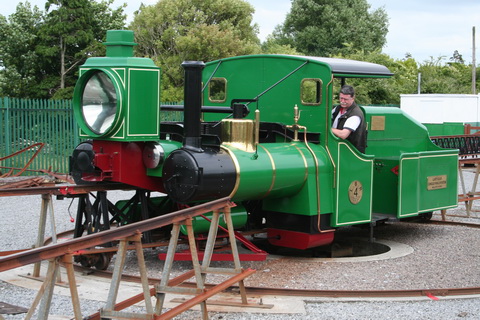
The Listowel & Ballybunion Railway operated between 1888 and 1924, using perhaps the most eccentric railway technology ever invented: the monorail developed by Charles Lartigue.

Very little original material was left after the railway closed, but a short section of railway has been recreated in the town of Listowel, Co Kerry, with a single locomotive (now diesel rather than steam) and two carriages. However, it shows the more exciting features of the original: the ingenious turntables and switches. There is also a small display of models, photographs and artefacts, and a showing of three short films, with some original newsreel footage of the railway in operation. The volunteer staff are knowledgeable and happy to chat and, all in all, it makes for a very entertaining few hours for anyone interested in transport or engineering.

Listowel is close to Ballybunion on the south side of the Shannon Estuary; anyone visiting the industrial heritage artefacts of the Lower Shannon Industrial Heritage Park could easily build in a visit to the Lartigue – and then take the ferry from Tarbert to Killimer and visit the West Clare Railway.

Read about the Lartigue here.

Anguilla anguilla: the ESB eel fishery

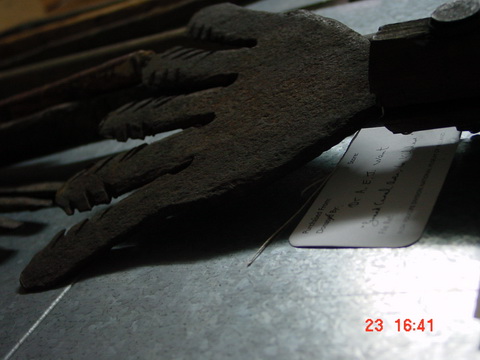
This photo shows an eel spear from the National Folklife Collection‘s overflow material, stored in the former “reformatory” at Daingean, on the Grand Canal in Co Offaly. There were many spears there, with different designs from different rivers. This one, to judge from the label underneath it, came from the extraordinarily prolific and observant Dr A E J Went.

If you look at pretty well any Irish river on the 1840s Ordnance Survey map (here’s the Shannon at Killaloe; switch to Historic 6″ if necessary), or indeed on the 1900s map (same URL but switch to Historic 25″), you’ll find evidence of eel weirs. Ireland’s shortest canal was built to allow the eel-boats of Anthony Mackey’s fleet to reach the trains at Banagher.

But the European eel is a “critically endangered species” and all eel fishing has been banned in Ireland. As far as I know, though, the Lough Neagh fishery, in Northern Ireland, continues.

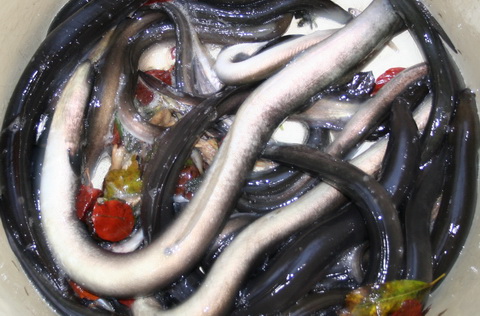
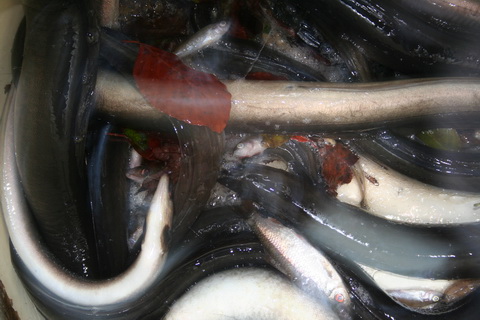
The Electricity Supply Board (ESB) is in charge of the eel fishery on the River Shannon. It has nets and a storage unit (packing station) at Killaloe and, until recently, it also had nets at Clonlara on the headrace supplying the power station at Ardnacrusha; the Clonlara nets have just been removed. This page is about the Clonlara and Killaloe operations, but includes a look at an eel survey conducted for the ESB in 2008, before eel fishing was banned in Ireland. The aim now is to make it easy for eels to reach the sea to reproduce, and that sometimes involves “trap and transport”: catching the eels and moving them past obstacles, whether on their way to the sea or, for the young glass eels, on their way upriver.

The photos on this page are a tribute to what was an important activity on the Shannon. I hope that the European eel stocks can recover.