Category Archives: Irish waterways general

Rockville navigator elected to Dáil

Ming Flanagan was the first to be elected a TD in the Roscommon South Leitrim constituency in the 2011 general election.

Ming launching himself on the Rockville Navigations

His sterling qualities were shown when, in September 2010, he kayaked down the Rockville Navigations, with a companion, to check this tourism and recreational resource (which I had brought to his attention in his capacity as Mayor of County Roscommon).

Another person on the side of righteousness is Paudie Coffey of Portlaw, mentioned favourably here; he was first home in Waterford, where he stood for Fine Gael.

Consultancy fee? No, it’s OK, thanks ….

How A N Other and I saved the Irish waterways … or at least suggested how Waterways Ireland should approach British narrowboaters.

Rowing

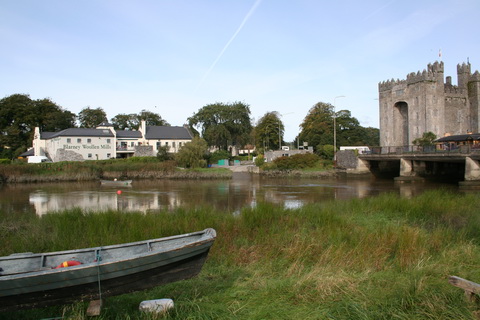
Big it up for the Irish Amateur Rowing Union (aka Rowing Ireland), which will be descending the Lower Shannon in May. Good to see that they’ll be doing the estuary, as fas as Bunratty, and are not confining themselves to non-tidal waters.

Bunratty

F E Prothero would be proud of them: he himself thought it best to see the estuary from the deck of the steamer to Kilrush.


Man at work

Odlum’s Bridge, Kilbeggan Branch of the Grand Canal, 19 February 2011

This slideshow requires JavaScript.

I should point out that I am unable to change the speed of transitions on the slide show, which considerably underrepresents the speed of the slashing. Even clicking the forward arrow as fast as possible doesn’t do it justice.


RVRC

It is necessary to draw public attention to a lamentable case of discrimination in Irish public policy and to announce the formation of a group to combat that discrimination and to ensure equal treatment for all.

Suppose you like travelling around Ireland in a white plastic whatsit. You need places to park, preferably free, with something nice to look at. You need services like toilets, showers, water and rubbish bins. You like to park close to fellow travellers and to meet them, perhaps for a barbie and some beer.

Your whatsit is well equipped with television and other entertainment; indeed the general standard of furnishing and equipment is very high. You can even carry toys — perhaps a dinghy and some bicycles — around with you, for some fresh air and exercise when you’ve reached a suitable place.

If your white plastic whatsit floats in water, you have the services of a cross-border implementation body, Waterways Ireland, spending millions (and charging practically nothing) on your leisure activities. You have government departments north and south looking after you, with the southern department keen to spend money borrowed from Germany on providing you with more places to go. And you have all sorts of other free services, like Coastguard and lifeboats, to help you out.
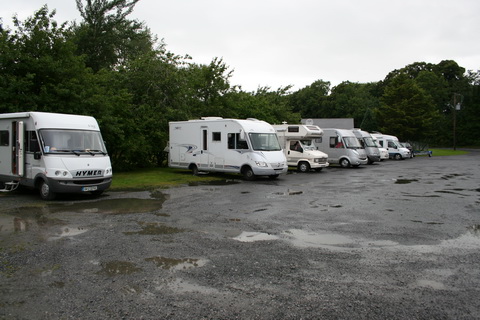
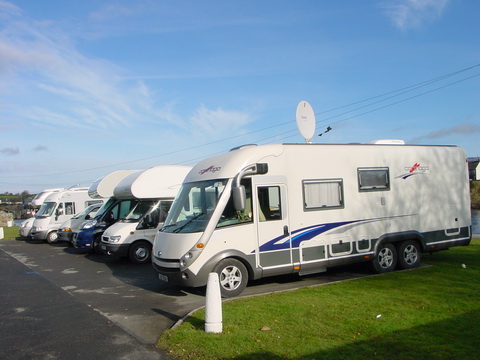
White plastic whatsits at Portumna Castle Harbour

If your white plastic whatsit has wheels, though, you are a pariah. You have no cross-border boy, no government departments, no free services, although your needs are the same as those of your boating brethren.

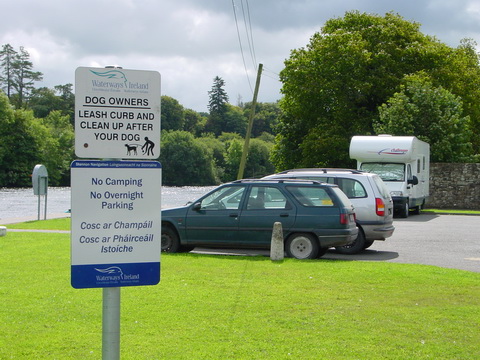
So owners of RVs (recreational vehicles, camper-vans, what you will) are forced to sneak in to Waterways Ireland harbours and to park inconspicuously along the edges. The best place to park is usually indicated by a sign.

Sign showing where to park at Killaloe

Parked beside Killaloe market

RVRC, the Recreational Vehicle Rights Campaign, seeks an end to this discrimination. We seek the provision of free facilities for camper-vans. We want a cross-border body of our own, RVways Ireland.

We have adopted Dana Lyons’s song RV as our anthem; you can listen to it free here (and while you’re at it see the animations of his best-known song here).

The Clones Canal

And this brings us, by a commodius vicus of recirculation, to Clones and the Craggy Island Canal. Boaters may like to see themselves as hardy mariners, sons of the sea who happen to be confined to inland waters, but economically they’re very similar to RVers. Many of them are older couples but some travel with children. They like going for weekends away; they need certain facilities; they don’t use hotels, B&Bs or other accommodation. They have enough equipment and supplies to prepare their own meals, but they do some shopping and may go to the pub or have a meal out.

As potential bringers of wealth, RVers have some advantages over boaters. You don’t have to spend €35 million to get them to your town; they are more mobile, so they’re not confined to a single site in the town; they can even park some distance outside and still get to the shops, pubs and restaurants. And RVers are hardy souls: in late February 2011 there was not a single boat in Portumna Castle Harbour but there were four RVs.
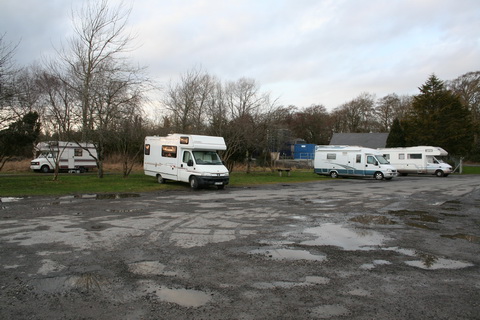
RVs in Portumna in February

So, given that Clones is an attractive destination, why is the Regeneration Partnership not now trying to attract camper-vans (and indeed campers and caravanners)? According to Discover Ireland, there is no caravan or camping site in Co Monaghan (although there could be sites whereof Discover Ireland is ignorant).

There are two points to this query. The first is that Clones could be doing something now to attract visitors, without waiting for Craggy Island to come up with €35 million. The second is that (assuming the blasted thing is ever built), after the excitement of having a canal dies down, Clones will have to do things to attract visitors. So why not start now?

Naas

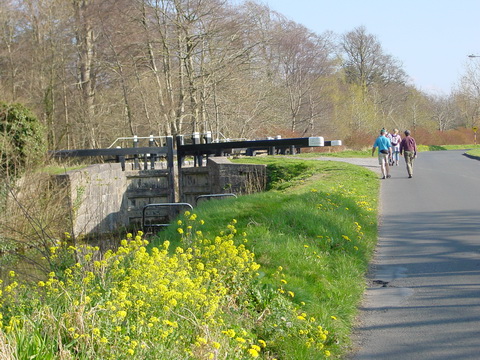
Lock 3 on the Naas Branch of the Grand Canal

Big it up for the Naas Local History Group: it’s holding a canal walk, led by Paddy Behan, on Thursday 19 May 2011. Meet at the Harbour at 7.30 pm.

The upper Barrow

Charlie Horan (of Go with the Flow, the canoe expedition specialists) left a comment on my post about Abbeyleix (below) saying

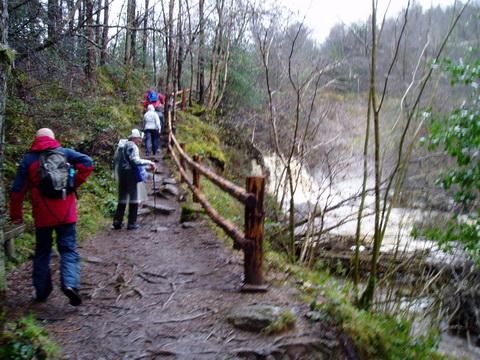
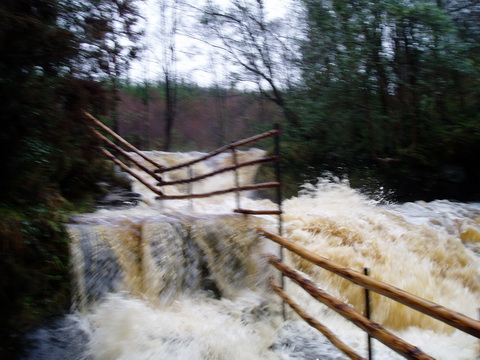
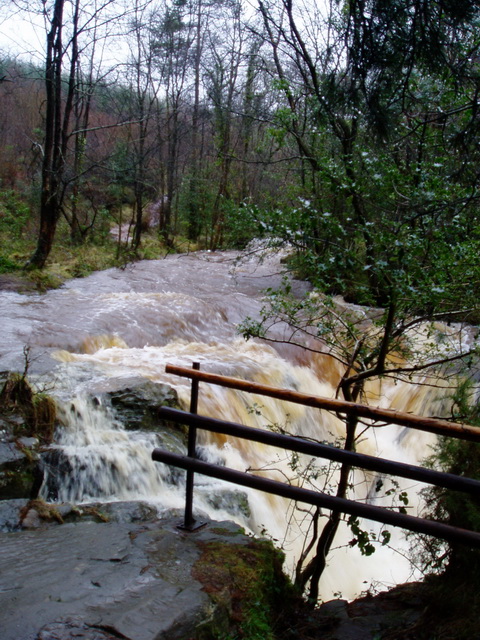
I have some very very interesting pictures of the Barrow near source in flood taken just two weeks ago ….

And here they are. They are indeed interesting!

White water (courtesy Eamonn and Charlie Horan)

Eek (courtesy Eamonn and Charlie Horan)

The burling Barrow brown (as Gerald Manley Hopkins called it) (courtesy Eamonn and Charlie Horan)

Even the indefatigable F E Prothero might have been put off …. He canoed down from Mountmellick to Athy in 1897, taking about eight and a half hours. Major Rowland Raven-Hart said that the Barrow had been canoed from a little above Portarlington (which is downstream of Mountmellick); there is a PDF of his book here.

The missing canal at Abbeyleix

The Lakelands & Inland Waterways Strategic Plan 2010–2015, downloadable from the Waterways Ireland website, has an Appendix II headed “Infrastructure Investment Lakelands and Inland Waterways Area – Land and Waterbased” and a subheading “(1) LAND BASED INFRASTRUCTURE”. This has three columns:

  • Project Name
  • County
  • Cost.

An earlier note, on page 2, said:

For details of infrastructure support in the Lakelands & Inland Waterways area  See Appendix II.

That’s on a page headed “Achievements to Date” and with the introductory line “Key successes of the initiative up to the end of 2009 have included:”. We can assume, therefore, that the amounts listed in Appendix II are amounts that have already been spent, in some unspecified period ending in 2009. There is no measure of what was achieved.

Anyway, I was intrigued by the inclusion of these items for County Laois (Queen’s County):

  • Signposting Project for the Slieve Bloom Mountains – Laois/Offaly: Co. Laois/Co. Offaly: € 93,750
  • Abbeyleix HeritageTown Co. Laois € 42,315

I can see the justification for including a range of mountains amongst the lakelands and inland waterways, because the River Barrow rises in the Slieve Bloom Mountains. Admittedly it is not, at that point, generally considered to be navigable, but let us not strain at gnats.

But why is Abbeyleix included? What canal served it and where has it gone?

Whaddya mean, it’s in the constituency of Laois-Offaly? What could that have to do with it?

All SEWn up?

Last week the Clones Regeneration Partnership Chairman called for politicians to support Craggy Island’s Canal to Clones. That’s the scheme being pushed by the Department of Community, Equality and Gaeltacht Affairs (which funds the Partnership’s Project Coordinator).

Then Brian Cassells, former President of the Inland Waterways Association of Ireland, joined the campaign, with an article in the Northern Standard. Happily, its Comments section is working (it was my fault that my comment was posted twice: I tried to edit it but ended up with two almost identical versions).

Brian says:

The phenomenal success of the Shannon/Erne waterway is largely down to the far sighted vision of the late Charles Haughey who had the dream of what has become an enormous tourist success.

I have argued that the success of the SEW is often over-stated and that much of the prosperity of the region is attributable to the businesses set up by Sean Quinn.

But there is another point that the Clones Canal’s fans overlook. According to askaboutireland.ie,

The £30 million funding [for the Shannon–Erne Waterway] came mainly from the European Union Regional Development Fund, the International Fund for Ireland and the E.S.B.

I have not been able to find any exact breakdown of who contributed how much, but it does seem that some large proportion of the costs was not paid by the taxpayers of either Ireland or Northern Ireland. That makes for a much better return on whatever amount of capital they employed.

This time, though, that’s not going to apply. The days of free Euroloot are over, and I haven’t heard that either the IFI or the ESB will be contributing.

Maybe the good people in Craggy Island are relying on winning the lottery?


The Erne to Lough Oughter

How they got the dredgers past the distillery in 1857. No pics, alas, but it’s worth using the links to the OSI maps.