Category Archives: Non-waterway

Kerry nitwits

See the Irish Times and the Guardian.

Download your copy of Kerry County Council’s road safety calendar here [PDF].

Not that this piece of idiocy will ever be passed but, if it is, tourists should avoid Co Kerry, lest they be mangled by a Kerry farmer, pissed as a newt, wobbling around the roads in his tractor.

What qualities — apart from being a publican — do you need to be elected in Co Kerry?


One for the Phizzers

Quite a few visitors to this site come to read about the Broadstone. Here is a piece about the pontoon bridge used at the Broadstone between (AFAIK) 1847 and 1877. It was designed by Robert Mallet and it is interesting to see how an inventive engineer solved the peculiar problems of the Broadstone site.

You can run …

… but you can’t hide. Harbour hoggers, and folk not meeting the new canals requirements, should watch out.

WI's eye in the sky

WI’s eye in the sky

[h/t & © JC]

[yes, I know]

Northsouthery 121212

The North/South Ministerial Council reports here [PDF] on the most recent inland waterways meeting, which was held on 121212. Not much happened (or at least not much that is being revealed to the citizens and subjects). Sponsor departments are to think about having a board; there is still no money for the Clones Sheugh but an interagency groups is to find some [hint: look under the end of a rainbow] and it was John Martin’s last appearance as he will be retiring in March and the search for a new CEO has a process (which is important).

The interesting bit is that WI is to transfer some property at Harvey’s Quay, Limerick, to Limerick City Council, which is making a boardwalk. And something similar is happening in Tullamore. You’re nobody nowadays unless you have a boardwalk; their usefulness in Irish weather is not proven.

Finally, I noted a certain modesty in WI’s aims for 2013, no doubt in keeping with the tenor of the times:

Ministers discussed the main priorities for Waterways Ireland in 2013 and noted progress on the 2013 Business Plan and Budget. The priorities for 2013 include:

• ensure the navigations are open and all existing facilities operational during the main boating season from April to October
• to actively promote the waterways to extend and expand recreational use of the waterways in all its forms.


Around the world with Irish waterways

Yesterday was one of those days: I managed to track down sources for several pieces of information I’ve been hunting for some time, but in the process I came across a few interesting links, from Gordon of Khartoum to the War between the States.

The starting point was William Watson, manager of the Inland Department and later Chairman of the City of Dublin Steam Packet Company. He worked with Robert Mallet on the design of an innovative boat for use on Irish inland waterways. Robert Mallet married a Cordelia Watson in 1831. (I thought that might be a daughter of William of the CoDSPCo but it’s pretty clear from the excellent Mallett Family History site that that was not so.)

One of Mallet’s inventions was a large mortar designed for use in the Crimean War. And one of Mallet’s sons, John William Mallet, went to the USA and became professor of chemistry at the University of Alabama. He joined the Confederate forces, rising to the rank of lieutenant-colonel in the artillery and superintendent of the Confederate ordnance laboratories.

Meanwhile Watson’s son Charles Moore went east rather than west. Colonel Sir Charles Moore Watson KCMG, CB, MA, of the Royal Engineers, Watson Pasha, was a general in the Egyptian Army and Governor-General of the Red Sea Littoral. Watson’s base was at Suakin on the Red Sea. The Dubliner was succeeded in that post by a Kerryman, Horatio Herbert Kitchener, from Ballylongford near Saleen on the Shannon Estuary, on which the City of Dublin Steam Packet Company operated.

Watson was “Gordon’s principal friend in Egypt”:

It is certain that Watson was, above all others, the one man in Cairo whom Gordon cared about most, and that he was the last to see Gordon off when he started [for Khartoum].

Gordon died at Khartoum; the relief expedition, led by another Irishman, Sir Garnet Wolseley, arrived two days too late.

A younger brother of Sir Garnet, Frederick Wolseley, went to Australia. His Sheep Shearing Machine Company made a brief expedition into the manufacture of motor-cars, under one Herbert Austin, who later founded his own company. Austin and Wolseley both ended up in British Leyland Motor Corporation, which made diesel engines, some of which were marinised and used in boats on the Irish inland waterways … which brings us back to where we started.

Blarna, Canima and the Liffey Dockyard

Pat Sweeney, in Liffey Ships & Shipbuilding [Mercier Press, Cork 2010], tells us that in December 1960 Cork Harbour Commissioners got permission to raise a loan of £250,000 to build two diesel-powered tenders to carry passengers to and from transatlantic liners moored in Cobh. The tenders were built by the Liffey Dockyard in Dublin; the MV Blarna was launched in May 1961 and her sister MV Cill Airne in February 1962.

After a varied career, the MV Cill Airne is now back on the Liffey as a floating restaurant. Her website says that she and her sister were the last rivetted ships built in Europe; they were the third-last and second-last ships to be built at the Alexandra Basin, the last being the Shannon Navigation’s Coill-an-Eo.

MV Blarna spent much of her life in Bermuda as a party boat named Canimabut then spent ten years in Canada waiting vainly for restoration or conversion and coming to be regarded as an eyesore. That period is now over: the “Millbank eyesore“, the Canima, sank in December 2012 and “salvage may not be an option“.

h/t Niall Galway

What’s it oil about?

What with all those nasty chaps [PDF] doing whatever it is they do to diesel, thereby cheating the citizenry and polluting the countryside, it seems that the Revenue Commissioners, whom god bless and preserve, came up with a new scheme last year that might be made to look like a solution. (The real solution, of course, is to abolish green diesel, charge everyone full whack, and — if you really must, although personally I think they get too much subsidy as it is — give farmers back some money to shut them up … for a while.)

The new scheme is outlined here. As far as I can make out (but IANAL), anyone selling marked fuel oil (which I guess would include marinas selling it for private pleasure navigation, the category I’m interested in) has to pay €250 to get a Marked Fuel Trader’s Licence.

Actually, I may be simplifying it unduly: first they have to apply to be allowed to apply.

If this Application is approved the National Excise Licence Office will issue you with an Application Notice to apply for the Licence.

If the marina counts as a “forecourt retailer”, it also has to make a monthly electronic return of “oil movements”.

These requirements came into effect on 1 October 2012 and the Revenue website provides a 147-page PDF list of licence-holders as at 31 December 2012. I’ve had a quick look for a few Shannon marinas; I found none of them, although I confess I haven’t read the whole thing.

I haven’t been to any of the seminars (although I’ve looked at some of the PDFs available on that page) and I haven’t contacted the official sources of information (although I have emailed the Revenue press office). I have read the FAQ, though. There is no reference to boats or marinas or private pleasure navigation, so I assume that the scheme does apply to marinas. As far as I can see (again, IANAL), all traders in marked fuel must have licences, even if they sell only small quantities. However, for those selling under 2000 litres per customer per month, there is a simpler monthly return:

However, if you supply less than 2,000 litres per month per customer, you only need to notify Revenue of the number of customers you supplied during the month as well as the aggregate quantity of fuel supplied.

That would cover most marinas, I imagine, although the ROM1 procedure still has to be used.

The first return, in respect of oil movements during January 2013, must be submitted by 25 February 2013.

So does this apply to marinas? I’ve asked Revenue but I don’t expect to hear for a few days. If it does apply, what will the effect be? Is the increased cost (time to compile the application and meet any Revenue demands; €250; whatever the ROM1 system costs) likely to be significant? How are the marinas (and other waterways fuel retailers) responding?

Carrying on the Royal Canal

This is a point I’ve come across in passing. It’s not central to my main concerns so I won’t pursue it further for the moment, but I’m posting it here in case it helps anyone else researching the subject.

It will be recalled that, until the passing of the Canal Carriers Acts 1845 and 1847, most canal companies carried passengers but not freight on their own canals. After the passing of those acts, the Grand Canal Company set out to take over the bulk of the freight business on their own canal (and, in consequence, on the rivers connected thereto). But what of the Royal Canal, which had been taken over by the Midland Great Western Railway in 1845?

Ruth Delany, in Ireland’s Royal Canal 1789–2009 [with Ian Bath; The Lilliput Press, Dublin 2010], says on page 192:

In 1871, despite its failure to show a profit on the Grand Canal lease, the MGWR decided to try acting as carriers on the Royal, which had been permitted by legislation since 1845. Horse-drawn boats were used until 1875 when five steamers were purchased: Rambler, Rattler, Mermaid, Conqueror and Pioneer.

In a note, she says

For this period, 1849–1906, the principal source of information is found in the minutes of evidence to the Shuttleworth Commission, HC 1907 (Cd 3717), XXXIII, Part 1, 9.

Peter Clarke, in his The Royal Canal: the complete story (ELO Publications, Dublin 1992), says:

It is important to recall that at this time, the carriage of goods on the canal was undertaken by a number of boat owners who paid tolls to the railway company. The failure to have these tolls increased was what most probably prompted the railway company to establish themselves as carriers on the canal in 1870. […] Until 1876 an unknown number of railway owned horse drawn barges were used. In that year, the service was expanded when four new screw propelled boats were purchased at a cost of £5000.

His source is the Waterways Commission of 1923, Minutes of Evidence nineteenth day, p13.

Ernie Shepherd in The Midland Great Western Railway of Ireland: an illustrated history (Midland Publishing Ltd, Leicester 1994), says

The MGW decided to operare its own carrying trade in 1871 and this lasted until 1886. Horse drawn boats were used until 1875 when steamers were purchased.

On 15 August 1853 The Freeman’s Journal and Daily Commercial Advertiser of Dublin carried this notice in the Railways column.

Midland Great Western Railway (Ireland) Company — Royal Canal

Haulage of boats

The Directors will receive Proposals for the Haulage of their Trade Boats to and from Dublin and Longford and the River Shannon, from and after the 12th November next. Parties are at liberty to tender for a part or the whole of the work. Security will be required for the fulfilment of the Contract; and further particulars may be had on application at this Office.

Tenders to be sent in on or before 10th September next.

By order, Henry Beausire, Secretary.
Dublin Terminus, 10th August, 1853

This suggests that, in 1853, the MGWR had its own trade boats (lumber boats, freight-carrying barges) at work on the Royal Canal. It would be nice to know more. I have said before that we do not know anything like the full history of the Royal Canal.

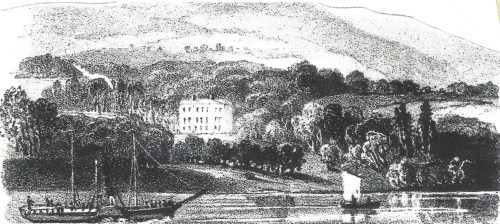
Where is this?

Paul Gauci's 1831 drawing of a Shannon steamer

Paul Gauci’s 1831 drawing of a Shannon steamer

This drawing of a steamer is from an 1831 book called Select Views of Lough Derg and the River Shannon by Paul Gauci. I haven’t seen the book myself, but this illustration is used in a couple of places, including Ruth Delany’s book The Shannon Navigation [The Lilliput Press Ltd, Dublin 2008]. Andrew Bowcock, in his article “Early iron ships on the River Shannon” in The Mariner’s Mirror Vol 92 No 3 August 2006, says of the steamer shown that

The funnel looks to be almost over the paddle shaft, which is artistic license.

But my question is not about the vessel but about the house in the background. If it is drawn without artistic licence, where is it?

It is a very large house, seven bays by three storeys, quite close to the water. Using the Historic 6″ Ordnance Survey map [~1840], I have followed the banks of the Shannon from Shannon Harbour down Lough Derg to Killaloe, then from Limerick down the estuary as far as Tarbert, across the estuary to Doonaha and back up on the Clare side to Limerick, then from Killaloe up the Clare and Galway shores back to Shannon Harbour. Anywhere I found a large house within what seemed the right distance of the shore, I looked it up in the Landed Estates Database and in the National Inventory of Architectural Heritage, with some supplementary googling.

I haven’t been able to find images of all the houses marked on the OSI map, but I found enough to show that houses of the size shown by Gauci were very rare. Within those few, I ruled out some (like Tervoe) because they didn’t seem to match Gauci’s drawing (although alterations could have accounted for that). I ended up with only one house that looked at all like Gauci’s, but the background may not match.

If you can identify the house, I would be glad if you could leave a Comment below.

Dick Gaughan and John Grantham …

… both had an interest in Erin-go-Bragh,