Category Archives: The turf trade

The Junction Navigation

Here are some pages about the Junction Navigation in the Ballinamore & Ballyconnell drainage district. It later became known as the Ballinamore & Ballyconnell Canal and later still as the Shannon–Erne Waterway.

The role of the cads and bounders of the Ulster Canal Company in getting a canal built at taxpayers’ expense

The construction of the Junction Navigation at Aghoo (Lock 4)

Lock gear old and new

And here’s a reminder of an old page about the Belturbet-built dredger used in constructing the navigation.

Seol Sionna

A reproduction Shannon Estuary turf boat is being built at Querrin.

Looping the Loop

The proposed Doonbeg Ship Canal. Can anyone produce evidence to show that work ever started on it?

Get me a duck punt

I have updated my page about the designation of the Shannon and Fergus estuaries as a Special Protection Area for our feathered friends. The more I learn about this proposal, the less I like it.

Garryowen and Dover Castle

In 1840 the rival steamers Dover Castle and Garryowen competed for traffic on the Shannon Estuary. While I know of no pictures of the steamers (if you know of any, please let me know), we have a reasonable amount of information about their operations. I discuss some aspects of those operations here. For an explanation of the page title, see here, but do not be diverted down this byway.

Sailing in Athlone

Athlone, from The Tourist's Illustrated Hand-Book for Ireland 3rd ed David Bryce, London 1854

The Broadstone pontoon

On my page about the Broadstone Line of the Royal Canal, I say this:

In 1845, the Midland Great Western Railway Company (MGWR) bought the Royal Canal. Doing so allowed it to run its lines beside the canal, which it did most of the way to Mullingar, without having to conduct lengthy negotiations about wayleaves with individual landowners. The company built a terminus at the Broadstone, with a pontoon bridge (which was moved out of the way when boats entered or left the harbour) to provide passengers with access to the station.

I have found a picture of the arrangement. Here it is.

The Broadstone, from The Tourist's Illustrated Hand-Book for Ireland 3rd ed David Bryce, London 1854

The pontoon looks rather solid, but there is a canal-boat heading for it and the canal clearly continues on the far side.

I have added the pic to the Broadstone page.

Shannon hooker

No, not a rugby player, but a replica of one of the Shannon estuary workboats — the Massey Fergusons of their day — that carried turf towards Limerick and limestone back, as well as anything else that needed shifting further, or in larger quantities, than the canoes could manage.

The boat is being built at Querrin; see this article in the Irish Times.

Location

Page 84 of Ruth Delany’s The Shannon Navigation (Lilliput Press 2008) has a drawing with this caption:

A drawing by Edward Jones which it is thought might depict the Shannon Commission’s survey in progress at an unidentified location possibly down the Shannon Estuary. (Courtesy of the Society of Antiquaries of London)

I suggest that the drawing is of Saleen, on the Ballylongford Creek in Co Kerry, on the lower reaches of the Shannon Estuary. The first word written on the  drawing looks like “Sawline”, which might be a version of “Saleen”.

Diesel, gas, turf or battery?

The Irish Times tells us that Endesa, a Spanish company, intends to sell its Irish operations. They include two water-side sites, at Great Island in Co Wexford and Tarbert in Co Kerry, as well as a near miss in Rhode, Co Offaly, and a fourth in Co Mayo.
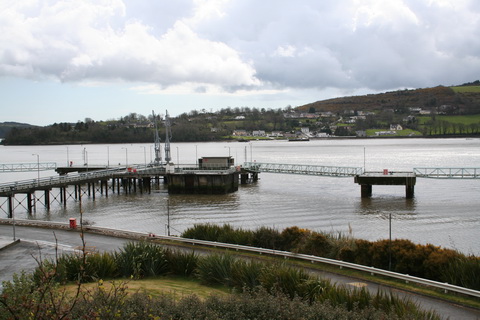
The Great Island power station on the Suir opposite Cheekpoint

The Irish Times says that Endesa had intended to change Great Island and Tarbert from diesel to natural gas. The Tarbert project received planning permission in December 2010; the Irish Times report was probably inaccurate in suggesting that a submarine cable from Tarbert would supply the ESB generating station at Moneypoint which, being a generating station, would be able to generate its own.
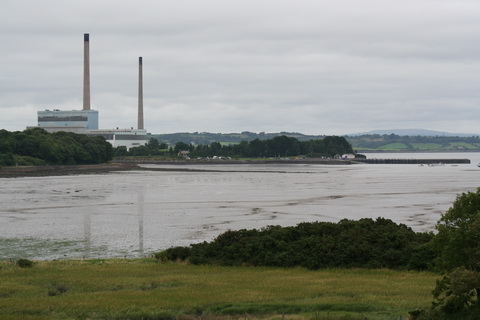
The old Tarbert power station

However, I had heard that Tarbert might have received its natural gas from the proposed storage plant at Ballylongford, near Saleen Pier whence Trinity College turf was sent to Limerick. A pipe from Tarbert might have supplied Moneypoint. I don’t think construction has yet begun.

The old Tarbert power station was built on the site of the Tarbert battery, the largest of the six Shannon estuary batteries and the only one to mount seven guns.