
Category Archives: Waterways management

For the record

The Limerick Leader article about a proposed Limerick river bus has some statements that do not accord with my understanding.

The venture will see the river bus depart Guinness Pier – across from Athlunkard Boat Club at O’Dwyer Bridge – every two hours, bound for the power station […].

As far as I know, the pier in question was the Ranks jetty and was not used by Messrs Guinness. The Eclipse Flower, and other vessels owned by Ranks and their predecessors, sailed up the Shannon from there rather than attempt the stretch from Baal’s Bridge to Custom House Quay.

The boat will follow the route taken by barges of old – both passenger and commercial – some of which historically transported Guinness to the city up until the mid-1960s.

“It is a tried and tested route,” said Mr Flynn, stressing the viability and safety of the route, which passes Long Pavement – the edges of which have been repaired and grassed over – and finishes at the hydro-electric plant.

“Every passenger and commercial barge that came to Limerick for 50 years used that stretch of water. It is very safe. It was navigated by all the barges,” he said.

The route to Limerick through Ardnacrusha came into use only after the construction of the power station in the 1920s and was used for a little over thirty years. To the best of my knowledge, there were no passenger services in those years: passenger carrying stopped in the first half of the nineteenth century, when traffic was still using the old Limerick Navigation. There have been some trip-boats in recent years, but they did not (and do not) use “barges of old”. Some old barges, now converted and with more powerful engines, have safely navigated that stretch, but they do it when conditions are right.

During the final phases of Ardnacrusha’s construction, both old and new navigations were closed; the Grand Canal Company (GCC), the main commercial carrying company, ran to Killaloe and had its cargoes carried onward by rail to Limerick. When the new route through Ardnacrusha was opened, the GCC thought it was so dangerous that it refused to use it for about a year. It resumed operations only when a boom was put across the river above Baal’s Bridge and posts were provided upstream of O’Dwyer Bridge to which barges could tie while waiting for suitable states of the tide.

I accept that the proposed river bus will not be going downstream as far as Baal’s Bridge, but it will still be navigating on a stretch of water where Waterways Ireland advises that boats should not navigate when more than one turbine is running at Ardnacrusha. The ESB can run up to four turbines, each of which is said to add a knot to the current, and it can switch them on immediately, with no warning to any boat using the river.

Other pages on this site make it clear that I share the promoters’ enthusiasm for Ardnacrusha and the canal and river thence to Limerick. I do not say that the difficulties of that stretch cannot be overcome, but I do not think that they should be dismissed.
 

That Limerick “river bus” …

… from the (presumably artificially created) photograph in the Limerick Leader seems to be the Cailín Turána, formerly part of the Aran Islands Fast Ferries fleet at Doolin and seen here out of the water at Cork Dockyard in 2004. The vessel has not been on the Dept of Transport’s List of Certified Passenger Ships since 2007 (and may have come off the list before that: I have not kept copies of the lists earlier than 2007). It could of course have been used in Ireland for purposes other than carrying fare-paying passengers, or outside Ireland for any purpose, after 2004.

And it may be that the vessel shown in the photo is not that which is to be used in Limerick.

Athy dry dock

I have been sent some photos of Athy dry dock and have added them to this page under the heading Grand Canal Barrow Line.

Portadown Foundry Ltd

I am grateful for a copy of Portadown Foundry Ltd: a history of the foundry 1844–1983, by Cardwell McClure and Wilson Steen, published by the authors in October 2012. It is available from five shops in the Edenderry (Portadown) area; the Edenderry Cultural and Historical Society may be able to assist.

The book’s breadth of coverage is very impressive. It may be thought of as having three main sections. The first provides five chapters covering the five main eras of control of the foundry. The second has four chapters covering employees, surviving artefacts, sporting history and Foundry Street, where many employees lived. The final section has six chapters providing the essential contest that is often omitted in local history books. These six chapters cover:

  • Portadown and the economy of Ulster
  • Foundry-built barges and lighters (of particular interest on this site)
  • The evolution of flax and linen processing in Ulster
  • The evolution of engineering in Ulster
  • The evolution of power plant in Ulster
  • The evolution of transport in Ulster.

It is richly illustrated throughout and is well worth a fiver (sterling) of anyone’s money.


Political parties: update

I said that I had asked many political parties whether they had asked the Department of Community, Equality and Gaeltacht Affairs [now the Department of Arts, Heritage and the Gaeltacht] for costings for the Clones Sheugh (aka the Ulster Canal). Those I asked were:

Christian Solidarity Party
Fianna Fáil
Fine Gael
Fís Nua
Green Party
Labour
People before Profit
Sinn Féin
Socialist Party
South Kerry Independent
Workers and Unemployed Action Group [WUAG]
Workers’ Party

I have so far had responses from Fís Nua, the Green Party and Labour; it seems that none of them made the request. I have emailed a reminder to the others and I await their responses.

What’s really going on

A useful post on the perils of relying on insider briefings when you want to find out about something (or at least to pretend that you know something about it).

A London pub and the history of the Shannon

Piloti’s “Nooks and Corners” column in the latest issue of Private Eye [No 1325] reports [brief extract available to non-subscribers here] that a London pub is threatened with demolition. On the Google satellite view with photos, press the button to the bottom right of the building to see a pic headed “Derelict pub”.

Piloti says that the pub was built in the 1840s [Diamond Geezer says 1839] and at that time the Marquis (or Marquess) was Henry Petty-Fitzmaurice, 3rd Marquess of Lansdowne, KG, PC, FRS. The family’s main base was in Britain but they owned large estates in Ireland, notably in Counties Limerick and Kerry; certain roads in Dublin are also named after the family.

The late Marquis has two claims on the attention of Irish waterways enthusiasts. First, the best-known of the early River Shannon steamers, the Lady Lansdowne, was named after his wife. Second, he was Lord President of the Council [the current holder of the post is Nick Clegg] when the government of Her Late Majesty Queen Victoria decided, in 1839, to spend about half a million pounds improving the Shannon Navigation.


WI & OSI

Ordnance Survey Ireland piece on Waterways Ireland’s use of OSI data.

Coill an Eo

Arklow Marine Services reports:

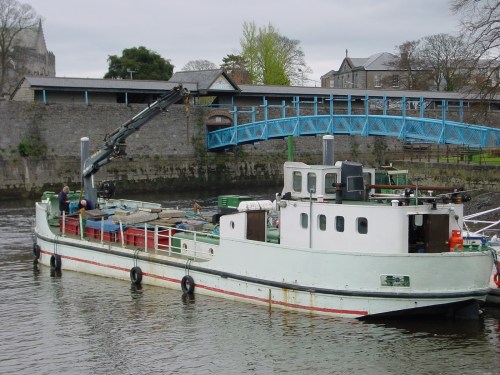
The “Coill an Eo” a 26 metre works barge, used in maintaining buoys and markers on the Shannon and owned by Waterways Ireland, has recently been docked in Rooskey, Co. Roscommon.

The first job the Yard had to do was carry out ultrasonic readings on the vessels hull, both internally and externally. A new main engine, tailshaft, propeller and bearings are to be fitted to the vessel and a complete electrical installation carried out.

Coill an Eo in Limerick in 2003

More photos of WI vessels here.

Pat Sweeney, in Liffey Ships and Shipbuilding Mercier Press, Cork 2010, says that Coill an Eo, launched in 1969, was the last vessel built on the Alexandra Basin slipways. He describes her as “a small grab hopper dredger” and says that the £40,000 cost was shared by the Commissioners of Public Works (then responsible for the Shannon) and Bord Fáilte.

Canal mooring rules

Waterways Ireland issued two press releases about moorings today. The first was the usual one about winter moorings on the Shannon and the SEW; the second was about the canals. Here, unedited, is the text of the second.

Canal Mooring Rules Coming into Force

Waterways Ireland announced in June 2012 that the Canal Bye-laws on the Grand & Royal Canal and Barrow Navigation are to be enforced from autumn 2012, with an accompanying change in the permit system allowing for year-long mooring permits and locations.

Part of bringing in this new location-based permit has been the identification of locations suitable for extended mooring. This process is now completed and work has begun in some areas to improve accessibility.

Waterways Ireland will roll out Extended Mooring Permit applications by area, rather than giving a date when applications for the permit will open. For boat owners this will mean that enforcement of the maximum stay rule will not commence in an area until after boat owners have had the opportunity to purchase an Extended Mooring Permit.

The initial 12 month Extended Mooring Permit will cost €152 and will only be available to boats already holding a valid annual Mooring and Passage Permit.

Boats that cruise and move (staying at a mooring for up to 5 days) will not be in breach of the Bye-laws or require an Extended Mooring Permit.

Waterways Ireland has proposed a small number of draft amendments to the current Bye-laws which date from 1988. These include proposals to provide a range of charges for mooring permits that reflect the location and services provided throughout the canals and also will take into account the size of boat. These proposals include low cost rural moorings on soft banks to ensure the canals are accessible for everyone who owns a boat and requires a mooring. Boat owners allocated an extended mooring location in key areas in villages or towns or with services should be aware that if the new Bye-laws are approved Waterways Ireland will increase the charges for moorings in the future to reflect the location, services, and size of boat.

Waterways Ireland recognises the current situation whereby a small number of boat owners use their boats as their sole or permanent residence. Proposals to make provision for this use of the navigation property have been included in the Bye-law changes.

Furthermore Waterways Ireland intends to work towards the provision of a small number of serviced house boat moorings on the canal network. Such provision will be subject to finance, land availability and compliance with requisite statutory approvals.

Waterways Ireland recognises that a transition period of a number of years will be required to implement this. In the interim these boat owners should apply for an Extended Mooring Permit.

The draft Bye Law amendments are currently being considered by Waterways Ireland’s sponsor Departments. When Waterways Ireland has Ministerial consent, it will proceed to public consultation on the proposed Bye-law amendments.

Waterways Ireland will continue to contact permit holders regularly to ensure they are kept up to date with the roll-out of the new permit. All queries about the enforcement of the current bye-laws or the Extended Mooring Permit should be directed to Shane Anderson, Assistant Inspector of Navigation: Tel no +353 (0)87 286 5726, Email shane.anderson@waterwaysireland.org . Queries about houseboats should be directed to Property & Legal Section Tel no +44 (0)28 6632 3004.

These changes are necessary steps to improve the management of the canals and waterway amenities for both the navigational and recreational user, so that investment in the new infrastructure and facilities which Waterways Ireland has undertaken is maximised for every user.