Tag Archives: Grand Canal

Skew arch bridges

The IHAI AGM at the weekend, in Newtownabbey Borough Council’s splendidly restored Mossley Mill,  included a tour of the premises and its museum. Then Professor Adrian Long of Queen’s University Belfast gave a short talk about the FlexiArch bridge, which his team have been developing since the 1990s.
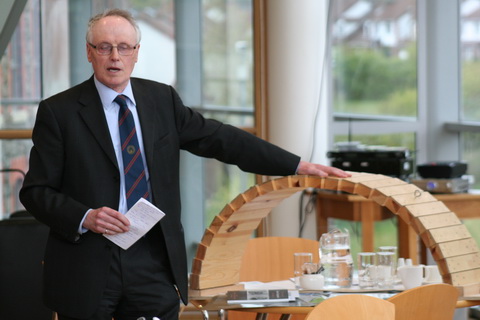
Professor Adrian Long with a wooden model of the FlexiArch bridge

He said that their work started by asking why nobody built arched bridges any more; they developed a system that used pre-cast voussoirs (the wedge-shaped blocks) linked by a polymeric flexible membrane. The voussoirs for any bridge are cast to give the correct taper for the span and rise required for that bridge.

Arch rings arrive on site stowed flat on the back of a truck; when they are lifted off, they fall into the correct shape and are lowered into position on previously-installed footings. Each arch ring is 1m wide; several of them can be placed side by side to give whatever width is required. The end walls are added and the structure is filled and given the appropriate surface (eg tarmac).

FlexiArch is manufactured by Macrete of Toomebridge (beside Lough Neagh); their website shows several examples of installation including one at a name familiar on Irish waterways. There is a brochure [PDF] and there is a video showing the installation of a 15-metre bridge.
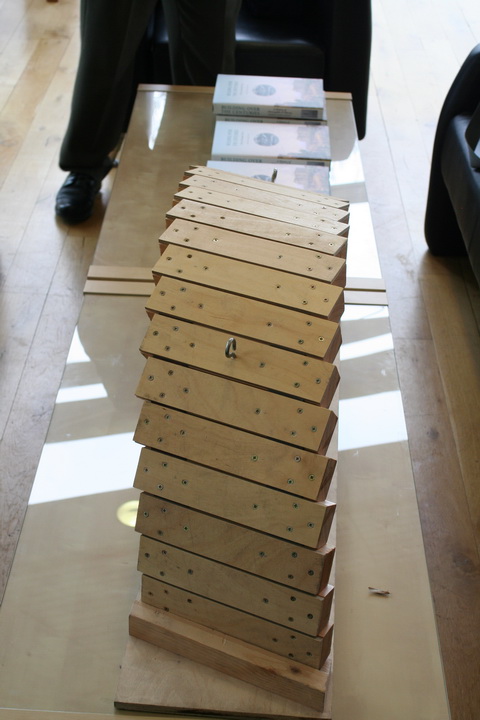
Wooden model as a skew arch

No, I haven’t any shares in it. I just thought it was interesting, for three reasons: first, the speed of construction is very impressive; second, there is a link to Lough Neagh; third, it might encourage the construction of more skew arch bridges over canals.
 

Dry docks

GRAND CANAL

At a Meeting of the Company of Undertakers of the Grand Canal, duly convened by public Advertisement, and held at the Company’s House in Dublin, on Monday, the 6th day of April, 1840,

WILLIAM MURPHY, Esq., in the chair,

The following Resolution, moved by James Pim, jun., Esq., seconded by James Dawson, Esq., passed unanimously in the afformative: —

Resolved — That the Court of Directors of this Company be authorised, if they shall see fit, to call the attention of the Government, of the Chamber of Commerce, of the Ballast Corporation, of the several Steam Companies, and of Capitalists generally, to the important advantages which the Grand Canal Company’s Floating and Graving Docks at Ringsend offer to all parties connected with the Shipping interests of the Port of Dublin, and to apprize them that this Company will at all times be ready to entertain any well considered proposition for increasing the general usefulness of these Docks, on the fairest and most liberal terms as regards the Public. Under the firm persuasion that by whatever well-arranged proceeding this important portion of the Company’s property can be best made available in increasing the Trade and promoting the prosperity of the City of Dublin, it will be rendered the most effectually conducive to the interests of the Company.

By order, JOHN McMULLEN,
Secretary of the Company.

From The Freeman’s Journal 8 April 1840.

Perhaps Waterways Ireland might follow the example of its predecessors and, rather than getting into bed with the DDDA, might consider some “well considered proposition for increasing the general usefulness of these Docks”.


Willie Leech and the Royal trade

I have uploaded an old article of mine based on an interview with Willie Leech of Killucan, whose father ran the last trading boats on the Royal Canal.

Mirabile dictu …

… it’s raining.

Grand water

Here is a page about the feeders that supplied water to the Grand Canal. There will soon be a page about the Royal Canal feeders; these will lead to an examination of the current and proposed supply of water to the Royal.

Kildare canal history

John W Freeman of Donadea, near Naas, Co Kildare, has very kindly sent me a copy of his third book, Reflections through a Parish Window, which he published in November 2010, and tells me that he is at work on his fourth book. As usual, his third has several items of waterways interest from the land between the canals: Donadea is south of the Royal and north of the Grand.

John gives special thanks to Essie Conroy of Lowtown (19th Lock), who died in September 2010. There is an article (p111 et seq) about her grandparents, Murt and Mary Murphy; Murt, originally from Ballycowan near Tullamore, died in 1922 aged 73. The Lowtown section also includes photos of a model flyboat, the wooden canal boat 104B (Maid of Erin, owned by Roches of Tullamore) and Essie Conroy with one of Ted Barrett’s boats at Lock 19. Her husband John Conroy is pictured on p123.

There is a photo of another wooden canal boat at Lowtown. It has the name Ocean Star written across its stern and what look like horizontal wooden slots on both sides of the rudder. The crew are named as William Connolly and his son Patrick, with Thomas Murphy (Essie Conroy’s father) standing on the bow holding a rope.

Other Grand Canal items include a photograph of 31M at Landenstown (p56)  and two photos of Robertstown, one undated (p120) and the other taken in 1895 (p116). There is a photo of the Royal at Kilcock (p64), perhaps taken in the 1980s, and a short article about the Royal with a photo of Lock 1 (pp137–8). There is even a photo of Guinness Liffey barges of, I think, the first fleet (p68).

Perhaps the most surprising item is a photograph from the Irish Press of 23 October 1947 with this caption:

Propeller-driven “water-bike”, built by motor and cycle mechanic Patrick Kennedy, of Corduff, Co Kildare, to contact his clients in their village homes along the Grand Canal. Comfortably seated on the kitchen chair “tandem seat” is Christie Brereton, Patrick’s assistant, enlivening the pair’s progress with his accordion. These mechanics say that they will perfect this style of transport for river and lake travel.

The photograph is a little blurred, but the two men can be seen clearly, with Patrick in front clasping the handlebars. The structure of the craft seems to include at least two 40-gallon drums but the steering and propulsion methods are not specified. If anyone has any more information about this craft, do please leave a Comment below.

All in all, a lot of very interesting material once again, and I am looking forward to John’s fourth book.


River and canal keepers

No, not Waterways Ireland, the soi-disant “guardian of Ireland’s inland navigations” (it says here), which is actually responsible for only seven of them on the island, whereof only six are actually navigable, what with nobody’s having noticed that it wasn’t raining, but the Irish Wildlife Trust, which is providing training for river and canal keepers, although I can’t find any mention of it on IWT’s own website.


Seamus McDonnell …

… is paddling from Maynooth on the Royal Canal to the Shannon, down the river (and across Lough Ree) to Shannon Harbour, eastward along the Grand Canal and then (in May, during the IWAI Dublin Rally) into Dublin, across the Liffey and back to Maynooth. He is raising money for the Irish Hospice Foundation.

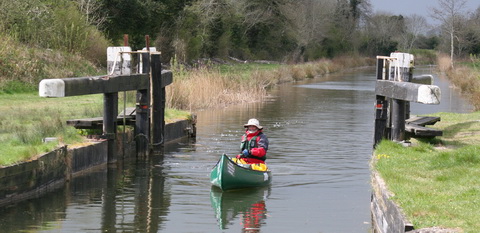
Here he is on Tuesday 3 April 2012 at the stop-lock near Edenderry on the Grand, heading towards Dublin.


You can donate to the Hospice Foundation here.

Lowtown

Statement from Lowtown Marine here.

Lowtown

Dáil Written answers Tuesday 27 March 2012

Department of Arts, Heritage and Gaeltacht Affairs: Harbours and Piers

Clare Daly (Dublin North, Socialist Party):

Question 350: To ask the Minister for Arts, Heritage and the Gaeltacht the steps he will take to prevent the eviction of residents by Waterways Ireland from Lowtown Marina near Naas, County Kildare; and if he will make a statement on the matter. [16675/12]

Jimmy Deenihan (Minister, Department of Arts, Heritage and the Gaeltacht; Kerry North-West Limerick, Fine Gael):

As the Deputy will appreciate, the issue referred to relates to operational day-to-day matters for Waterways Ireland (WI) and is one for which I have no direct responsibility. On foot of the Deputy’s Question, however, I have been informed by WI that for some time it has been endeavouring to regularise the ownership and lease arrangements at Lowtown Marina and that, following lengthy negotiations, it is in the process of recovering the property. WI advises that part of that recovery will be to restore the public right of way over the towpath and to remove any unauthorised developments attaching to the marina, especially those which present health and safety risks. I am advised also that certain remedial works are considered necessary, following inspections by WI’s safety advisor, and that these works require the removal of craft moored at the locations in question.

I understand from WI that affected persons living on board craft moored at Lowtown Marina have already been advised to contact WI’s Inspectorate in regard to alternative locations. I am informed that, ultimately, WI intends to re-develop the area in question and is presently examining possibilities for the site, including the installation of serviced berths for houseboats. Any such plans will, however, be contingent on available resources and planning permission.

Here’s a notable notice.