Tag Archives: green diesel

Still only two

For most people, I imagine, the high point of the week is the publication by the Revenue Commissioners of the updated list of those holding Marked Fuel Trader’s Licences [.xls rather than .xlsx this week]. Alas, although the list is now up to 178 pages, there are still (as far as I can see) only two licensed traders along the Shannon. None south of Killinure and no more IBRA members, unless my eyes deceive me.


Competition arrives

The number of Shannon-side operations holding Marked Fuel Traders’ Licences [XLS] has doubled since last week: Ciaran Fallon of Rooskey is joined by Quigley’s Marina at Killinure. Congratulations to Brian Quigley.

So there are now two licence-holders on the Shannon. Still no sign of IBRA members (save that Quigleys supplies Waveline) but no doubt they will appear soon.

E&OE: the list now covers 170 pages and I may have missed someone. If so, sorry; let me know and I’ll post the information.

IBRA and fuel supply

I asked IBRA about the absence of its members from Revenue’s list of holders of Marked Fuel Trader’s Licences. I was surprised by the absence as I believe IBRA members to be compliant with Revenue demands; for example, they (and I) are amongst the few making Mineral Oil Tax returns.

I am happy to say that IBRA members have registered for the new licence and are compliant with the requirements, but it seems that the Revenue lists are not up to date. That raises the possibility that other waterways-based traders have been omitted; if that is so, I would be glad to hear of them.

Fuel shortage continues

As far as I can see, from the new list published by Revenue today. there is still only one trader along the Shannon who is licensed to sell marked fuel (green diesel).

The diesel monopoly

I wrote here about the Revenue Commissioners’ new Marked Fuel Trader’s Licence. In brief, anyone selling marked fuel oil [green diesel] has to pay €250 to get a Marked Fuel Trader’s Licence and must also make monthly returns to Revenue of all “oil movements”. I thought, but I wasn’t sure, that this applied to marinas and others selling fuel for private pleasure navigation; as far as I could see at the time, none of those selling fuel along the Irish inland waterways had registered.

I have two pieces of news about that.

First, the Revenue Commissioners have confirmed that the new scheme does apply to sales of marked fuel for private pleasure navigation: in other words, those selling green diesel for boats along the inland waterways should all be registered under the scheme.

Second, I am happy to say that there is now at least one registered seller: Ciaran Fallon of Rooskey Craft & Tackle at Rooskey Quay. (There may be others that I haven’t spotted; you can check the latest list of Licensed Marked Fuel Traders here.) For the moment, then, Rooskey Craft & Tackle seems to have a monopoly of the legal supply of marked fuel on the Irish inland waterways.

Finally, on a somewhat related matter, here is the form [PDF] for making mineral oil tax returns for 2012. The numbers of returns received so far have been 38 in 2009, 41 in 2010 and 22 in 2011.

What’s it oil about?

What with all those nasty chaps [PDF] doing whatever it is they do to diesel, thereby cheating the citizenry and polluting the countryside, it seems that the Revenue Commissioners, whom god bless and preserve, came up with a new scheme last year that might be made to look like a solution. (The real solution, of course, is to abolish green diesel, charge everyone full whack, and — if you really must, although personally I think they get too much subsidy as it is — give farmers back some money to shut them up … for a while.)

The new scheme is outlined here. As far as I can make out (but IANAL), anyone selling marked fuel oil (which I guess would include marinas selling it for private pleasure navigation, the category I’m interested in) has to pay €250 to get a Marked Fuel Trader’s Licence.

Actually, I may be simplifying it unduly: first they have to apply to be allowed to apply.

If this Application is approved the National Excise Licence Office will issue you with an Application Notice to apply for the Licence.

If the marina counts as a “forecourt retailer”, it also has to make a monthly electronic return of “oil movements”.

These requirements came into effect on 1 October 2012 and the Revenue website provides a 147-page PDF list of licence-holders as at 31 December 2012. I’ve had a quick look for a few Shannon marinas; I found none of them, although I confess I haven’t read the whole thing.

I haven’t been to any of the seminars (although I’ve looked at some of the PDFs available on that page) and I haven’t contacted the official sources of information (although I have emailed the Revenue press office). I have read the FAQ, though. There is no reference to boats or marinas or private pleasure navigation, so I assume that the scheme does apply to marinas. As far as I can see (again, IANAL), all traders in marked fuel must have licences, even if they sell only small quantities. However, for those selling under 2000 litres per customer per month, there is a simpler monthly return:

However, if you supply less than 2,000 litres per month per customer, you only need to notify Revenue of the number of customers you supplied during the month as well as the aggregate quantity of fuel supplied.

That would cover most marinas, I imagine, although the ROM1 procedure still has to be used.

The first return, in respect of oil movements during January 2013, must be submitted by 25 February 2013.

So does this apply to marinas? I’ve asked Revenue but I don’t expect to hear for a few days. If it does apply, what will the effect be? Is the increased cost (time to compile the application and meet any Revenue demands; €250; whatever the ROM1 system costs) likely to be significant? How are the marinas (and other waterways fuel retailers) responding?

More budget

Here’s a fun bit from the bumpf pile about the Department of Arts, Heritage and the Gaeltacht, Waterways Ireland’s parent department in roI:

From the Expenditure Report 2013 Part 1

From the Expenditure Report 2013 Part 1

As last year, waterways exist only in the context of northsouthery, which itself is the lowest of DAHG’s priorities. The interesting thing is that DAHG is having its expenditure ceiling raised by €2.2 million, but it’s not going to waterways or even to northsouthery.

Culture for Angela

Culture for Angela

So we’re going to be forcing unfortunate EU leaders to sit through plays and such. But hold on: is there a staging of An Béal Bocht available?

At least the money is not going on the Ghastly Gathering.

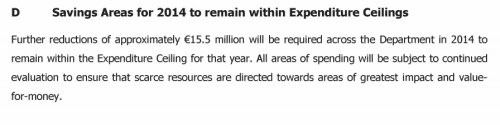
Anyway, there will be lots of unspecified savings to compensate, like these:

Sauve qui peut

Sauve qui peut

The two right-hand columns are headed Savings in 2013 and Full Year Savings.

And more to come:

Tomorrow, tomorrow ....

Tomorrow, tomorrow ….

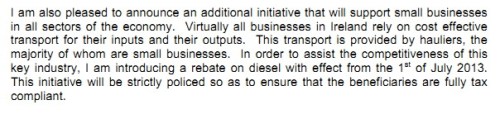
Finally, here’s a bit from the MinFin:

From Michael Noonan's Financial Statement

From Michael Noonan’s Financial Statement

Wouldn’t it be nice if he took the opportunity to abolish green diesel altogether as part of the scheme?

Tax-dodging boat-owners redivivus

In December I posted a piece suggesting that the amount of money received by the Revenue Commissioners in Mineral Oil Tax was far below what it should be. New readers may wish to know that, under an insane system introduced by the Irish government to give the impression of complying with a European Union ruling, owners of private pleasure-craft are allowed to buy cheap green (rebated) diesel (marked gas oil) but are supposed to pay to the Revenue the difference between the amount they paid at the pumps and the amount that would have been paid without the rebate. This difference is called Mineral Oil Tax.

Having discovered the total amount received by the Revenue, and deduced from that the number of litres on which the tax was paid, I wrote:

Let us suppose, for the sake of argument, that the average pleasure craft has a 40hp diesel engine (which is what my 1960s cruiser had). That would use two gallons or nine litres per hour. So the 313,748 litres of diesel on which Mineral Oil tax was paid [for the year 2010] would have kept one cruiser going for 34,861 hours.

On the other hand, if there are 10,000 pleasure craft in Ireland, with diesel engines averaging 40hp, then they are claiming to have cruised for an average of three and a half hours each in the whole of the year 2010.

I suspect therefore that there is significant underpayment of the Mineral Oil tax and I suggest that the system should be abolished: boat-owners should pay the full (auto diesel) price.

I later converted that post into a page, to give it more permanence. On that version, I added the suggestion that the inland hire fleet probably accounted for the vast majority of the diesel on which Mineral Oil Tax was paid. Note that the owner of a hire fleet would make a single return covering the entire fleet.

Some folk objected to my mentioning this matter at all; others suggested that I was wrong and that most boat-owners were undoubtedly law-abiding taxpayers. Accordingly, I asked the Revenue for the number of returns received in each of the two full years for which the scheme has operated. The response:

[…] the number of returns for 2009 (received in 2010) was 38 and for 2010 (received, near end of 2010 or in 2011), the figures was 41.

Most boat-owners have been dodging the tax. I rest my case.


Subsidising boat-owners

I wrote here about the method that the Revenue Commissioners employed to implement new rules on the rate of duty to be paid on diesel used for private pleasure navigation.

For reasons best known to themselves, Irish governments allow farmers to use cheap (“rebated”) diesel in their tractors, on the grounds that the tractors are for off-road use. And for many years boat-owners with diesel engines were allowed to use the same cheap diesel. The same arrangement applied in the UK and in Belgium. The diesel (“marked gas oil”) was coloured, latterly red in the UK and green in Ireland.

The EU decided some time ago that the rules should be standardised throughout Europe and that boats used for private pleasure navigation should not be allowed to use the subsidised fuel. The UK and Ireland sought and received successive derogations allowing them to delay the introduction, allegedly so that they could make appropriate arrangements. The governments did nothing about it. Accordingly, when the European Commission got fed up and told them there would be no more derogations, they had no plans ready and were faced by well-organised gangs of well-to-do boat-owners anxious to continue enjoying their subsidy.

The Irish authorities decided that boat-owners could continue to buy the marked gas oil, at the rebated rate, but that they would have to make a return to the Revenue Commissioners at the end of each year, showing how much diesel they had bought and how much Mineral Oil Tax they were paying to make up the difference. The December 2011 version of the document and forms is here (PDF). Mineral Oil Tax is intended to cover “the difference between the auto diesel and marked gas oil rates at the time of purchase of the oil”.

I asked the Revenue Commissioners how much they had taken in from boat-owners in 2009 and 2010. They said that they got  €169,895.51  in 2009 and  €140,929.12  in 2010.

For most of 2010, the rate of Mineral Oil Tax was  €449.18 per 1,000 litres  (it was slightly higher from 8 to 31 December 2010, a period when there would have been little pleasure-boating). That means that duty was paid on 313,748 litres of diesel.

So how effective is this system? On what proportion of sales for private pleasure navigation is the tax being collected? Revenue has no idea  and has no way of getting any idea because

Mineral Oil Tax on marked gas oil (MGO) is collected at the point of release for consumption from tax warehouse or upon importation to the State and, for the vast bulk of MGO, no information is available at that stage as to the ultimate destination or use of the oil, as most of it goes through a distribution network before it reaches the final consumer.

So let’s see if we can help to provide a rough estimate. According to the RNLI

A diesel engine burns about 1 gallon per hour for every 20hp. So a 90hp diesel would use about 90/20 = 4.5 gallons of fuel per hour. For those who prefer to work in litres then simply multiply the horsepower by 2 and then divide by 9. So a 90hp has an estimated consumption of 2 x 90/9 = 20l/hour.

Let us suppose, for the sake of argument, that the average pleasure craft has a 40hp diesel engine (which is what my 1960s cruiser had). That would use two gallons or nine litres per hour. So the  313,748 litres of diesel on which Mineral Oil tax was paid would have kept one cruiser going for 34,861 hours.

On the other hand, if there are 10,000 pleasure craft in Ireland, with diesel engines averaging 40hp, then they are claiming to have cruised for an average of three and a half hours each in the whole of the year 2010.

I suspect therefore that there is significant underpayment of the Mineral Oil tax and I suggest that the system should be abolished: boat-owners should pay the full (auto diesel) price.


Paying up

Text of email sent today to the Revenue Commissioners press office:

===begins=====

I would be grateful if you could tell me:

– how much marked gas oil was supplied to sellers of diesel fuel along Irish inland waterways in years ending 31 December 2009 and 2010

– what rates of duty applied in those periods

– how much duty was paid by owners of private pleasure craft for each of those years using form PPN1 Mineral Oil Tax Return.

===ends=====