
Tag Archives: Royal Canal

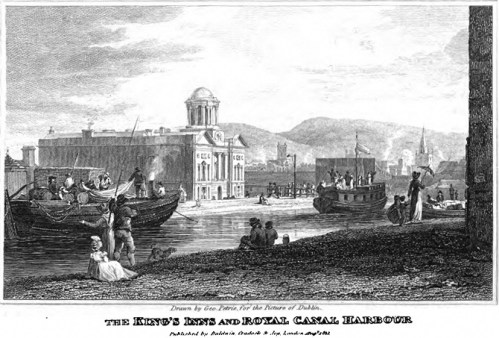
The Broadstone in 1821

The Broadstone Harbour with King’s Inns in the background, early 1820s

This is a drawing by George Petrie, made for J. J. McGregor’s New Picture of Dublin of 1821. The details of the vessels are interesting. More on the Broadstone here.

Canal mooring rules

Waterways Ireland issued two press releases about moorings today. The first was the usual one about winter moorings on the Shannon and the SEW; the second was about the canals. Here, unedited, is the text of the second.

Canal Mooring Rules Coming into Force

Waterways Ireland announced in June 2012 that the Canal Bye-laws on the Grand & Royal Canal and Barrow Navigation are to be enforced from autumn 2012, with an accompanying change in the permit system allowing for year-long mooring permits and locations.

Part of bringing in this new location-based permit has been the identification of locations suitable for extended mooring. This process is now completed and work has begun in some areas to improve accessibility.

Waterways Ireland will roll out Extended Mooring Permit applications by area, rather than giving a date when applications for the permit will open. For boat owners this will mean that enforcement of the maximum stay rule will not commence in an area until after boat owners have had the opportunity to purchase an Extended Mooring Permit.

The initial 12 month Extended Mooring Permit will cost €152 and will only be available to boats already holding a valid annual Mooring and Passage Permit.

Boats that cruise and move (staying at a mooring for up to 5 days) will not be in breach of the Bye-laws or require an Extended Mooring Permit.

Waterways Ireland has proposed a small number of draft amendments to the current Bye-laws which date from 1988. These include proposals to provide a range of charges for mooring permits that reflect the location and services provided throughout the canals and also will take into account the size of boat. These proposals include low cost rural moorings on soft banks to ensure the canals are accessible for everyone who owns a boat and requires a mooring. Boat owners allocated an extended mooring location in key areas in villages or towns or with services should be aware that if the new Bye-laws are approved Waterways Ireland will increase the charges for moorings in the future to reflect the location, services, and size of boat.

Waterways Ireland recognises the current situation whereby a small number of boat owners use their boats as their sole or permanent residence. Proposals to make provision for this use of the navigation property have been included in the Bye-law changes.

Furthermore Waterways Ireland intends to work towards the provision of a small number of serviced house boat moorings on the canal network. Such provision will be subject to finance, land availability and compliance with requisite statutory approvals.

Waterways Ireland recognises that a transition period of a number of years will be required to implement this. In the interim these boat owners should apply for an Extended Mooring Permit.

The draft Bye Law amendments are currently being considered by Waterways Ireland’s sponsor Departments. When Waterways Ireland has Ministerial consent, it will proceed to public consultation on the proposed Bye-law amendments.

Waterways Ireland will continue to contact permit holders regularly to ensure they are kept up to date with the roll-out of the new permit. All queries about the enforcement of the current bye-laws or the Extended Mooring Permit should be directed to Shane Anderson, Assistant Inspector of Navigation: Tel no +353 (0)87 286 5726, Email shane.anderson@waterwaysireland.org . Queries about houseboats should be directed to Property & Legal Section Tel no +44 (0)28 6632 3004.

These changes are necessary steps to improve the management of the canals and waterway amenities for both the navigational and recreational user, so that investment in the new infrastructure and facilities which Waterways Ireland has undertaken is maximised for every user.

Dublin’s canals in 1801

Grand Canal

The formation of canals was scarcely known in Ireland until the year 1765, when the Grand Canal was begun by a company of enterprising men, who were incorporated in 1772 by an act of parliament; boats began to ply to Sallins in 1783, to Athy in 1791; it is a cheap and pleasant mode of travelling, at the rate of 3½ miles an hour. This Canal is carrying on to Philipstown, Banagher, and Birr. From the first lock at Kilmainham, a cut has been made to the river Liffey at Rings-end, extending 3 miles, having 12 neat bridges to accommodate the different roads to Dublin. At the seventh lock on this line, the great basons and docks are, 4000 feet long, and 330 feet average breadth, capable of containing 400 sail of square-rigged vessels. On the 23rd of April 1796, it was opened at high tide; when his excellency Earl Camden in the Dorset yacht, commanded by Sir A. Schomberg, with a number of barges from the canal, cutters, and boats highly decorated, were admitted under a discharge of 21 pieces of cannon, and had room to sail in various directions. There were 60,000 people present; it was the best aquatic fête ever seen in this kingdom. John Macartney Esq addressed his Excellency, and was knighted.

Royal Canal

The Royal Canal is another proof of national spirit and national industry. The subscribers were incorporated in 1789; it is now finished beyond Kilcock, 14 miles, and is proceeding rapidly to Kinnegad. On Sunday the 20th of December 1795, the first excursion was made in a barge to Kilcock, with the Duke of Leinster and Marquis of Kildare, amidst the acclamations of the people.

J S Dodd, MD The Traveller’s Director through Ireland; being a topographical description not only of all the roads but of the several cities, towns, villages, parishes, cathedrals, churches, abbeys, castles, rivers, lakes, mountains, harbours, the seats of noblemen and gentlemen on those roads: their antiquities and present state respecting parliamentary representation, patronage, trade, manufactures. commerce, markets, fairs, distances from each other, and natural curiosities; with an account of their foundations, vicissitudes, battles, sieges, and other remarkable events that have occurred at them — insomuch, that this work comprehends in itself, an accurate Irish itinerary, an extensive Irish gazetteer, an Irish chronological remebrancer [sic], and an epitome of the ecclesiastical, civil, military and natural history of Ireland, from the earliest accounts to the present year, and every information necessary for the resident, or the stranger. Embellished with  two elegant maps; one of the roads and post towns in Ireland, the other of the city of Dublin, compiled from the most authentic authorities Dublin 1801

A use for the Royal

In an article on making use of the Royal Canal, I wrote:

[…] I am neither active in user groups nor a confidant of Waterways Ireland, so it is quite possible that folk have developed, or are developing, some plans to increase use of the Royal and Grand Canals (and the Barrow): plans that involve boats rather than, say, cyclists or walkers, who don’t actually need a functioning canal, just wayleaves and interesting artefacts to look at. I’d like to see such plans published on the Waterways Ireland website, but I haven’t found anything there.

But it seems that the cyclists may get in first. According to a report in today’s Irish Times [which may eventually disappear behind a paywall]:

Minister for Transport Leo Varadkar has instructed the National Roads Authority to examine possible routes for a cross-country cycle path from Dublin to Galway, similar to the award-winning Great Western Greenway in Co Mayo.

Mr Varadkar, who is also responsible for tourism and sport, said he wanted to secure funding for the project he predicted had the potential to bring in at least €15 million per annum. While a proposed route remained to be decided, the Royal Canal was an “obvious candidate” for the stretch outside Dublin from Mullingar to Maynooth, he said.

[…] Mr Varadkar said the proposed Galway-Dublin facility should be open to walkers as well as cyclists, like the Great Western Greenway.

Nothing wrong with any of that, of course. And perhaps walking and cycling routes could be developed in other ares, eg from Belturbet to Clones ….

Notice, by the way, that the news story mentions the National Roads Authority and the National Transport Authority. But which body is not mentioned?

Dry docks

Waterways Ireland has a new web page up about the conditions under which it will allow its dry docks to be used. The page includes links to a downloadable MS Word application form and a PDF. Anyone applying to use a dry dock must now submit:

  • a completed application form
  • a letter from an insurance company confirming that the owner has adequate insurance in place [sic] to bring vessel into a dry dock for works
  • a letter from the insurance company of any third party contractors to be employed confirming they have adequate insurance in place [sic] to carry out the proposed works
  • the relevant payment for number of days usage booked
  • a security deposit payment of €250
  • a shoring/propping certificate
  • a method statement of work to be carried out
  • a safety statement for work to be carried out.

In April 2012 I discussed the issues here.

My page about dry docks is here.

NSMC latest

The joint communiqué from the latest North-South Ministerial Council inland waterways sectoral meeting, held on 9 July 2012, is here as a web page and here as a PDF.

The exciting bits:

  • WI provided more moorings, sponsored 101 events, maintained the waterways [see below], published its restaurant guide and list of events and continued involvement with the Waterways Forward project
  • WI is developing its budget and business plan for 2012 [isn’t that a bit late?]
  • the NSMC “noted” WI’s annual report and draft accounts for 2011
  • the NSMC allowed WI to sell some stuff
  • WI has thought of some funding options for the Clones canal (but citizens can’t be told what they are). An “inter-agency group”, “set up to examine all possible options to advance the project”, will meet in July; the options “will be explored taking account of fiscal constraints”, although it’s not clear whether the unfortunate members of the “inter-agency group” will do the exploring or whether some more authoritative body, like the Troika, will make the decisions. But as the canal is said to be such a good investment, it may be that a public-private partnership will develop it under the Irish government’s €2 billion stimulus package.

The waterways maintenance part includes the claim that “97.5% of waterways remain[ed] open during the months of April and May”. That depends on how you measure things, though. The summit level of the Royal Canal was closed for almost the whole of that two-month period, so the canal (one seventh, about 14%, of WI’s waterways) was impassable throughout.


But the dog did nothing in the night-time

The recent water shortages on the Royal Canal had me seeking information. I turned, of course, to the website of the Royal Canal Amenity Group but found it completely useless: it appeared to be entirely ignorant of the closure of the summit level of the Royal Canal.

I have visited the website for another look. The promised PDFs of the RCAG newsletter are not there. There is a link to a Facebook page that cannot be found, although the Flickr link does work.

The Events page lists events for 2011, with nothing for 2012. The History section stops before restoration was completed. Fifteen branches are listed but there are no links to any branch pages.

No branch is listed at Abbeyshrule, but I found what appears to be a separate body called Abbeyshrule Canal Group, which has a Facebook page that is updated fairly frequently.

So where is RCAG? And what is it doing to communicate with the general public — and with its non-local members?


Mullingar

The Met Éireann report [PDF] for spring (March to May) 2012 shows that rainfall measured at its Mullingar station was only 59% of the average for 1981–2010.

Towpath: legal case about access

The Irish Times has a report here.

Royal water: oral hearing

Irish Times report on the oral hearing into the proposed abstraction of water from Lough Ennell. The hearing is scheduled for three days at the Mullingar Park Hotel and a decision is expected by 11 June 2012. The two cases are being heard together:

PW3005: Ladestown, Mullingar, Co. Westmeath.
Case Type: Provisional Order Water Supplies Act (Board Reference: PL25 .PW3005)
Description: Taking of a Supply of Water from Lough Ennell to Supply the Royal Canal.

and

JA0030: Kilpatrick Bridge and Clonsingle, County Westmeath.
Case Type: LA Non-Road development – Application (Board Reference: PL25 .JA0030)
Description: Royal Canal Water Supply Scheme from Lough Ennell, Ladestown.