Tag Archives: Waterways Ireland

Dublin saunter

I’ve made some changes to my pages about (parts of) the waterways in Dublin. Essentially, I’ve suggested a walking route that would take you:

  • from Connolly Station to Newcomen Bridge and Lock 1 on the Royal Canal, then up the Royal as far as Lock 5 (with possibilities for refreshment)
  • back a bit to the junction with the abandoned Broadstone Line, then down that line to Constitution Hill
  • from there to the Liffey quays, with some thoughts on the Guinness Liffey barges, then up Steevens Lane and James’s Street to Echlin Street and the filled-in Grand Canal Harbour
  • around the harbour before ending in the Guinness Storehouse.

More information here or go directly to this page.

Big it up for Waterways Ireland

Waterways Ireland and the National Trails Office have come together to develop a technical specification, including code of practice and risk assessment for canoe and small vessel trails in Ireland.

The National Trails Office started work on the classification of water based trails in its publication,”Classification and grading of recreational trails.” The purpose of this tender is to develop this process further and produce a technical specification, including a code of practice and risk assessment for the future development of canoe and other small water vessel trails on the rivers and waterways of Ireland.

Tender notice on the eTenders Public Procurement website here, but you may need to be registered to get the bumpy.

This is a Jolly Good Idea and much to be encouraged. There are some suggestions for possible trails (mostly not on WI waters) on this site.

WI and residential boaters

Here is an opinion piece about Waterways Ireland’s letter to the residential boaters (live-aboards) at Sallins on the Grand Canal.

Ulster Canal to lead to united Ireland, says French blogger

Google’s translation:

A great work that does not really captivates crowds in Ireland, unfortunately, apart from a few enthusiasts navigation, and it is a pity because the symbolic significance of these waterways, crisscrossing the island as a vector of unity, has not escaped the Dublin government has unblocked 35 million euros in 2007 to renovate the Ulster Canal, a waterway linking artery, once renovated, Belfast to Limerick (277 km apart for motorists).

More in French here.

Can it be that Craggy Island wants the Ulster Canal as a “vector of unity” rather than as a contribution to the economic development of Clones? Or that the Ulster Canal is (comme on dit) a Fenian plot? Surely not!

Goodbye Craggy Island?

RTE is reporting that the Department of Community, Equality and Gaeltacht Affairs may be broken up. Oh dear.

But no doubt its elements will continue the fight to build the Clones canal.

WI’s Lakelands and Inland Waterways Strategy

Some thoughts here. Overall conclusion: must try harder. Why no mention of the Royal Canal? Why nothing about industrial, transport or waterways heritage?


Consultancy fee? No, it’s OK, thanks ….

How A N Other and I saved the Irish waterways … or at least suggested how Waterways Ireland should approach British narrowboaters.

Contractors

L & M Keating, contractors, are currently working on Portumna Bridge, Killaloe flood gates and Shannon Harbour houseboat moorings. Some info and pics here, with links to info on some projects.

RVRC

It is necessary to draw public attention to a lamentable case of discrimination in Irish public policy and to announce the formation of a group to combat that discrimination and to ensure equal treatment for all.

Suppose you like travelling around Ireland in a white plastic whatsit. You need places to park, preferably free, with something nice to look at. You need services like toilets, showers, water and rubbish bins. You like to park close to fellow travellers and to meet them, perhaps for a barbie and some beer.

Your whatsit is well equipped with television and other entertainment; indeed the general standard of furnishing and equipment is very high. You can even carry toys — perhaps a dinghy and some bicycles — around with you, for some fresh air and exercise when you’ve reached a suitable place.

If your white plastic whatsit floats in water, you have the services of a cross-border implementation body, Waterways Ireland, spending millions (and charging practically nothing) on your leisure activities. You have government departments north and south looking after you, with the southern department keen to spend money borrowed from Germany on providing you with more places to go. And you have all sorts of other free services, like Coastguard and lifeboats, to help you out.
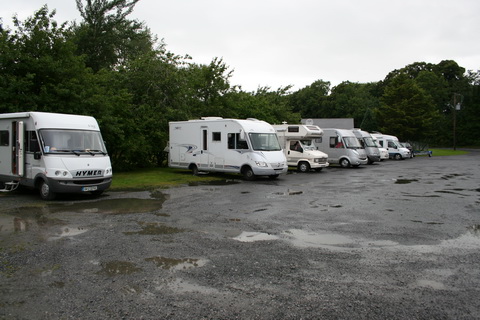
White plastic whatsits at Portumna Castle Harbour

If your white plastic whatsit has wheels, though, you are a pariah. You have no cross-border boy, no government departments, no free services, although your needs are the same as those of your boating brethren.

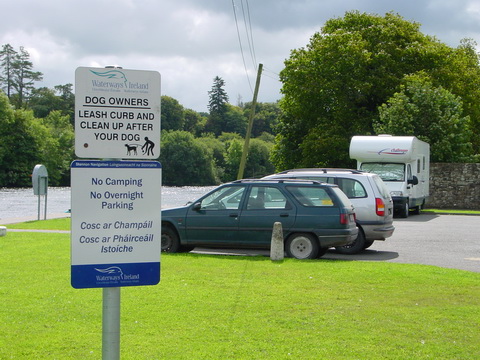
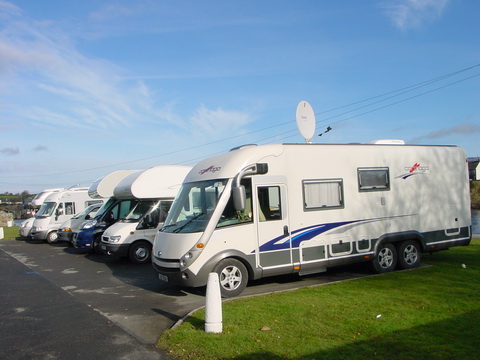
So owners of RVs (recreational vehicles, camper-vans, what you will) are forced to sneak in to Waterways Ireland harbours and to park inconspicuously along the edges. The best place to park is usually indicated by a sign.

Sign showing where to park at Killaloe

Parked beside Killaloe market

RVRC, the Recreational Vehicle Rights Campaign, seeks an end to this discrimination. We seek the provision of free facilities for camper-vans. We want a cross-border body of our own, RVways Ireland.

We have adopted Dana Lyons’s song RV as our anthem; you can listen to it free here (and while you’re at it see the animations of his best-known song here).

The Clones Canal

And this brings us, by a commodius vicus of recirculation, to Clones and the Craggy Island Canal. Boaters may like to see themselves as hardy mariners, sons of the sea who happen to be confined to inland waters, but economically they’re very similar to RVers. Many of them are older couples but some travel with children. They like going for weekends away; they need certain facilities; they don’t use hotels, B&Bs or other accommodation. They have enough equipment and supplies to prepare their own meals, but they do some shopping and may go to the pub or have a meal out.

As potential bringers of wealth, RVers have some advantages over boaters. You don’t have to spend €35 million to get them to your town; they are more mobile, so they’re not confined to a single site in the town; they can even park some distance outside and still get to the shops, pubs and restaurants. And RVers are hardy souls: in late February 2011 there was not a single boat in Portumna Castle Harbour but there were four RVs.
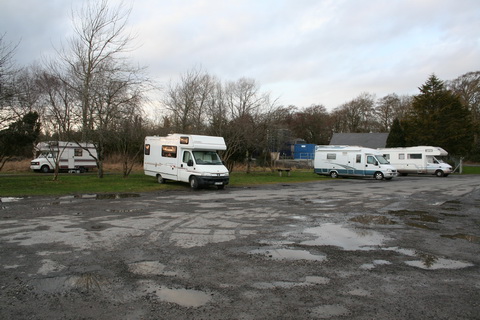
RVs in Portumna in February

So, given that Clones is an attractive destination, why is the Regeneration Partnership not now trying to attract camper-vans (and indeed campers and caravanners)? According to Discover Ireland, there is no caravan or camping site in Co Monaghan (although there could be sites whereof Discover Ireland is ignorant).

There are two points to this query. The first is that Clones could be doing something now to attract visitors, without waiting for Craggy Island to come up with €35 million. The second is that (assuming the blasted thing is ever built), after the excitement of having a canal dies down, Clones will have to do things to attract visitors. So why not start now?

The missing canal at Abbeyleix

The Lakelands & Inland Waterways Strategic Plan 2010–2015, downloadable from the Waterways Ireland website, has an Appendix II headed “Infrastructure Investment Lakelands and Inland Waterways Area – Land and Waterbased” and a subheading “(1) LAND BASED INFRASTRUCTURE”. This has three columns:

  • Project Name
  • County
  • Cost.

An earlier note, on page 2, said:

For details of infrastructure support in the Lakelands & Inland Waterways area  See Appendix II.

That’s on a page headed “Achievements to Date” and with the introductory line “Key successes of the initiative up to the end of 2009 have included:”. We can assume, therefore, that the amounts listed in Appendix II are amounts that have already been spent, in some unspecified period ending in 2009. There is no measure of what was achieved.

Anyway, I was intrigued by the inclusion of these items for County Laois (Queen’s County):

  • Signposting Project for the Slieve Bloom Mountains – Laois/Offaly: Co. Laois/Co. Offaly: € 93,750
  • Abbeyleix HeritageTown Co. Laois € 42,315

I can see the justification for including a range of mountains amongst the lakelands and inland waterways, because the River Barrow rises in the Slieve Bloom Mountains. Admittedly it is not, at that point, generally considered to be navigable, but let us not strain at gnats.

But why is Abbeyleix included? What canal served it and where has it gone?

Whaddya mean, it’s in the constituency of Laois-Offaly? What could that have to do with it?