Category Archives: Ashore

Interesting information about the Ulster Canal …

… as distinct from ministerial reelection photo opportunities.

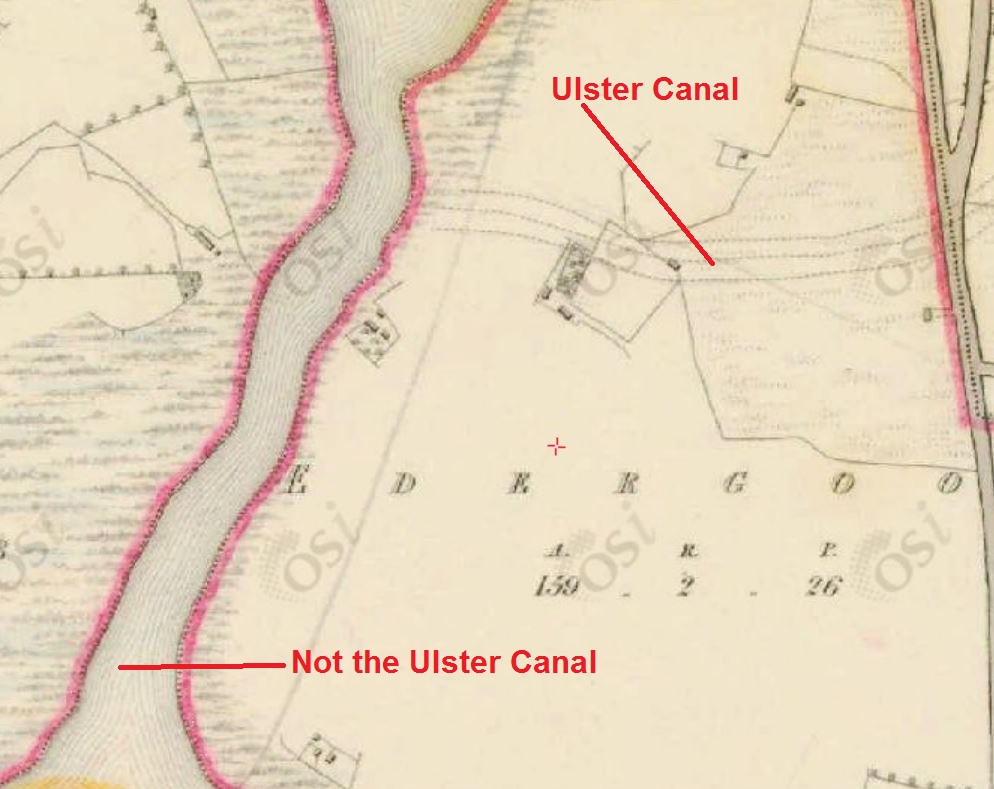
By the way, some folk get confused about the location of the Ulster Canal; this map may help:

Saunderson's Sheugh -v- the Ulster Canal (OSI ~1840)

Saunderson’s Sheugh -v- the Ulster Canal (OSI ~1840)

Anyway, for folk who are interested in weightier matters than ministers talking through portions of their anatomies that they can’t distinguish from their elbows, here is some speculation about opening bridges on the Ulster Canal.

That’s the Ulster Canal Ulster Canal, not the Saunderson’s Sheugh “Ulster Canal”, by the way.

My OSI logo and permit number for website


The industrial heritage of Mullingar …

in song.

Mick the Coach

A familiar face in unfamiliar surroundings ….

For railway enthusiasts

The economics of the current Irish railway system have received insufficient attention. If they had, the entire system (with the possible exception of some commuter lines) would have been closed down years ago and we wouldn’t have the current mad proposal to reopen the railway line to Foynes [h/t COM] at the same time as a road improvement scheme is being studied.

Happily, however, the railways of the neighbouring island have recently been the subject of considerable attention. Duncan Weldon considers here the “economic, financial and business questions raised” by the railway systems of the island of Sodor, concluding:

Economists do not fully understand the long term drivers of productivity growth. But the lesson of Sodor is this: over investing in a technologically backward, sheltered and protected from competition railway is not the road to prosperity.

And yet despite stagnant living standards the people/engines of Sodor appear content. Indeed it is unclear if they get paid at all — instead they seek meaning and joy in a Stakhanovite desire to be “really useful engines”. The great trick of Sir Toppham is employ engines who essentially evoke the image of the New Soviet man in the service of a proto-capitalist, semi-feudal enterprise.

Responding, James Kwak said:

Sodor Railways seems to be the epitome of a fat, dumb, and happy company. Labor is incompetent, yet management does nothing about it, and in return labor is eternally loyal to management. Who loses? Customers and shareholders.

However, Dan Davies offers a different perspective here. But Tracy Van Slyke has spotted other issues. I wonder whether any university offers courses in TtTE Studies.

But back to Foynes. I see that Councillor Emmett O’Brien believes that

[…] the tourism potential of this line could be explored with the possibility of steam train tourism linking Adare to Askeaton and Foynes.

The appropriate information is here.

Ballygalane on the Blackwater

Lismore Canal lock 28_resize

The Lismore Canal lock

The only lock on the Lismore Canal is at Ballygalane, on the River Blackwater. Here is a new page about the canal, with photos of some of its important features.

Waterside Belturbet

Here is a small amount of information about Belturbet and some of its industrial heritage. The photos were taken on a brief visit in July 2011.

Was the Brickey a navigation?

The Brickey is a small river that flows into Dungarvan Bay. Small boats used its lower, tidal reaches, but in the eighteenth century there was a proposal to link the Brickey to the Finisk, another small river that flows into the Blackwater south of Cappoquin.

Waterford County Museum, and others, believe that work began on that project in the mid nineteenth century and that a driveable track along the south bank of a stretch of the river was built as a towpath.

I have visited the river and looked online for further information; my conclusions (with maps and photographs) are here. However, I would welcome further information.

Grand Canal Greenway

Ewan Duffy reports on damage here.

“Rural Ireland no longer exists”

Sensible comments here from a knowledgeable chap, who provides a link to this piece too.

Limerick flooded again

The waves covered the quays in some places to a depth of three and four feet, and rolled in to the adjoining streets with resistless fury. Shannon-street, Charlotte’s Quay, and the Mall were completely inundated, and in the corn stores on Honan’s-quay, Harvey’s quay, &c, the water reached a height of four feet in some instances.

I already had a page about the floods in Limerick in November 2009; here is an account of the floods in Limerick in 1850.