Category Archives: Ashore

A load of old bollards

Our London Correspondent reports that the latest and most fashionable souvenir to go on sale there is a reproduction cast-iron “paperweight/doorstop/bookend based on the mooring bollards of Regents Canal”. Available in black or fluorescent red, these items were designed by a designer who was being worked with by another chap who was commissioned by a Creative Agency. The result is a “desirable antidote to the overly-commercial, tacky souvenirs” available elsewhere, it says here.
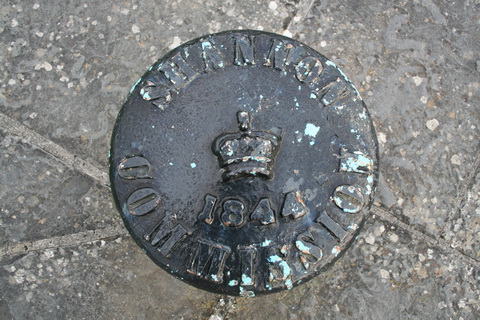
Shannon Commission bollard 1844_resize

A bollard at Meelick

Well, that’s nice. Maybe Waterways Ireland could commission the same creative types to design a range of reproductions of Irish waterways bollards; folk could be encouraged to collect the entire set.

But one minor drawback does strike me. The artistic merits of these reproduction bollards are of course obvious, but as souvenirs they have one minor drawback. A souvenir is something you buy, while on holiday, to take home to someone else. Nowadays, the steamer services are not what they once were and many folk travel on these new-fangled flying-machines. But according to that nice Mr O’Leary, who operates some such machines, you may take only 10 kg of cabin baggage. These bollards, though, weigh about 1.5 kg each, which rather limits the number of bollards you can carry as souvenirs.

Canal boat sunk on the Liffey

In a comment here I wondered what a canal boat was doing as far up the Liffey as Grattan Bridge in 1873. Here is a report from the Freeman’s Journal of 10 March 1875 that may provide a possible explanation.

THE LATE WRECK IN THE RIVER LIFFEY:— The porter-laden canal boat which was swamped on Monday by being borne by the flood in the river against the southern abutments, at the western side of Grattan-bridge, still remains in the place where she sank. Though she came with great force against the structure, she did not inflict the slightest injury upon it. Measures will be at once taken for floating the sunken vessel, which does not in any way interfere with the river traffic, as the centre arches are quite clear. All the porter which was on board the canal boat when she went down has been secured.

Remember that Guinness built its wharf on the Liffey in 1873 but did not start building its own fleet of barges for the Liffey until 1877. It did, however, have “a few small tugs” that were used to draw laden boats.

Guinness had easy access to the Grand Canal Harbour at James’s Street, so it seems unlikely to me that Grand Canal boats would risk the Liffey passage to supply pubs along the Grand, the Barrow and the lower Shannon. It therefore seems more likely that the boats were either Royal Canal boats or were being used to supply ships in the port.

Newcomen Bridge again

Last month I wrote about the lock at Newcomen Bridge on the Royal Canal:

Industrial Heritage Ireland has created a page giving the history of the railway crossing at Newcomen Bridge. However, it would be nice to have some documentary evidence about the resiting of the lock — and about the headroom under the bridge before the lock was moved.

Here it is, from the Freeman’s Journal of 12 April 1873, in an article about the new Spencer Docks:

Above the new metal bridge there is a basin for Canal boats, with a quayage of 450 feet at either side and a depth of six feet. In connection with the new works, the lowering of Newcomen-bridge on the Clontarf-road must be alluded to. To effect this the old lock had to be moved higher up, and the old bridge replaced by one suited for the requirements of the tramway traffic. The arch of the bridge crossing the Canal was lowered five feet, and a new girder iron bridge crosses the railway at the same level. The Main Drainage Board wisely took advantage of the opportunity of the Canal being drained to make a main sewer under the canal and the railway above Newcomen-bridge at the low level required.

Happy, Mick?

Clever chaps …

those Danes and Belfast folk at Harland and Wolff (which is on the Lagan, so this is of inland waterways interest).

More Northern Ireland engineering ingenuity here.

Kerry nitwits

See the Irish Times and the Guardian.

Download your copy of Kerry County Council’s road safety calendar here [PDF].

Not that this piece of idiocy will ever be passed but, if it is, tourists should avoid Co Kerry, lest they be mangled by a Kerry farmer, pissed as a newt, wobbling around the roads in his tractor.

What qualities — apart from being a publican — do you need to be elected in Co Kerry?


L+M Keating again

Here are some photos of recent L+M Keating projects.

Rescue boats on Irish inland waterways

I’ve moved my photos of rescue boats to a new page and added photos of some more services. Still a lot missing, though.

Dublin

Dublin City Public Libraries have some nice photos available online. The section on the Port of Dublin includes 1926 aerial photos of the Guinness wharf and of Spencer Dock (not busy) and Grand Canal Dock (including the section beyond the railway line, now filled in). There is also a photo of a steam barge at the Guinness wharf. In the Commercial Dublin section, I saw two businesses beside the Grand Canal, Ever Ready Batteries at Portobello and Gordon’s Fuels at Harold’s Cross.

One for the Phizzers

Quite a few visitors to this site come to read about the Broadstone. Here is a piece about the pontoon bridge used at the Broadstone between (AFAIK) 1847 and 1877. It was designed by Robert Mallet and it is interesting to see how an inventive engineer solved the peculiar problems of the Broadstone site.

For anoraks

I have added a few more photos at the bottom of this page of pics of Waterways Ireland vehicles.