
Where is it?
Where is it?
Here is an account of the background to, and the main features of, the proposed supply of water from Lough Ennell to the summit level of the Royal Canal. It does not discuss the amounts of water involved; I intend to cover that on a separate page.
Posted in Ashore, Built heritage, Drainage, Economic activities, Engineering and construction, Extant waterways, Industrial heritage, Ireland, Natural heritage, Operations, Politics, Restoration and rebuilding, Scenery, Sources, Tourism, waterways, Waterways management, Weather
Tagged abstraction, An Bord Pleanála, anglers, boats, canal, Dublin, floods, flow, Ireland, Lilliput, lock, Lough Ennell, Lough Owel, mills, Operations, Royal Canal, Shannon, summit level, trout, water level, water supply, waterways, Waterways Ireland, weir
I mentioned the other day that extensive searches of tinterweb had failed to find any data on the heights of overhead power lines above the Shannon and that I had been forced to resort to the telephone.
I am pleased to report that the ESB expert duly rang me back today, and further pleased to report that he had himself measured the height of every cable over the Shannon. Oh joy, oh happiness, I thought. But not for long.
The ESB, it seems, does not reveal the actual height of power lines above the water. This, if I understood the reasoning correctly, is because the water level varies and a boat-owner might not understand that, hit a line with a mast and then sue the ESB [where “ESB” means “electricity transmission or distribution operation”]. I have been told that a boat-owner in coastal water did just that (presumably between the mainland and an island) and that the lawyers have advised ESB to take no further risk; I would welcome information about the incident.
So, if you want to find the height of a power line, you’ll need to polish up your trigonometry (and then relate the height to Ordinary Summer Level). But the ESB does supply the information to one organisation that makes charts: the United Kingdom Hydrographic Office. That’s OK for coastal charts, but the UKHO (to the best of my knowledge) has not surveyed the inland Shannon since 1839, and I don’t think its inland charts have been updated since then. It is possible, of course, that the UKHO supplies the data to other (electronic or paper) chart-makers; I have emailed them to ask.
The quest continues again. More info when I get it.
Posted in Ashore, Built heritage, Economic activities, Engineering and construction, Extant waterways, Industrial heritage, Ireland, Irish inland waterways vessels, Operations, Politics, Shannon, shannon estuary, Sources, waterways, Waterways management
Tagged boats, clearance, ESB, height, Ireland, Lough Derg, Operations, OSL, overhead power line, Shannon, transmission, vessels, water level, waterways
Went out without the camera today, alas, and found Waterways Ireland crews at work at the canal harbour in Limerick. One crew had launched a Pioner Multi (I didn’t see them do it, alas, but it may have come on the back of a truck with a HIAB or suchlike) and were hauling rubbish out of the water. Another were welding new railings to prevent access to the old hotel/canal manager’s house and installing a steel plate in a window aperture on one of the Shannon Navigation buildings.
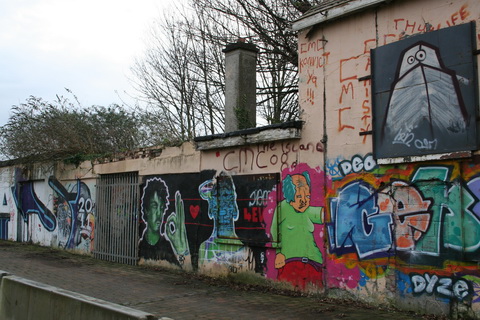
I presume the new plate will soon be decorated. I rather like the artwork, I must say, and I think it a pity that Young Folk should not have somewhere to go to do the things that Young Folk like to do.
Posted in Ashore, Built heritage, Charles Wye Williams, Economic activities, Engineering and construction, Forgotten navigations, Industrial heritage, Ireland, Non-waterway, Operations, Scenery, Shannon, waterways, Waterways management
Tagged harbour, Limerick, lock, Operations, Park Canal, Shannon, Waterways Ireland, workboat
Posted in Ashore, Built heritage, Drainage, Economic activities, Engineering and construction, Forgotten navigations, Industrial heritage, Ireland, Operations, People, Politics, Sources, The turf trade, waterways, Waterways management
Tagged boats, bridge, canal, harbour, Ireland, Lough Key, Rockingham, Shannon, vessels, waterways, workboat
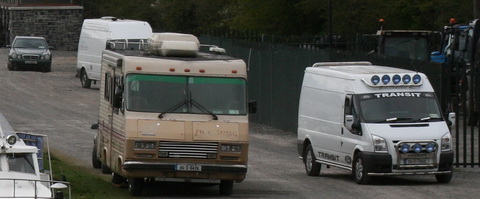
Look! There behind the camper van: it’s a white Waterways Ireland van.
Here’s a rear view.
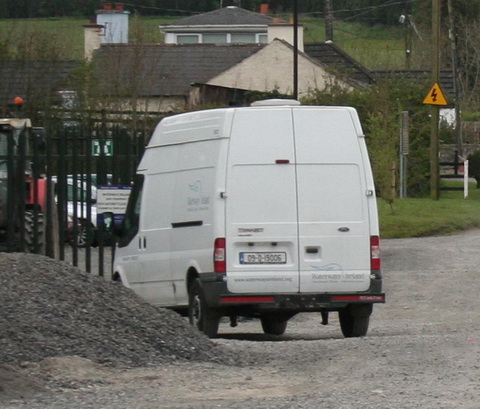
What can this mean? Is it a stealth van? A dancing van? A kinky van? Or is Waterways Ireland changing its corporate image, away from the standard blue vans? Does someone in WI want to be a White Van Man? Or is it because the van is based in Kildare? Why is there a white van in the WI fleet?
Enquiring minds want to know.
So you’re out in your sailing-boat, heading for Portumna, and you see that there’s an electricity cable crossing the waterway ahead of you, just downstream of the bridge. You think you’ll fit under it but it would be nice to know the clearance ….
Electricity is ESB, isn’t it? Well, perhaps not: it could be ESB Networks, which seems to mean distribution, or EirGrid, which means transmission. It could also be one of the other companies that sells volts, but I don’t think they run big wires.
Half an hour of searching the websites of the three bodies failed to produce anything about the heights of pylons or cables or overhead powerlines. Safety advice said not to go near them, but that’s what you are trying to do: it would help to know how near is near. Another half an hour of general googling; still no result.
So, as it’s a smallish line on wooden poles, rather than a large one on very tall steel pylons, you guess that it might be distribution rather than transmission, and thus ESB Networks rather than EirGrid.
I rang; someone will ring back within 48 working hours. The quest continues ….
What is the magic combination of search terms that will find the heights above water of all power lines over Irish waterways?
Posted in Ashore, Economic activities, Engineering and construction, Extant waterways, Ireland, Operations, Shannon, Sources, waterways
Tagged boats, distribution, ESB, Ireland, Lough Derg, mast, Operations, power line, Shannon, transmission, waterways, yacht
The heading shows I’m trying hard to find a waterways link for this ….
If you’re anywhere near Belfast, visit Patterson’s Spade Mill near Templepatrick on the Antrim Road. The IHAI visited it after the April 2012 AGM and it was quite fascinating. Did you know that there were once 171 different types of spades in use in Ireland, catering for different uses and different types of soils?
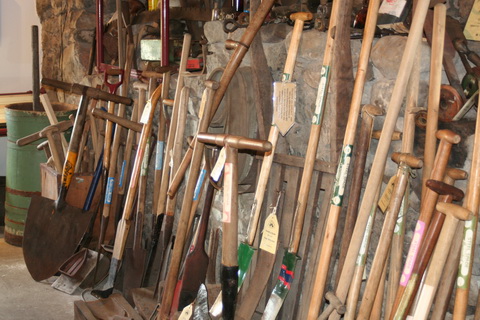
Some of the many types of old spades on display
The mill is powered by water, using a turbine, and it’s the last water-driven spade mill in These Islands:
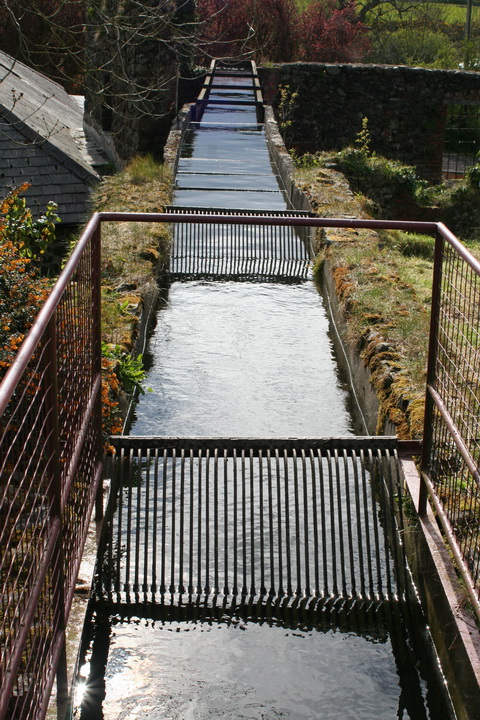
The channel taking water from the stream to the turbine. Part of the channel runs in a trough made by Portadown Foundry
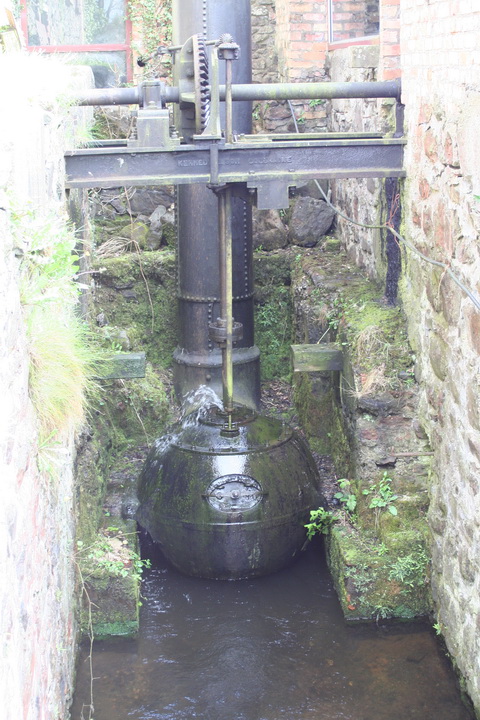
The turbine
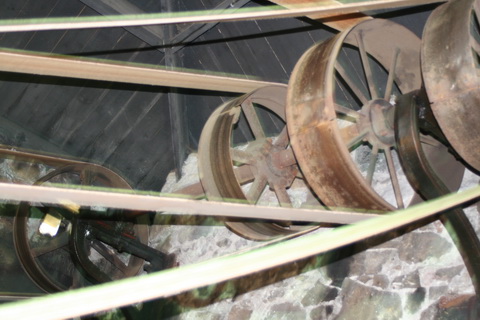
The turbine turns a shaft, which turns these wheels, and the belts power many of the machines in the mill
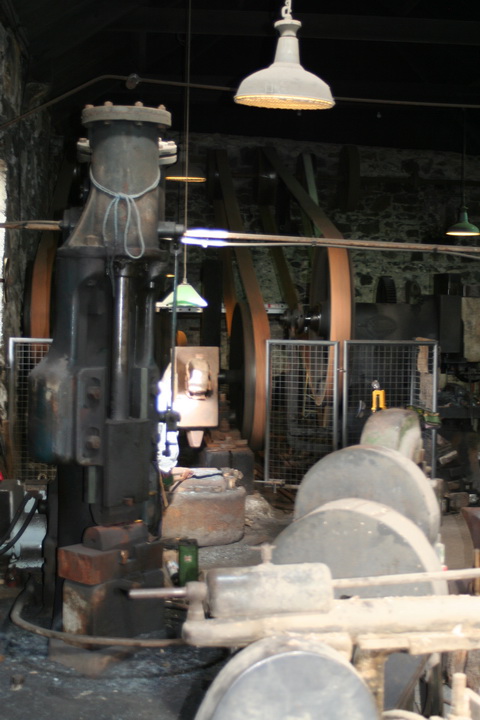
The water-powered trip-hammer towards the back
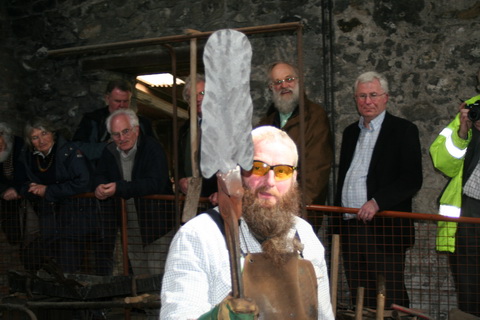
A spade after being hammered (just one of the many stages in its production)
The mill (which is original, not a reconstruction) is absolutely packed with machines and must have been a hellish place to work when in full production, with the heat from the furnace, the noise from the trip-hammer and several workers producing spades at the same time. The spade-maker above is one of the last six in Europe and really knows what he’s talking about: not just the process but the uses to which spades were put. The other guide, who took us around the other parts of the site, was also knowledgeable and helpful.
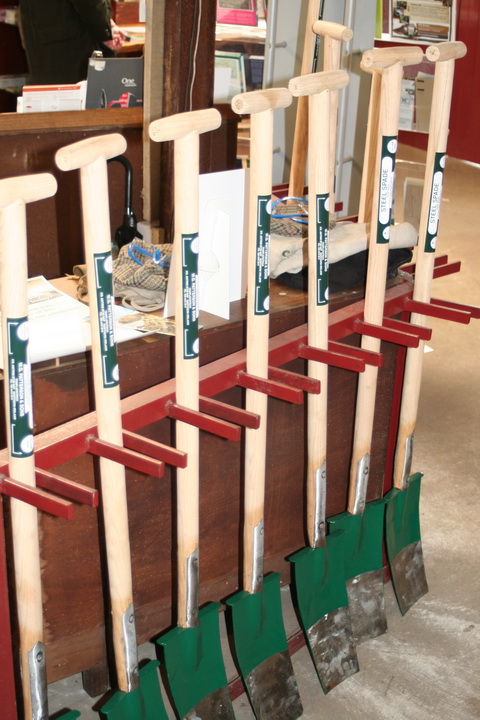
Some new spades
Highly recommended.

 Irish waterways history