
Category Archives: Forgotten navigations

User surveys

Last Saturday, I had just checked that the nineteen members of the Inland Waterways Protection Society, and accompanying walkers from O’Briensbridge Community Group, IWAI Lough Derg Branch and elsewhere, had successfully crossed the Shannon at Plassey, using the University of Limerick’s road-bridge instead of the Black Bridge, which is still closed after last year’s floods.

I was walking back to my car, so that I could drive to meet the group at Gillogue and ensure that they were getting their sandwiches at the Lame Duck, when I was accosted by a woman in a car. It was pouring rain and my dogs were getting impatient, but I listened politely while she asked if I would participate in a survey. “For whom?” I asked. “For Waterways Ireland,” she said. So I thought I’d better play along.

The survey was conducted as she sat in her car, dry, but obstructing the traffic, while I stood outside in the rain, keeping an anxious eye on the dogs. I was not inclined to prolong the time spent answering questions.

Now, I was told recently (after submitting an FOI request) that the towing-path and bridge at Plassey were leased by the Department of Finance to Limerick County Council, so it’s not entirely clear what Waterways Ireland has to do with the current management of that stretch or why it wanted user views. Did the interviewer choose that stretch as a bit of Limerick in which she could see water while staying in her car?

I was asked what I thought of the facilities “toilets and so forth”, and pointed out that there weren’t any. I struggled to convey the fact that, although I was walking before I was accosted, I disliked the activity intensely (especially in the rain) and that, although I visit Plassey several times a year, it is because I am interested in industrial archaeology, not because I want exercise. And there didn’t seem to be a way of conveying that I had organised for about twenty-five other people to walk the towing-path, but that I wasn’t myself participating.

Then I was asked if I had heard of Waterways Ireland and if I knew what they did ….

The 2004 survey is available from WI’s website here. But I wonder whether WI commissioned any surveys between 2004 and 2010 and, if so, where they are to be found.
The Ulster Canal: abandon it now

I have now completed an examination of the proposals for the reconstruction of a section of the Ulster Canal from Lough Erne to the town of Clones in Co Monaghan. My conclusions are linked from this page, which also contains a brief summary of my views.

Ulster Canal 0: overview presents the main points of the argument in about 3,600 words. It does not contain most of the quotations and omits the references; it also omits some sections of the argument. However, it’s about one fifth of the length of the whole thing.

Ulster Canal 1 to Ulster Canal 10 present the argument under ten headings, amounting to about 18,500 words in all. That may be too much for most people. There are no photos or other illustrations, and most of the argument is about economics or politics.

It will be clear that I do not have full information; I will be glad to have Comments from anyone who can fill the gaps or correct anything I’ve got wrong.

For anyone who can’t wait, here is a copy of the summary of my views.

Summary

The Irish government has been pushing, since the 1990s, for the restoration of the Ulster Canal. Several studies have been commissioned; all of them show that the project is uneconomic. At no stage has either the UK or the Northern Ireland administration shown any willingness to commit funding to the project. As a result, the Irish government has scaled back its ambitions, proposing to fund the construction of a canal from Lough Erne to Clones in Co Monaghan: it would cross the border several times, but it would pass through no significant conurbation on the northern side.

However, this scaled-back project makes even less sense than the proposal for full restoration, and there is no reason to believe that the canal will ever get any further than Clones. The Irish government might, I suppose, decide to dig on to Monaghan, as a form of famine relief work, but there is no evidence that the Northern Ireland Executive will ever put money into completing the route to Lough Neagh.

The costs of the proposal have not been reexamined for many years (or, if they have, the results have not been published), and the economic analyses may overstate the likely benefits. Even if they are accurate, though, the main benefits seem to come from casual visitors rather than from boaters. The benefits will go to service providers in the area, rather than to the waterways authority, but even if they went to Waterways Ireland they would not pay the running costs, never mind repaying the capital cost. The project has failed every economic test to which it has been subjected: it simply does not provide the sort of return that would justify the project.

There seems to be some doubt over the source of the proposed funding. The Irish government said that it canal to Clones would be paid for by the Irish Exchequer, but it later said that Waterways Ireland would sell surplus assets to pay some or all of the cost. It is not clear that Waterways Ireland’s surplus assets would, in current economic conditions, bring in enough money; nor is it clear that the Department of Finance is willing to make up any shortfall.

There might be something to be said for acquiring the land and creating a walking and cycling route, but the current proposal for a canal to Clones is utterly unjustifiable and should be dropped.

The Ulster Canal: the supposed benefits

Here is the latest (and almost the last) in this series of posts: an examination of the expected benefits of the canal to Clones. My conclusion is that the benefits cited are higher than those likely to arise in current conditions.

The Ulster Canal: the costs

The figure of €35 million is widely quoted as the cost of the canal to Clones, but the basis for that figure is not clear. Here are some thoughts on the subject.

The Ulster Canal

The next page of the Ulster Canal series is now up. It is, I’m afraid, rather boring: an account of the various reports (“studies and appraisals”, in the jargon) commissioned since 1994. It may help in sorting out who said what where and when.

The Clones Canal (the first part of the Ulster Canal to be abandoned)

Waterways Ireland intends to build a canal to Clones at the instigation of the Irish government. I believe that this proposal is an unjustifiable waste of money, at a time when public expenditure (and especially capital expenditure) is being cut.

This page provides links to a series of pages about aspects of the proposal. At time of writing, there are four pages up; there will be more, concentrating on the economic and financial aspects.

I have had limited access to documents:

  • every debate in the Dáil or Seanad in which the Ulster Canal was mentioned
  • every debate and committee session in the Northern Ireland Assembly in which the Ulster Canal was mentioned
  • every debate in the House of Lords and the House of Commons in which the Ulster Canal was mentioned
  • the minutes of meetings of the North/South Ministerial Council in Inland Waterways Sectoral Format and relevant minutes of Plenary Format meetings
  • the documents available on the websites of Waterways Ireland and of the Department of Community, Equality and Gaeltacht Affairs.

Neither the Department of Community, Equality and Gaeltacht Affairs nor Waterways Ireland has answered all the questions I asked them. Accordingly, I may have got some things wrong, and I would welcome correction. I would also welcome copies of confidential documents: this could become WikiLocks.

Down the Rockville

Some time ago I wrote three pages about the Rockville Navigation, which is linked to Grange on the Carnadoe Waters in Co Roscommon.

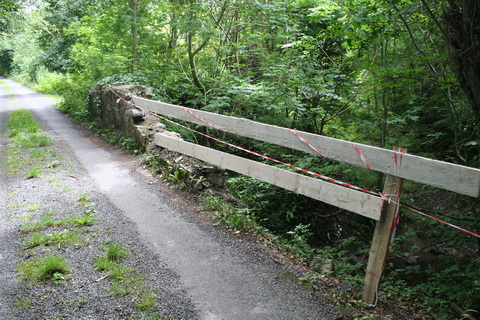
I recently revisited the area. I was horrified, first, to find that the bridge — built in June 1765 — has been severely damaged, with large chunks of masonry in the cut beneath and with a crude wooden repair. How many bridges of that age are there in Co Roscommon? How many that are associated with one of the oldest navigations in the country? Please, someone, restore the bridge!

Damage to the bridge

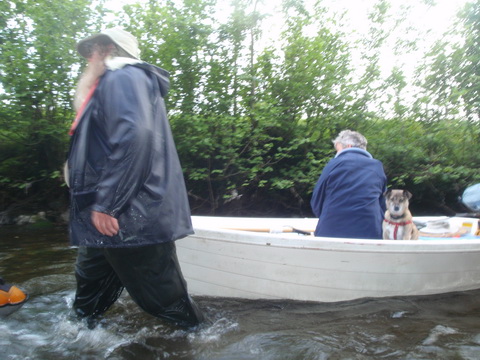
Anyway, the more pleasant part of the day was the four hours that we spend descending, by dinghy and kayak, from the bridge to Grange. The route took us through artificial cuts, small lakes and sections of river, with very clear water and an extraordinary abundance of vegetation. This route would have been easily navigated by large wooden cots or similar boats, and it should be developed today as a canoe-and-small-boat trail. Even with very low water levels, we had no real problems, although someone has to end up with wet feet …. Here is an account of the trip.

Wading in the water

Ordnance Survey maps

Let joy be unconfined. The OSI has further improvements to its online maps, with a beta of a street map application and the return (I think) of the 25″ 1900s maps. Start from here.

bjg

Dry docks

I’m starting a new section on Irish inland waterways dry docks. The thing is, I have photos of very few of them, and even my list of docks is almost certainly incomplete. So this page has photos of a few of the docks, but I’m hoping readers will be able to help with lots more.

Knock knock …

Knock in Co Mayo is well known, having its own airport; Knock in Co Clare is less well known, though it has its own port. Here is a short account of its history, with some photographs, but more information would be welcome.