
Category Archives: Non-waterway

Some new things arise

First, I’ve checked all the linked sites listed at the bottom of the right-hand column and removed some that have died. If you know of others to which I should provide a link, do please let me know.

Second, I’ve added a link to the excellent Grace’s Guide to British Industrial History, and I take the opportunity to draw it to the attention of folk interested in who made what. I have received much useful information from its volunteers and I have been able to contribute photos of a few artefacts. It’s well worth exploring. I have also added a link to the Railway and Canal Historical Society.

Third, I am glad to see that the Irish Times‘s conversion to the benefits of civilisation continues: yesterday it featured an Intel Pentium chip from 1994, which provided the basis for an essay on Ken Whitaker’s 1950s report, globalisation, television, women, Northern Ireland and Viagra. If only some more of the nineteenth century industrialists, entrepreneurs, engineers and modernisers had been covered.

That, fourth, reminds me that I came across a couple of interesting articles by Roy Johnston on the Victorian Web site: they’re under the heading Science, Technology, and Politics, on this page, which has several articles about Ireland. They include articles on whether Ireland was a colony, although I must confess that I have yet to be persuaded that that is a question in which I should take an interest.


From Kilrush to Carlingford …

ferry interesting news.

SESIFP

Read about the draft Strategic Integrated Framework Plan (SIFP) for the Shannon Estuary here. You can comment on it up to 15 February 2013.

VdeP and the canal turf trade

My eye was caught this morning by one point in an Irish Times story about the Society of St Vincent de Paul:

One of the organisation’s most frequent requests for help at present is for solid fuel.

“People are using their fireplaces again. It’s too expensive for them to fill the tank with oil, or pay electricity heating bills and so we are getting huge demand for coal and briquettes,” says Kenny. “There is real poverty in this country now. We hear their stories every day.”

That was one of the reasons the canal-borne turf trade lasted so long in Dublin. Turf had two advantages. First, it did not require a grate, which was an expensive piece of equipment. And, second, you could buy it in small quantities. Coal had to be bought in large quantities, eg a quarter of a ton, so you needed spare cash and you also needed a secure place to store the fuel.

Turf, on the other hand, could be bought in small quantities, a few sods at a time, for small amounts of money. During a coal shortage in 1926, for instance, the Irish Times reported:

Early yesterday morning there were large supplies of brown turf at several points along the Grand Canal in Dublin, but these were quickly sold off at famine prices. Before the coal strike this quality of hand-dug turf was sold at two sods a penny, and sometimes cheaper. By Friday last the price had risen to tenpence per dozen sods; yesterday it was being retailed at a shilling a dozen when carried away from the dumps, while hawkers in the streets were reaping a rich harvest selling turf to importunate poor people at 1.5d a sod or 1/6 a dozen.

Poor people complained bitterly that one dealer refused to sell in small quantities; instead he sold cartloads to hawkers and bellmen at a shilling a dozen. The hawkers took the turf a little distance from the canal bank, and sold it in small lots at three halfpence a sod, making a clear profit of 50 per cent.

Turf, especially the brown turf sold in Dublin (as opposed to the black turf used in the south and west), was a less efficient fuel than coal, but it could be bought for small sums and did not require a large initial outlay.

The Vincent de Paul website is here; it accepts donations.

No Heritage Council grants this year

Heritage Council Grant Programme Suspended for 2013:

In 2012 the Heritage Council was in a position to allocate €1.4 million to 273 public projects across Ireland supporting jobs and improving the quality of our tourism product now and for the long term. Regrettably, due to additional budget cuts from the Dept. of Arts, Heritage & the Gaeltacht for 2013, the Heritage Council will not be in a position to advertise grants for the coming year. This is the first time since the Heritage Council was established in 1997 that it will be unable to allocate funding for the wider heritage sector and we will be working to see that this situation is reversed for 2014.

Core aspects of our national heritage infrastructure, including the Heritage Officer Programme, the Irish Walled Towns Network (IWTN), the Irish Landmark Trust, and the National Biodiversity Data Centre (NBDC) will continue to receive some level of support. Funding for the 2012/13 REPS4 Traditional Farm Buildings Grant Scheme, which is funded by the Dept. of Argiculture, Food & the Marine will not been affected.

The Council had conducted a strenuous and successful campaign to ensure its own survival, as I noted back in November.

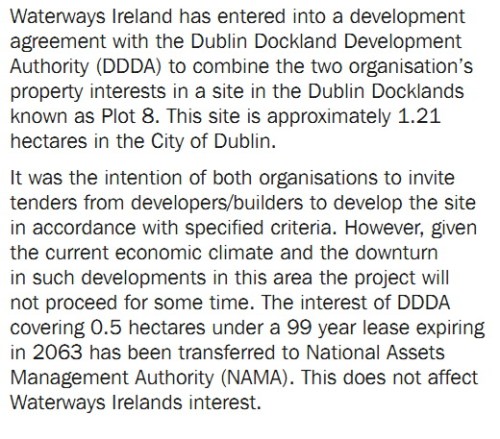
WI and NAMA

From WI's annual report for 2011

From WI’s annual report for 2011

Disband Clare County Council

In order to save some money, it might be a good idea to disband Clare County Council. Then we wouldn’t have county councillors proposing idiotic projects (joined in this instance by some TDs) requiring vast capital expenditure (which we can’t afford) to produce zero jobs.

More about Ardnacrusha here.

Water levels

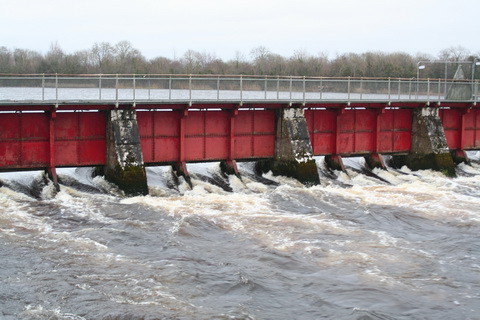
Meelick Weir today

Meelick Weir today

Almost level.

Budget

Vast wodges of bumpf from the government’s budget site, with non-searchable PDFs, god rot ’em. An initial look suggests these points:

  • the Dept of Arts, Heritage and the Gaeltacht’s total allocation to northsouthery, which includes waterways, will be down 6% next year
  • current spending on northsouthery will be down from €38 244 000 to €36 178 000. Waterways Ireland gets the biggest wodge of that, about 60% [see my comment last year] in 2011; I guess that the cuts will be shared pro rata, but I can’t be sure
  • WI’s capital expenditure allocation will be reduced from €4 500 000 to €4 071 000, which may go towards shovels for thon sheugh
  • decisions on northsouthery have to be agreed by the NSMC [Irish government and NI executive].

More as I plough the pile, but the summary (to nobody’s surprise) is less spending on waterways. Maybe Éanna should have pushed ….

Ireland’s most popular waterways artefact?

The search term most often used to find this site is Ardnacrusha, which scores 1655, almost twice as many as the next term, the generic Waterways (875). But other variants occur too: Ardnacrusha Lock is at position 3 (768), Ardnacrusha power station 18 (274), ESB Ardnacrusha 21 (225), Ardnacrusha ESB 33 (169), Ard na Crusha 43 (140), Ardnacrusha hydroelectric power station 58 (120), Ardnacrusha dam 86 (89); Parteen Weir is at 14 (369).

Thus I deduce that Ardnacrusha is by far the most popular artefact on Irish inland waterways.

Here is the full top twenty.

1 Ardnacrusha 1,655
2 Waterways 875
3 Ardnacrusha lock 768
4 Wooden boat 728
5 Skies 613
6 Athlone 573
7 Strancally castle 483
8 Lough Erne 480
9 Homemade boat 460
10 Wooden boats 453
11 Irish waterways history 451
12 Boats 448
13 Irish waterways 393
14 Parteen Weir 369
15 Flying Fifteen 344
16 Homemade boats 333
17 Pioner Multi 301
18 Ardnacrusha power station 274
19 Johnstown Co Kilkenny 247
20 Ormond Castle 237

Most hits on this site come from searches rather than links.