Category Archives: Non-waterway

A London pub and the history of the Shannon

Piloti’s “Nooks and Corners” column in the latest issue of Private Eye [No 1325] reports [brief extract available to non-subscribers here] that a London pub is threatened with demolition. On the Google satellite view with photos, press the button to the bottom right of the building to see a pic headed “Derelict pub”.

Piloti says that the pub was built in the 1840s [Diamond Geezer says 1839] and at that time the Marquis (or Marquess) was Henry Petty-Fitzmaurice, 3rd Marquess of Lansdowne, KG, PC, FRS. The family’s main base was in Britain but they owned large estates in Ireland, notably in Counties Limerick and Kerry; certain roads in Dublin are also named after the family.

The late Marquis has two claims on the attention of Irish waterways enthusiasts. First, the best-known of the early River Shannon steamers, the Lady Lansdowne, was named after his wife. Second, he was Lord President of the Council [the current holder of the post is Nick Clegg] when the government of Her Late Majesty Queen Victoria decided, in 1839, to spend about half a million pounds improving the Shannon Navigation.

 

The O’Briensbridge [non-]emergency

The Irish Times today reports that

The Irish Coast Guard has issued an appeal to sailors and people who might fly aircraft about the safe handling of modern emergency locator equipment.

This follows an incident in which a badly stored aircraft emergency beacon sparked a massive search operation involving two helicopters and ground crews amid fears that a small aircraft had crashed.

Killaloe Coast Guard had covered the search in postings on 17 and 18 October 2012 here. It reported that

Killaloe Coast Guard Unit after over eight hours searching located three active emergency beacons, ELT’s in the O’Brien’s Bridge area.


Nothing to do with waterways: the evil influence of Famous Seamus

I blame Famous Seamus.

Listening to the wireless this evening, I heard some medic chap being interviewed on 2RN. He began almost every statement with “So”. And his interviewer thus began several of her over-long questions. Other instances of this affliction have since come to my notice.

Clearly this is all Seamus Heaney’s fault. The first three lines of his translation of Beowulf are:

So. The Spear-Danes in days gone by
and the kings who ruled them had courage and greatness.
We have heard of those princes’ heroic campaigns.

Still, it is no doubt gratifying that, er, so many folk are reading poetry.

Ardnacrusha

Killaloe Coast Guard report here.

Another description of the Dublin City Bason

From the Rev G Hansbrow’s 1835 publication An Improved Topographical and Historical Hibernian Gazetteer; describing the various boroughs, baronies, buildings, cities, counties, colleries, castles, churches, curiosities, fisheries, glens, harbours, lakes, mines, mountains, provinces, parishes, rivers, spas, seats, towers, towns, villages, waterfalls, &c &c &c, scientifically arranged, with an appendix of ancient names. To which is added, an introduction to the ancient and modern history of Ireland Richard Moore Tims; William Curry, Jun and Co; John Robertson and Co, Dublin; King and Co, Cork; Marks, Waterford; Simms and Mairs, Belfast; Campbell, Derry; M’Kerin, Limerick; Wheelock, Wexford; Collins, Drogheda; Dunlap, Coleraine; Purcel, Tralee; Kyte, Cashel; Blackham, Newry; Bole, Castlebar; Devir, Westport; and other booksellers:

The City Bason is the pleasantest, most elegant and sequestered place of relaxation the citizens can boast of; the reservoir, which in part supplies the city with water, is mounded and terraced all round, and planted with quickset hedges, limes and elms, having beautiful green walks between, in a situation which commands a most satisfactory prospect of a vast extent of fine country to the south. The entrance is elegant, by a lofty iron gate, and the water that supplies it, is conveyed from the neighbouring mountains.


For, and, nor, but, or, yet: nothing to do with waterways

How cheering to see an article about the importance of writing. I don’t want to overemphasise the importance of a single instance or to be taken as supporting the methods described: I have not studied their advantages and disadvantages. But I am firmly of the opinion that (a) writing is important and (b) writing and thinking are inseparable. Furthermore, I am heartened to see that some of the things I have said to PhD students — about the importance of the short words that show the connections between concepts and ideas — are repeated in the Atlantic article.

Arthur’s Day

There is quite a modern branch of trade risen up in Ireland — I mean the exportation of Dublin porter. I am not a proprietor in the brewery, and, in praising the beverage, which I consider most excellent, I cannot be considered to be actuated by interested motives. But, it is a curious fact, that, a few years ago, Ireland was an importing country of porter, while, at the present moment, a very considerable export trade is growing up in Dublin.

In this point, and, perhaps, in this point only, I fully expect the learned member for Dublin [Daniel O’Connell MP] to concur with me. I only venture to entreat hon. Members opposite, who wish to give some activity to the trade of their country, to encourage the fermentation of the vat, rather than the fermentation of politics. By so doing, they may greatly improve our trade and our internal condition; and, if they will but take my advice, I, for one, shall be ready, most heartily, to drink their healths in their own porter.

Thomas Spring Rice, MP for Cambridge (and previously for Limerick), Joint Secretary of the Treasury, in a House of Commons debate on the repeal of the Act of Union on 23 April 1834. On this site, you’ll find more on Daniel O’Connell here and on Uncle Arthur here.

Kildare Street

In the recent past, I have made several postings referring to debates or parliamentary questions in the Dáil or Seanad. I was able to do do because of the service provided by the excellent KildareStreet.com website. The site allowed me to identify and set key words for topics that interested me (waterways, for instance); it then sent me alerts when any of those topics was mentioned. Simple, pain-free, efficient — and an excellent way of making the Oireachtas seem slightly more important. KildareStreet also provided a search function and a facility for reading and commenting on recent debates. I found the Oireachtas’s own debates website far less user-friendly.

The Oireachtas has now decided to change its system — and to make it worse. Not only is its own site inadequate (no alerts, no search, despite there being a search button) but it has ceased to supply the XML-formatted data that enabled KildareStreet.com to work and has thereby crippled what was a really useful service.

If there are any computer-literate politicians in Dáil or Seanad, I would be grateful if they would enable the KildateStreet.com service to be restored.

Big it up for the National Library …

… which is seeking a commercial partner to help it to digitise its collections. O si sic omnes.

Wordling Repeal

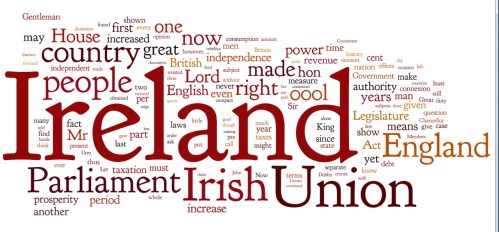
On 22 April 1834 Daniel O’Connell, MP for Dublin but a native of Kerry, argued in the House of Commons at Westminster for, IIRC, five hours in favour of the repeal of the Act of Union. Here is what Wordle makes of his speech.

Daniel O’Connell Wordled

On the following day Thomas Spring-Rice, MP for Cambridge but a native of Limerick, responded for six hours. Here is what Wordle made of it.

Thomas Spring-Rice Wordled