
Interesting piece here; h/t Dave Shirlaw of SeaWaves.
Update here.
Posted in Ashore, Extant waterways, Foreign parts, Historical matters, Operations, People, Politics, waterways
Tagged boat haulers, Russia, Volga
The other day I posted an account of the Grand Canal Company’s inspection launch, built at its own docks in James’s Street Harbour in 1909. I said
I had not been aware of the existence of a GCC inspection launch later than the gondola of 1795. I would be glad of information from anyone who knows more about it: please leave a Comment below if you can help.
Then I remembered that, back in January, Alan Lindley had kindly permitted me to post this photograph, taken at Lowtown in 1911 or 1912.
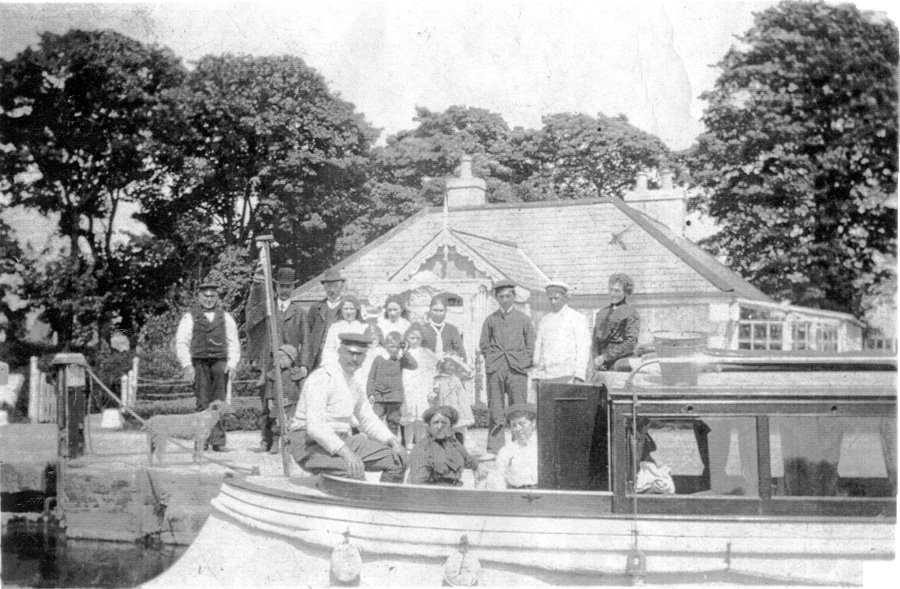
Unidentified boat at Lowtown (courtesy Alan Lindley)
Alan identified the man on the left of the group — with cap, waistcoat and watch-chain, and with a dog standing in front of him — as the lock keeper, Murtagh Murphy, the great-grandfather of the present incumbent, James (Jimmy) Conroy.
I said at the time that, although the boat had been described as a passenger flyboat, that seemed unlikely, and that the boat looked much more like a pleasure vessel than a working boat. I added:
If the Grand Canal Company had an inspection launch, this might be it, but I have found nothing to indicate that it did. The boat does, though, seem to have been designed for canal travel: it seems (from the twenty feet or so we can see) to have straight sides and to be well equipped with fenders. It might therefore have been designed to travel on the canals (as well as on other waters).
Well, now we know that the Grand Canal Company did have an inspection launch, built in 1909, not long before this photo was taken. Could this be it?
Posted in Ashore, Canals, Engineering and construction, Extant waterways, Historical matters, Industrial heritage, Ireland, Irish inland waterways vessels, Operations, People, Sources, waterways, Waterways management
Tagged Alan Lindley, Grand Canal, Grand Canal Company, inspection launch, James's Street Harbour, Jimmy Conroy, lock, Lowtown, Murtagh Murphy
On Saturday, a man applied at one of the Scotch sailing vessels, opposite the North Wall, Dublin, and offered a large parcel directed for Greenock. He stated that the parcel was a set of books, but the foul smell proceeding from it excited suspicion, and it was opened by the mate, who found that it contained a body, wrapt in oil-cloth, and over that a thin matting, the entire contained in a bag.
The body was that of a boy, about 13 years of age, tightly corded, and doubled up. The bones of the legs and arms were broken, and blood flowing from the mouth and nose. This gave rise to a suspicion, that the boy had met a violent death.
Many persons exclaimed “this is Burkism“, “seize the villain” &c. Such was the excitation of the multitude, that it was only by the intervention of some of the police, that the fellow who brought the parcel was saved from destruction. He and the body was taken to the Police-office, where the latter remains for inquest, and the former in custody to abide the result of the inquiry. Several of the Faculty that examined the body, have given their opinion that death came by disease, the legs being dropsical. The prisoner says his name is M’Dowell.
Drogheda Journal, or Meath & Louth Advertiser 18 February 1829

On 28 February 1829 the Leeds Patriot and Yorkshire Advertiser carried a longer report, which it said it had taken from the Dublin Morning Post; it did not give the date of the Post issue.
This report said that a boy spotted a cart coming down Eden Quay to the North Wall. He recognised the man sitting on the cart’s shafts as a resurrectionist and told the mate of the ship to “have an eye” to him. That was why the mate was suspicious enough to open the parcel.
The report added some more gruesome details about the body. It said that, although the man gave his name as M’Dowel, he was found to be John Cadwell, from Longford. After he was taken into custody by peace-officer Gilloghly and police constable Paine from the Henry-street office, he said that he had been given the body by a gentleman he met in Grafton-street and employed to put it on board the vessel. The body was taken to Tucker’s-row watch-house for inspection, identification and inquest.
The boy appears to have been somewhat about 12 or 13 years of age, soft and full countenance, with a profusion of extremely fine light-brown hair, and looking remarkably fresh.
The Tipperary Free Press of 18 February 1829 gave the man’s real name as John Caldwell; it said that he had been taken up on suspicion of murdering the boy to sell his body to the “Scotch surgeons”. However, “After an examination before the Coroner, it appears that the boy was not murdered” although Caldwell could not account for his possession of the body.
The Clonmel Herald of 25 February 1829 gave a longer report of the inquest, taken from the Dublin Morning Post “of Tuesday”. It was less information about the specifics of the case than about what seemed to be a lively trade. It said that the vessel in question was the Scotia steamer, not a sailing vessel, and there was a strong suggestion that the mate was concerned in the trade, having investigated the parcel only when it became impossible to avoid investigating the parcel.
Caldwell himself said that he had delivered two or three similar parcels to the Scotia within the past fortnight but he did not name their senders; he did not know the Grafton-street gentleman’s name and had never carried parcels for him before, but had accepted half a crown to carry this one. He did not know a “medical man named Rea”.
James Killin, a ship labourer, said that Caldwell had taken two or three similar packages down the quay on the previous Saturday; Killin seems to have known that they contained bodies:
The witness then gave an account of dead bodies that had been discovered to have been shipped on board the same vessel, by the prisoner on the Saturday week preceding.
One of the jurors said that the body looked like those prepared for dissection; another said that
[…] he had heard a gentleman say that day that he had within the present season cleared £220 by the exportation of subjects.
He said that an Edinburgh surgeon had offered an Irish resurrectionist £10 per body plus post and packing.
There was no funding to pay a member of the profession to examine the body in such cases and the coroner said that he was unable to afford to pay for one out of his own remuneration, so the jury was unable to decide on the cause of death. The body was sent to Surgeons’ Hall for examination and Caldwell was remanded in custody.
Posted in Economic activities, Foreign parts, Historical matters, Ireland, Operations, People, Sea, Steamers
Tagged Burke, Caldwell, coroner, dissection, Dublin, Greenock, Hare, inquest, police, Rea, resurrectionist, Scotia, steamer, surgeon
It is proposed that six cwt should travel on the Rail-road between this City and Waterford, ten miles an hour, urged by the propelling and locomotive engines. Thus, on the sixth day, the heaviest goods will reach London from Limerick; the fourth, Liverpool; and the third, Bristol.
In case the navigation of the Suir should be found inapplicable, an extension of the Railway to Dunmore is intended.
The undermentioned are expected to form the Committee, some of whom have already signified their intention to that effect:—
The Duke of Devonshire, the Marquis of Lansdowne, Earls Darnley, Glengall, Kenmare, Charleville, Kingston, and Ennismore; Lords Oxmantown and Lismore; Messrs T S Rice MP, J Smith MP, R Wellesley MP, Captain Maberly MP, Sir C Flower, Alderman Heygate &c.
Dublin Evening Post 3 February 1825
Some later information here.
Nowadays, the average duration of the eight daily trains between Limerick and Waterford is four hours and five minutes, for say eighty miles, so speeds have doubled since the 1825 proposals were made.
Posted in Ashore, Economic activities, Engineering and construction, Extant waterways, Forgotten navigations, Historical matters, Industrial heritage, Ireland, Modern matters, Operations, Passenger traffic, People, Politics, Rail, Suir, waterways
Tagged Carrick-on-Suir, Dunmore East, Limerick, railway, Suir, Waterford
A possible outcome of the dog’s brexit?
Saith Alan Bermingham, policy and technical manager of the Chartered Institute of Public Finance and Accountancy:
I assume some of the cross-border bodies such as Waterways Ireland with separate jurisdictions would need to be disentangled,
He says that closing cross-border projects could increase administrative costs.
We have reason to know that the public of Great Britain and Ireland are indebted for the return of their incomparable Lyric Bard, T Moore, from the banishment to which his misplaced confidence in others had consigned him, to his rural home near Devizes, to an act of noble generosity and kindness on the part of his friend and neighbour, the Marquis of Lansdown[e].
Saunders’s News-Letter 3 December 1822
quoting Cork Southern Reporter
Posted in Canals, Foreign parts, Historical matters, Ireland, People, Politics
Tagged Lansdowne, Thomas Moore
I see that P&O Cruises [about which there is a not-very-accurate Wikipedia page here: not very accurate, I mean, about the history of the P&O Line] will seek public suggestions for a name for its latest vessel, which they call “the nation’s ship”:
P&O has also previously run a similar exercise, coming up with the stately Britannia for a ship that launched last year. The company hopes for something similarly dignified and patriotic this time round […].
I do hope there will be a concerted campaign to have it named Hibernia, to recognise that
Of course, as this great Irish company expanded, it took on more British shareholders and directors, training them no doubt in how to run scheduled steam shipping services, but it is about time that the Irish role was acknowledged.
See Freda Harcourt “Charles Wye Williams and Irish steam shipping 1820–1850” in The Journal of Transport History Third Series Volume 13 Number 2 September 1992, Manchester University Press, and Freda Harcourt Flagships of Imperialism: the P&O Company and the politics of empire from its origins to 1867 Manchester University Press 2006 [ebook now also available].
I had much pleasure in availing myself of an ascent in Mr Hampton’s Balloon on Monday, accompanied by that gentleman and Mr Townsend. At two minutes to five, all the necessary arrangements being made, the bridling was cast off, and we ascended (apparently to us in the balloon gradually), but having relieved the car of five bags of ballast, which was thrown over, our ascent then became much more rapid.
The course taken by the balloon being at first almost due north we glided beautifully across the Shannon, and found ourselves at twelve minutes after five, at the north side of the river. The balloon, in this position, rested for some minutes, giving us an opportunity of gazing on the grand and magnificent panorama beneath us.
The prospect of Limerick was very extraordinary, every street, lane, and building, being at the same moment distinctly visible, but so apparently diminished in size that it assumed more the appearance of a beautiful miniature model than the actual city; the expanse of view was vastly greater than I anticipated, the various windings of the Shannon, with little interruption, being visible to Killaloe, above which the grand and noble expanse of water on Lough Derg was a prominent feature, flanked on either side with a lofty range of mountains. The view of the lower Shannon was also very attractive, extending far below the Beeves’ tower, and on which was visible one of the river steamers towing, I will not say a large ship, for it appeared no bigger than a turf boat.
We now bent our course towards Cratloe Wood, and at 22 minutes after 5, found ourselves standing right over its centre, the appearance of which was very extraordinary, the trees appearing more like a beautiful mantling of richly-coloured heath, or of short brushwood. Here I took an indication of a barometer, brought up at the request of Mr Wallace, the proprietor of the Observatory, for the purpose of getting for him its indication at the greatest altitude, and by which I found we were still ascending, soon getting us into another current, floating the balloon gradually towards the Shannon; and, at 30 minutes after 5, we found ourselves over the north bank of the river, opposite the Maigue.
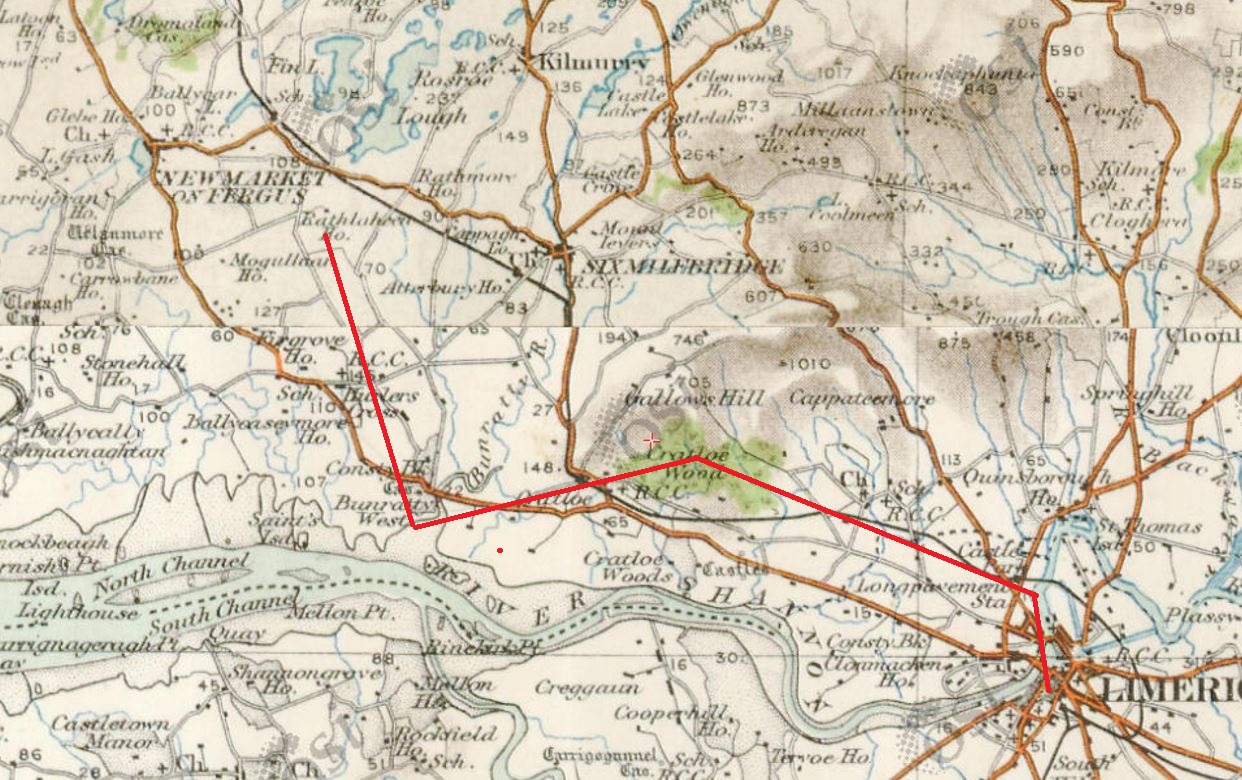
The flight of the balloon (OSI ~1840)
There, by indication of the barometer, it appeared we attained our greatest altitude, being then 4261 feet above the level of the river. The country beneath, from this great height, much resembled one of the Ordnance Survey maps. Undulations of the ground, except hills and mountains at a distance, not being visible, and large fields looking not much bigger than pocket-handkerchiefs; nor could I help thinking what a sad waste of land there was under stone walls, making such varied subdivision of property, and being much more numerous than I had any idea of.
At this altitude the atmosphere was so rarified that Mr Townsend felt his respiration considerably affected, which, under such circumstances, is very usual, though I did not experience it.
I was particularly attracted in this place, as would be supposed of perfect tranquillity, removed from the busy world, to find the buzz or murmuring sound of those beneath us (though, I need hardly say, invisible) ascend and fall on the ear distinct, though faintly, being different from any sound I ever before experienced, and but ill-conveyed by my inadequate description.
I found we had now got into another current diametrically opposite to what had been our last travelling, having taken a rapid course in the direction of Ennis. The barometer indicating a gradual descent, at 45 minutes after 5, Mr Hampton deemed it advisable to prepare for his descent, the country wearing a favourable aspect for doing so, and here he first worked the valves for that purpose; so that our descent and progressive movement now became very rapid.
And at two minutes to six we once more came in contact with terra firma; the car first striking obliquely two walls about 5 feet high, of dry masonry, being at either side of a road or bye way, through which it made a clean breach to the very foundation; the car, after passing through the breach, again oscillated, and found its resting place in a pasture field at the foot of Ralahine demesne, about three miles from Newmarket-on-Fergus, where we were quickly surrounded by a large peasantry, showing forth their true national characteristic generosity, for they not alone gave their most anxious aid in the saving of the balloon, and its various appendages, but many offered their horses to bring us into Limerick. Mr Creagh, I should also add, was most polite, having invited us to Ralahine, to partake of his hospitality.
I hope it may not be considered presumptive of me to state, from my slight knowledge of mechanical operations, that I consider Mr Hampton a perfect master of the management of a balloon, so far as practicable, and is, I feel, owed a debt of gratitude by the citizens of Limerick, for the very great treat which he has afforded them.
Hampden W Russell
Limerick and Clare Examiner 8 September 1849 in the British Newspaper Archive
On Tuesday 21 August 1849 the Southern Reporter and Cork Commercial Courier announced that “Mr Hampton, the aeronaut” had arrived in Limerick and was preparing to ascend thence in his balloon, the Erin go Bragh. It was not his first flight from Limerick: he had ascended in October 1846, when the necessary gas (£14 worth) seems to have been sponsored by the “Limerick Gas consumers company” [Limerick Reporter 6 and 13 October 1846].
The 1849 ascent was on Monday 3 September from Mr Marshall’s Repository, Upper Cecil Street, and was advertised in advance. According to the Limerick and Clare Examiner of 29 August 1849, the “Splendid Band of the 3d Buffs” was to attend. Ladies and Gentlemen could watch from reserved seats [2/=; children 1/=] in a gallery; Second Places cost 1/=, children 6d.
Mr [John] Hampton offered seats in the balloon’s car to ladies or gentlemen who wished to accompany him; the balloon could lift six people and had two cars, one for descending over land and the other “for Sea-ports, in case the wind should be for Sea”. Those interested could find the fares by applying to himself at 12 Cecil Street or to Mr G Morgan Goggin at 34 George Street.

Posted in Ashore, Engineering and construction, Extant waterways, Historical matters, Industrial heritage, Ireland, Irish inland waterways vessels, Operations, People, Scenery, Sea, Shannon, shannon estuary, Sources, Steamers, Weather
Tagged aerial, aeronaut, balloon, Buffs, Cratloe, Erin-go-Bragh, flight, Hampton, Killaloe, Limerick, Lough Derg, Maigue, Newmarket-on-Fergus, Ralahine, Shannon
Here, with more details here. Although actually forming a club seems, somehow, rather over-energetic.
H/t, as so often, to Tyler Cowen who, as a polymath, probably wouldn’t be allowed in.
Fianna Fáil, an Irish political party, has published what it describes as a “new Bill to help tackle River Shannon flooding“.
In fact, of course, the bill, if enacted, would do nothing of the sort, as the party itself admits. It proposes to add even more idiotic measures, including subsidies to encourage people to live in flood plains. But at the core of its thinking is that no interests, other than those of the inhabitants of flood plains, should carry any legal weight, and that that can be assured by placing a single body, the Electricity Supply Board, in charge of everything to do with the Shannon. Perhaps it was inspired by the ESB’s success in dealing with the salmon and eel fisheries — although some might prefer that the ESB concentrate on reducing electricity prices instead.
Blithering idiocy of this kind is not confined to Fianna Fáil and it is, I suggest, a reflection of the generally low level of ability and experience of Irish politicians. They are, I suggest, simply unable to think usefully about large and complex problems.
I tried to find CVs for all members of the current Dáil. I looked at Wikipedia entries, personal websites and party websites, as well as a few other sites that I hoped might have information.
I was looking for TDs whose CVs indicated significant experience in running large organisations or large projects: projects as large and complex as, for instance, managing Shannon floods, hospitals or the water supply.
I found nobody whose experience came anywhere near those levels (although it is of course possible that some TDs have such experience but choose to keep quiet about it). There were a few who had worked in medium or large organisations, but at junior levels, and some who had worked at senior levels in small organisations. Some of those with relevant experience had gained it in public or third-sector bodies: I was not looking solely for private-sector experience. But there were far too many who had worked in “professions” or as lobbyists of one kind or another, whose proudest boasts were of involvement in local bodies and of a desire to help individual constituents.
I’m sure they’re all very nice people. But I don’t believe that they have any conception of what it takes to analyse complex data, cost alternative policies or set up and run large organisations carrying out difficult tasks. Hence their focus on nit-picking and on the personal: they are simply unable to cope with anything more difficult. And hence too their fondness for setting up new organisations, reallocating functions and passing laws: they can do all of those things (and perhaps find places on boards for their mates) without having to get to grips with the real, the complex issues. They don’t even have to cope with the chaos their meddling causes — and they then have a new set of people they can shout at.
Some of them might just about be able to organise a piss-up in a brewery; few if any of them could organise the construction and fitting out of anything as complex as a large brewery or could manage the operations of such a brewery. That might not matter if they worked on policy analysis instead, but few of them seem to have any abilities in that sphere either. The problem is one of scale: organising a successful parish bingo night, or an election campaign, is not sufficient preparation for running a large project or organisation.
I see that wiktionary defines “shifting the deckchairs on the Titanic” as
To do something pointless or insignificant that will soon be overtaken by events, or that contributes nothing to the solution of a current problem.
That about sums it up.

 Irish waterways history