Category Archives: Restoration and rebuilding

Thon Strabane sheugh

[I’m practising Ulster Scots in a spirit of parity of esteem and such.]

I wrote the other day about a Sinn Féin campaign to have the Strabane Canal foisted upon the unfortunate Waterways Ireland (as though it didn’t have enough trouble already, what with smooth newts and mooring permits).

I once went looking for the Strabane Canal but I couldn’t find it (and wasn’t allowed to spend enough time searching). I don’t know that area at all, so I thought it would be useful to send a drone [well, actually, I used Google Maps in Photos view] to capture an aerial view of the Foyle. I was particularly interested in the likely demand for the Strabane Canal and I thought the number of pleasure craft on the Foyle might be a useful indicator.

This might be the Google view of the downstream lock on the canal.

So I flew the Googledrone down one bank from Strabane to the sea, crossed the mouth of the estuary and came back on the far side. And as far as I can see, there are very few pleasure boats on the Foyle. Londonderry Port and Harbour Commissioners have a small marina in Stroke City, Lough Foyle Yacht Club races dinghies and Foyle Punts from Culmore Point and there is a port at Greencastle, but that seems to be about it. I saw no serried ranks of motor cruisers, narrowboats or barges parked anywhere. It is of course possible that I missed them in my flyover, but where are the boats to come from to sue the Strabane Canal?

Save the newts: abandon the Clones sheugh!

Why has the proposed sheugh not yet been approved in Northern ireland? Because the Northern Ireland Environment Agency has been asking hard questions. WI has very kindly put the answers on its website.

The newts are going to be evicted, the stables may have to go but the Orange Hall won’t be affected. Hours of interesting reading.


Northern Ireland seeks cutting-edge technology … of the 18th century

IndustrialHeritageIreland reports on two recent outbreaks of cargo cultism in Norn Iron. Folk in Tyrone want the whole of the Ulster Canal to be restored to its, er, former glory, which presumably means without any water west of Monaghan, while a Sinn Féin MLA wants to lumber Waterways Ireland with responsibility for the useless Strabane Canal on which £1.3 million has already been wasted.

What is it with Sinn Féin and canals? I realise that Irish republicanism is by definition a backward-looking creed, with little contact with reality, but why not look to (say) early nineteenth century technology, like the steam railway, rather than that of the eighteenth century?

Part of the problem, I suspect, is that Sinn Féin folk, especially those who are subjects of Her current Majesty, adopt a British conception of inland waterways. In Britain, canals dominate and boats must travel slowly, no faster than the horse-drawn vessels of the eighteenth and nineteenth centuries. But Irish waterways are dominated by lakes, whereon modern folk like to zoom around in fast boats: jetskis, speedboats and skiboats, fast cruisers. Such boats are entirely unsuitable for canals: they damage the banks and the pace bores their owners.

As it happens, we have lots of lakes where owners can zoom. [I’d prefer if they didn’t, but that’s the way it is.] And with reductions in the amount of boating activity, we don’t need any additional waterways. Sinn Féin, though, doesn’t seem to have grasped this. Stuck in the eighteenth century, it wants canals. I suppose we should be grateful it isn’t proposing to have the taxpayer stump up for coal-mines as well.

For the record

The Limerick Leader article about a proposed Limerick river bus has some statements that do not accord with my understanding.

The venture will see the river bus depart Guinness Pier – across from Athlunkard Boat Club at O’Dwyer Bridge – every two hours, bound for the power station […].

As far as I know, the pier in question was the Ranks jetty and was not used by Messrs Guinness. The Eclipse Flower, and other vessels owned by Ranks and their predecessors, sailed up the Shannon from there rather than attempt the stretch from Baal’s Bridge to Custom House Quay.

The boat will follow the route taken by barges of old – both passenger and commercial – some of which historically transported Guinness to the city up until the mid-1960s.

“It is a tried and tested route,” said Mr Flynn, stressing the viability and safety of the route, which passes Long Pavement – the edges of which have been repaired and grassed over – and finishes at the hydro-electric plant.

“Every passenger and commercial barge that came to Limerick for 50 years used that stretch of water. It is very safe. It was navigated by all the barges,” he said.

The route to Limerick through Ardnacrusha came into use only after the construction of the power station in the 1920s and was used for a little over thirty years. To the best of my knowledge, there were no passenger services in those years: passenger carrying stopped in the first half of the nineteenth century, when traffic was still using the old Limerick Navigation. There have been some trip-boats in recent years, but they did not (and do not) use “barges of old”. Some old barges, now converted and with more powerful engines, have safely navigated that stretch, but they do it when conditions are right.

During the final phases of Ardnacrusha’s construction, both old and new navigations were closed; the Grand Canal Company (GCC), the main commercial carrying company, ran to Killaloe and had its cargoes carried onward by rail to Limerick. When the new route through Ardnacrusha was opened, the GCC thought it was so dangerous that it refused to use it for about a year. It resumed operations only when a boom was put across the river above Baal’s Bridge and posts were provided upstream of O’Dwyer Bridge to which barges could tie while waiting for suitable states of the tide.

I accept that the proposed river bus will not be going downstream as far as Baal’s Bridge, but it will still be navigating on a stretch of water where Waterways Ireland advises that boats should not navigate when more than one turbine is running at Ardnacrusha. The ESB can run up to four turbines, each of which is said to add a knot to the current, and it can switch them on immediately, with no warning to any boat using the river.

Other pages on this site make it clear that I share the promoters’ enthusiasm for Ardnacrusha and the canal and river thence to Limerick. I do not say that the difficulties of that stretch cannot be overcome, but I do not think that they should be dismissed.

 

That Limerick “river bus” …

… from the (presumably artificially created) photograph in the Limerick Leader seems to be the Cailín Turána, formerly part of the Aran Islands Fast Ferries fleet at Doolin and seen here out of the water at Cork Dockyard in 2004. The vessel has not been on the Dept of Transport’s List of Certified Passenger Ships since 2007 (and may have come off the list before that: I have not kept copies of the lists earlier than 2007). It could of course have been used in Ireland for purposes other than carrying fare-paying passengers, or outside Ireland for any purpose, after 2004.

And it may be that the vessel shown in the photo is not that which is to be used in Limerick.

Sinn Féin and the Clones Sheugh

Northern Ireland Assembly debate 6 November 2012, via TheyWorkForYou.com:

Phil Flanagan (Sinn Féin): […] Will the Minister provide an update on the restoration of the Ulster canal from Clones to Upper Lough Erne?

Martin McGuinness (Sinn Féin): As I said, there was a presentation on the issue at the North/South interparliamentary forum, and the planning processes are up and running. I understand that, on the Cavan side of the border, it has been successfully concluded. There is still some work to do on this side. Everyone realises, from a tourism point of view, that this is filled with all sorts of potential for us, particularly in the context not only of whatever construction jobs will be created by the project but of the prospects for utilising our waterways in a way that can bring employment to local communities.

For “everyone” read “everyone except irishwaterwayshistory.com and a few other sane people”.

Athy dry dock

I have been sent some photos of Athy dry dock and have added them to this page under the heading Grand Canal Barrow Line.

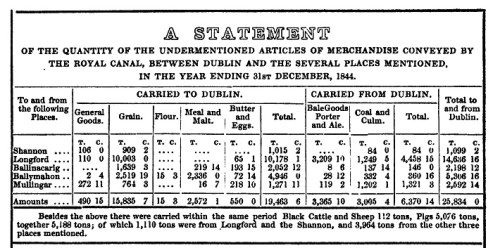
Royal Canal traffic in 1844

Royal Canal traffic in 1844 (Salt)

That table is extracted from Samuel Salt’s Statistics and Calculations essentially necessary to persons connected with railways or canals; containing a variety of information not to be found elsewhere 2nd ed Effingham Wilson and Bradshaw & Blacklock, London 1846, available from Messrs Google here.

The interesting point is how little of the Royal’s traffic travelled the whole way from the Shannon to Dublin or vice versa: only about 5% of the Dublin-bound traffic and less than 3% of the traffic westward.

Another point of interest is that traffic to Dublin was three times the traffic from Dublin.

Amongst the livestock, pigs were the dominant animals: they lost too much condition if they were walked long distances, which was the only alternative to canal transport before the railways came. Even there, I suspect that much of the tonnage described as “from Longford and the Shannon” was actually from west of the river, in Counties Mayo and Roscommon.

All sheugh up

Thinking about the exciting news from the North South Ministerial Council plenary session about the Clones Sheugh, I was reminded of the even more exciting news of the first meeting of the North/South Inter-parliamentary Association.

Strangely, its meeting received little publicity in the great world. I asked Messrs Google to search for it but to omit links from the Oireachtas and the Northern Ireland Assembly, as well as those from politicus.org and flickr.com. It found only 42 hits, of which the first seven were links to the site of a Labour senator called Mary Moran. (I won’t provide a link to her site as she’s obviously perfectly capable of generating all the links she wants.)

Anyway, the first meeting of the North/South Inter-parliamentary Association seems to have passed almost unnoticed. You can read about it on InsideIreland.ie, which seems to be a news site run by an advertising agency.

From Ciarán Hanna’s account, I deduce that the North/South Inter-parliamentary Association is an entirely pointless body. I note that it won’t meet again until April 2013. And perhaps the Irish government’s support for the Clones Sheugh is because it gives this pointless body something to discuss, thus keeping it from commenting on anything important.

Grand trumps Royal

A victory today for St James’s Hospital, close to the former harbour of the Grand Canal, over the Mater Hospital, close to the former harbour of the Royal Canal at the Broadstone.

Perhaps, if St James’s needs space to expand, it could take over the former canal harbour; work on its latest development seems to have ceased.