Category Archives: Shannon

That Limerick “river bus” …

… from the (presumably artificially created) photograph in the Limerick Leader seems to be the Cailín Turána, formerly part of the Aran Islands Fast Ferries fleet at Doolin and seen here out of the water at Cork Dockyard in 2004. The vessel has not been on the Dept of Transport’s List of Certified Passenger Ships since 2007 (and may have come off the list before that: I have not kept copies of the lists earlier than 2007). It could of course have been used in Ireland for purposes other than carrying fare-paying passengers, or outside Ireland for any purpose, after 2004.

And it may be that the vessel shown in the photo is not that which is to be used in Limerick.

Economics

Limerick river bus, allegedly.

The end of a ghost

In the UK, the Statute Law Repeals Bill is working its way through the House of Lords. You can download a PDF list of the bills being repealed. In amongst the turnpikes, Indian railways, benevolent institutions and lotteries, we find Part 4: Ireland (Dublin City). Within that, Group 1 sees the repeal of these statutes:

  • 3 & 4 Will.4 c.cxv (1833) (City of Dublin Steam Packet Company Act)
  • 6 & 7 Will.4 c.c (1836) (Dublin Steam Packet Act)
  • City of Dublin Steam Packet Company’s Act 1860 (23 & 24 Vict. c.xcviii)
  • City of Dublin Steam Packet Company’s (Consolidation of Shares) Act 1861 (24 & 25 Vict. c.iii)
  • City of Dublin Steam Packet Company’s Act 1868 (31 & 32 Vict. c.xxx)
  • City of Dublin Steam Packet Company’s Act 1876 (39 & 40 Vict. c.xi)
  • City of Dublin Steam Packet Company’s Act 1884 (47 & 48 Vict. c.cxxx)
  • City of Dublin Steam Packet Company’s Act 1895 (58 & 59 Vict. c.cxxiii)
  • City of Dublin Steam Packet Company’s Act 1910 (10 Edw.7 & 1 Geo.5 c.vii)
  • City of Dublin Steam Packet Company’s Act 1916 (6 & 7 Geo.5 c.viii)
  • City of Dublin Steam Packet Company’s Act 1920 (10 & 11 Geo.5 c.i).

In a Consultation Paper published in 2008, the Law Commission explained:

The City of Dublin Steam Packet Company was founded by Charles Wye Williams in 1822. From 24 January 1839, the Post Office contracted the company to run the mail service from Dublin to Holyhead. This service was later extended such that the company ran both the day and night service.

During the First World War the company suffered heavy losses, including the sinking of its ship the R.M.S. Leinster by a German submarine on 10 October 1918, resulting in a loss of over 500 lives. A further two ships were sunk during this period. The company never fully recovered from its wartime losses and, in 1924, an order for the winding-up of the City of Dublin Steam Packet Company
was petitioned for and granted by the High Court at Dublin Castle.

In Ireland, the Statute Law Revision Act 2009 repealed the 1833 and 1836 Acts and the Statute Law Revision Act 2012 repealed all the rest — except the 1895 Act. I don’t know where to get a copy of that Act, so I don’t know why it was specifically retained. But, with that exception, it seems that the ghost of the CoDSPCo has been laid to rest.


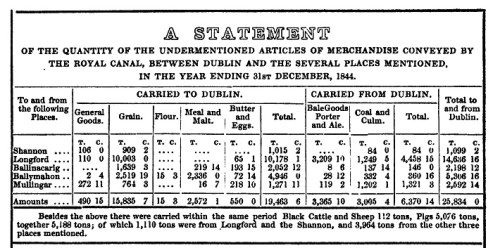
Royal Canal traffic in 1844

Royal Canal traffic in 1844 (Salt)

That table is extracted from Samuel Salt’s Statistics and Calculations essentially necessary to persons connected with railways or canals; containing a variety of information not to be found elsewhere 2nd ed Effingham Wilson and Bradshaw & Blacklock, London 1846, available from Messrs Google here.

The interesting point is how little of the Royal’s traffic travelled the whole way from the Shannon to Dublin or vice versa: only about 5% of the Dublin-bound traffic and less than 3% of the traffic westward.

Another point of interest is that traffic to Dublin was three times the traffic from Dublin.

Amongst the livestock, pigs were the dominant animals: they lost too much condition if they were walked long distances, which was the only alternative to canal transport before the railways came. Even there, I suspect that much of the tonnage described as “from Longford and the Shannon” was actually from west of the river, in Counties Mayo and Roscommon.

Boating off piste

Coast Guard rescue between O’Briensbridge and Clonlara.

Divided by oceans, linked by a canal

Last Monday the erudite and sapient Póló wrote about a photo he took in Armagh on a school trip in the 1950s. He put a copy of the photo on a web page in 2004 and, eight years later, he got an email from the person who now lives in a house that was shown in the photo. Póló was able to supply a better copy, pleasing his correspondent, and (as Póló said)

[…] he learned something new and I got a better dating on my trip and photos.

But it was his next paragraph that rang a bell with me:

I am always telling people, particularly those who are following up their family history, that they should have a presence, however minimal, on the web. That way people can find you and you never know what they might be bringing to the table.

Just before reading that, I’d had a message from a correspondent in Australia. He had seen my page about the old Athlone canal and reckoned that he was probably related to a previous, British, visitor to the page; I put them in touch and it seems that they are cousins. You can read the correspondence on my Athlone canal page. So a reference to an abandoned canal on an obscure Irish website has helped two folk to get in touch — and I, and other visitors to the site, have learned a bit more about the canal.

But there is more to learn. Does anyone know anything about Canal Lodge? The AthloneLive forum has disappeared, so I can’t ask there, and I have no other information to hand. I am making enquiries, but if anyone has any information about the building I would be glad to receive it and I’ll make sure it’s passed on.



A London pub and the history of the Shannon

Piloti’s “Nooks and Corners” column in the latest issue of Private Eye [No 1325] reports [brief extract available to non-subscribers here] that a London pub is threatened with demolition. On the Google satellite view with photos, press the button to the bottom right of the building to see a pic headed “Derelict pub”.

Piloti says that the pub was built in the 1840s [Diamond Geezer says 1839] and at that time the Marquis (or Marquess) was Henry Petty-Fitzmaurice, 3rd Marquess of Lansdowne, KG, PC, FRS. The family’s main base was in Britain but they owned large estates in Ireland, notably in Counties Limerick and Kerry; certain roads in Dublin are also named after the family.

The late Marquis has two claims on the attention of Irish waterways enthusiasts. First, the best-known of the early River Shannon steamers, the Lady Lansdowne, was named after his wife. Second, he was Lord President of the Council [the current holder of the post is Nick Clegg] when the government of Her Late Majesty Queen Victoria decided, in 1839, to spend about half a million pounds improving the Shannon Navigation.


WI & OSI

Ordnance Survey Ireland piece on Waterways Ireland’s use of OSI data.

Blunderbuses on the Shannon

Saturday 10 May 1845

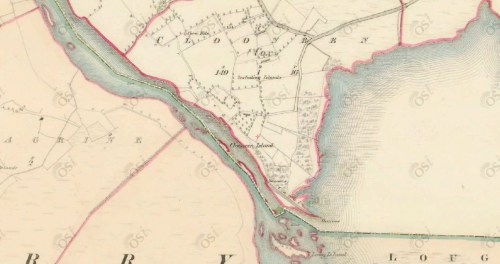
[…] On our way to Rooskey this Morning we visited Cloneen [Clooneen] & Cox shoal and they were going on very well with about 60 Men

I ordered them to double that Number to my astonishment I found 4 Policemen Barricked in one of our houses and a new Barrick erecting for 30 or 40 more Men this was being done in consequence of three villains placing themselves on the opposite bank of the River and deliberately firing four rounds of Ball from Blunderbuses some of which went into the office and from the marks made by one Ball must have been only a few inches from striking Joe Lambs head — afterwards the villains retired to the Bogs — the object of this outrage was revenge on the Men for not striking for 1/6 [8p] Pd day — the average being about 1/2 [6p] — which is considered at present ample

From David Brooke ed The diary of William Mackenzie, the first international railway contractor Thomas Telford Publishing, London 2000

What the blurb doesn’t say is that Mackenzie was the contractor for works on four areas of the Shannon, working for the Shannon Commissioners in the 1840s. He was responsible for Killaloe, Meelick, Banagher and Rooskey and also held a dredging contract.

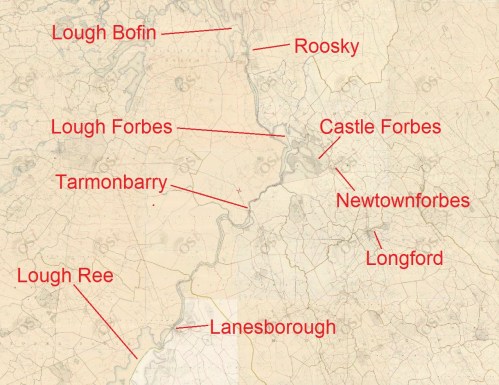
Lanesborough to Rooskey showing Lough Forbes

Clooneen (Cox) is the area at the upstream end of Lough Forbes; other Clooneens lie to the north on the east side of the river. Joe Lamb was the ganger.

Clooneen (Cox)

The O’Briensbridge [non-]emergency

The Irish Times today reports that

The Irish Coast Guard has issued an appeal to sailors and people who might fly aircraft about the safe handling of modern emergency locator equipment.

This follows an incident in which a badly stored aircraft emergency beacon sparked a massive search operation involving two helicopters and ground crews amid fears that a small aircraft had crashed.

Killaloe Coast Guard had covered the search in postings on 17 and 18 October 2012 here. It reported that

Killaloe Coast Guard Unit after over eight hours searching located three active emergency beacons, ELT’s in the O’Brien’s Bridge area.