Category Archives: Uncategorized

Of spam

Messrs WordPress provide good spam filters. This is just as well, as in the last twenty-four hours they have found over 200 messages that they think are spam.

Unfortunately I have neither the time nor the enthusiasm to review every message that is caught in the spam filters: I just delete the lot. If, Gentle Reader, your Comment has not appeared, it may have been caught in the filters, and in that case it has gone. But if you have made several [sane, intelligent] comments, and they have all been caught in the spam traps, do please let me know (somehow) and I’ll try to do something about it.

Southron sheughs

For reasons now lost in the mists of time, I forgot to draw the attention of Learned Readers to an exchange in the Dáil on 18 April 2012, which was reported on the invaluable KildareStreet website as well as on the Oireachtas site. Jack Wall, a Labour TD for Kildare South, asked this question:

Question 702: To ask the Minister for Arts, Heritage and the Gaeltacht the position regarding the canal system under Waterways Ireland; the plans the agency has for the development of the canals; the number of lock keepers in the system; if there are any vacancies; if so, when same will be filled and the mechanism that will be adopted to do so; if the agency has any plans to refurbish existing systems that are not in use at present; if the agency has any plans to increase the number of berthings on the canals and if so, in which areas; if the traffic on the canals has shown a percentage increase over each year for the past three years; and if he will make a statement on the matter. [18431/12]

Now, that’s a bit of a portmanteau question. I wonder whether Jack Wall was prompted to ask about lock keepers but not quite well enough briefed to ask follow-up questions. The minister, Jimmy Deenihan, gave a four-paragraph answer, and I’m going to break it up so that I can discuss each element individually.

Waffle

The minister’s first paragraph was background music:

Since its formation in 1999, Waterways Ireland has continued to upgrade the facilities on the canals through the capital allocations under the National Development Plans. The canals system has benefited extremely well during that time, particularly with the number of additional mooring and landing spaces that have been made available. The provision of further mooring space will be dependent on available finance and priorities over the coming years.

I’m going to move the third paragraph up and deal with it next.

Lockkeepers

The minister said:

I am informed by Waterways Ireland that there are 20 lock keepers employed at present on the Grand Canal and Barrow Navigation. A number of staff have retired recently and decisions on their replacement will be taken having regard to the business needs of the organisation. I understand that Waterways Ireland is not planning to recruit lock keepers at this time. Any posts filled will be either by internal transfer or external recruitment, depending on the particular circumstances.

Although the minister mentions the Royal Canal elsewhere in his answer, and the question certainly does not exclude the Royal, the minister doesn’t mention it in this paragraph. In fact, there are several things the minister doesn’t mention:

  • that there are no lockkeepers on the Royal
  • that agency staff have been employed
  • that, far from considering recruiting replacement lockkeepers, Waterways Ireland might be considering reducing their numbers, or at least assigning some of them to other duties, perhaps on the Royal.

Now, I’m not saying that any of those actualities or possibilities is necessarily a bad thing. In fact, given the virtual absence of lockkeepers on the Canal & River Trust’s English and Welsh canals, it’s hard to see why the Irish canals, with much lower traffic, need so many.

But my point here is that a TD, and especially a Labour Party TD (haven’t they something to do with supporting workers?), might be presumed to be interested in the aspects that the minister did not mention. The minister’s answer was true but incomplete.

For the 2011 election Fine Gael published a document called Reinventing Government, with section headings on “More Open and Transparent Policy-Making Processes” and “New Systems of Openness and Transparency”. Where are they?

Stop digging

Here is the minister’s second paragraph:

My Department’s 2012 capital allocation for Waterways Ireland is €4.5m. This will facilitate continued investment in the development and restoration of the inland waterways. The main thrust of the refurbishment of the waterways over the next few years will be focused on the re-opening of the Ulster Canal from Upper Lough Erne to Clones. However, Waterways Ireland is also undertaking feasibility studies on the Kilbeggan Branch of the Grand Canal and on the Longford Branch of the Royal Canal. These are due to be completed by the end of 2013.

AAAARRRGGGH!

They’re thinking of digging even more sheughs!

Look. I know that engineers love to have excuses (and money) to do engineering: all that kit, wellies and hard hats, muck-shifting and the satisfying feeling that you are bringing joy (and tourists) to a small town. But it’s a waste of time and money. And there is absolutely no point in doing feasibility studies: what you want are cost-benefit analyses. Pretty well every single canal ever built with public funding in Ireland has been a waste of money and there is no reason to believe that relining the canals to Longford and Kilbeggan will be any better. I mean, look at the Naas Branch: very scenic, but hardly anyone ever goes there other than in convoy.

What you want to do is to explain, politely, to the TDs of Longford and Kilbeggan that they can have canals only if they will agree to having all other public services (including the drinking-water supply) cut off. But of course both Kilbeggan and Longford already have ways of attracting tourists. Kilbeggan has a distillery while Longford has an absence of signposts, especially to Athlone, thus causing motorists to drive around in ever-decreasing circles until they imitate the oozlum bird.

I mean, the canal age is over; this is the age of the camper van.

Traffic

Here is the minister’s final paragraph.

I am informed that boat traffic numbers on the Grand Canal and Barrow Navigation have remained fairly constant over 2009 and 2010. In 2011 the numbers increased by 30% following the re-opening of the Royal Canal and the fact that access was available to the Tall Ships event in Waterford.

Now this is really interesting, for three reasons:

  • first, Waterways Ireland keeps telling me that it cannot produce any usage figures for the canals and the Barrow. So on what traffic numbers are the minister’s statements based?
  • second, note that the basis of comparison between the earlier years (2009 and 2010) and the later (2011) is not clear. The Royal was not officially open during the earlier years, although there was some traffic. Was it counted? And does the 2011 figure that shows the 30% increase include Royal figures (in which case it would be an invalid comparison) or not (in which case the few boats doing the complete triangular route caused a huge increase in traffic)?
  • third, note that the minister does not give any actual usage figures. Could it be that they are very small?

What the canals and the Barrow need is action to increase the amount of traffic, especially in summer (when few people travel because of weed and sometimes water shortages) and winter (when few travel because it’s miserable). Adding extensions only spreads the existing traffic more thinly over a larger number of destinations. When you get to the stage of having traffic jams at locks, you can begin to think about extra destinations. Until then, put the shovels away.

A gratifying display of loyalty

His Excellency the Lord Lieutenant took a trip on the Shannon Estuary in July 1856 on the City of Dublin Steam Packet Company’s vessel Erin-go-Bragh. He was greeted by demonstrations of loyalty from the populace, had dejeuner on board off Scattery Island and heard an address from the proprietary, clergymen, merchants, traders and inhabitants of Kilrush, read to him by Colonel Vandeleur. Here is the Freeman’s Journal‘s account of the trip.

Christmas caption competition

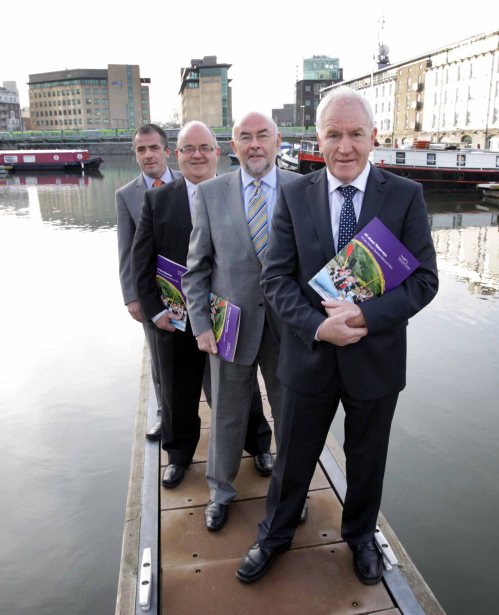
The usual prize of a glass of something or other [and I know the last two prizewinners still have a claim on me] for the best non-libellous caption for this photo, taken today at the launch of WI’s education programme for primary school children. I understand that the materials on WI’s e-learning page are complemented by “an off-line teachers resource pack”, which is what the besuited ones are clutching.

No lifejackets. Photo courtesy of Waterways Ireland, who are not to blame for my decision to use it for a caption competition

Starting at the back, the four chaps are Éanna Rowe, Waterways Ireland’s Marketing Honcho; John Martin, Heid Fector o’ Waterwyes Airlin [as we say in Ulster Scots]*; Ruairi Quinn, Minister for Education and Skills; Jimmy Deenihan, Minister for Arts, Heritage and the Gaeltacht but, on the other hand, a strong personal supporter of the Lartigue Monorail, which is a point in his favour.

Update 4 December 2012: the press release is now on the WI site.

* In its 2008 Annual Report, Waterways Ireland was, in Ulster Scots, Watterweys Airlann on the cover but Watterwyes Irelan in the Foreward bae the Cheif [sic] Executive, who signed himself as Chief [sic] Executive. By 2009, though it was still Watterweys Airlann on the cover, it was Waterwyes Airlan in the Foreward bae the Chief [sic] Executive, who signed himself as Heid Fector, a title I rather like. By 2010, though the cover remained unchanged as Watterweys Airlann, the body was Watterwyes Airlan in the Foreward, but the Heid Fector title had been dropped, alas, and John Martin was Chief Executive in two languages.

But 2008 was not the Heid Fector’s first appearance: in 2007 John Martin signed himself thus, though the foreword was called Twarthy words bae tha heid yin and the body was referred to in the text as Wattherweys [sic] Irelan.

Back in 2006, the foreword was Innin wi tha Heid Fector, and the body was Watterweys Airlann, with an accent, which I can’t reproduce, over the first e. That was the same as in 2005; in both years John Martin signed himself as Heid Fector.

I’m not sure whether I prefer Heid Yin or Heid Fector, but either seems better than Chief or Cheif Executive. But the real problem is the difficulty that this inconsistency causes for us eager students of Ulster Scots. I realise that change is inevitable in a thriving, developing language or dialect, but perhaps the cross-border bodies could give a lead in standardising the vocabulary and spelling.

Software licence agreements

A universal translation:

All your base are belong to us.

Political parties

Regular readers will know that I sent and FOI request to the Department of Community, Equality and Gaeltacht Affairs [now the Department of Arts, Heritage and the Gaeltacht] looking for files on the Clones Sheugh (aka the Ulster Canal). One of the grounds on which I was refused access was that certain files related to “the costing, assessment or consideration or any proposal of a political party carried out for or on behalf of that party”.

While my appeal against that refusal continues on its course, I thought I might as well ask the political parties directly for the information that might be in those files — in the process, of course, establishing which of them had Clones Sheugh proposals in mind.

Party time

As far as I can see, the parties that contested, or were eligible to contest, the 2011 general election were:

Christian Solidarity Party
Fianna Fáil
Fine Gael
Fís Nua
Green Party
Labour
People before Profit
Sinn Féin
Socialist Party
South Kerry Independent
Workers and Unemployed Action Group [WUAG]
Workers’ Party.

Accordingly, I decided to email them all, enquiring whether they had asked the [then] Department of Community, Equality and Gaeltacht Affairs for information “relating to the costing, assessment or consideration of the restoration of some or all of the abandoned Ulster Canal”. I added that, if they had done so, I would be grateful for a copy of the query they put to the department and of the response they received. I told them that I was sending my query to all political parties that contested the 2011 general election (or at least to all those for which I could find an email address).

That was not quite true: I omitted the South Kerry Independent Alliance, on the grounds that its interest in the Clones Sheugh was likely to be limited (I am of course open to correction on this). Furthermore, I was unable to find any website or email address for WUAG so I did not send my request to them.

Fianna Fáil logic

All of the other parties had websites and email addresses — except one: Fianna Fáil. Now, strictly speaking it falls outside the range of parties in which I might have been interested: not just for the obvious reasons but because it was in government at the time and would automatically have had full access to the civil service costings (such as they were). But I was interested to note that Fianna Fáil did not provide an email address on its website: interested enough to ring it and ask for an email address for its press office. The polite receptionist asked someone and told me that the address to be used was pressoffice@fiannafail.ie.

So I sent my query to that address. And I got back an autoresponse saying

This email is not monitored. For urgent queries you can contact the FF Press Office on 087 955 5600.

Well I never. What was the point of that?

Labour gains

Anyway, the results so far put Labour in the lead: I got an almost immediate informal response from Dermot Lacey, saying that he didn’t think Labour had contacted the department; I also got a more formal response next day, from Mags Murphy, Director of Councillor Services and Training, saying:

Labour did not include a specific commitment to the development of the Ulster Canal in our manifesto in the 2011 Election.

However, Labour is keen that all practical possibilities for cooperation, reconciliation and mutual benefit, including maximising tourism potential from a development of the Ulster Canal would be considered seriously as part of our deep commitment to the Good Friday agreement.

To this end, the Labour members of the Implementation of the Good Friday Agreement committee visited the Ulster Canal, Enniskillen and Clones with their cross-party colleagues for a range of meetings on 27 September 2012 with Waterways Ireland officials, local councillors and community groups.

Oh dear. Still, brownie points for responding.

What is the Implementation of the Good Friday Agreement committee?

Where are the others?

I am still awaiting responses from the other political parties.

Declaration of non-interest

I did not vote for any of those parties.


Every jar that hit the bar

This site has just passed 250,000 views.

Support the Clones Canal

It was suggested to me today that, because some boating organisations want the Clones Canal, the project must be worthy of support. I find that argument less than convincing. If I offer someone the benefit of a sum of money, without charge, I will not be surprised if that person likes the idea — but that won’t show that it’s a good deal for whoever bears the cost.

In this case, owners of boats are being offered the benefit of €45 million, so it’s not surprising that they like the idea. But I think they should be offered a practical method of demonstrating the depth of their support.

Accordingly, I propose that owners of registered boats on  the Shannon and the Erne be offered the opportunity to pay half the €45 million cost (the other half could be raised from a levy on the publicans of Clones, the other main beneficiaries). If there are 10,000 boats, the charge per owner, spread over three years, would be no more than €750 a year. Willingness to pay would provide more convincing evidence of support and would also make the project better value for the taxpayer.


DCAL, DAHG and WI

I was interested to see that DCAL has its own research programme [DOC file], but also makes use of other research services including the NI Continuous Household Survey:

To monitor engagement in culture and sport in Northern Ireland

The Continuous Household Survey (CHS) and the Young People Behaviour and Attitudes Survey (YPBAS) will continue to monitor engagement in sport, arts, museums and libraries in Northern Irelandfor adults and children. The CHS will also capture engagement by people in Northern Irelandat fisheries and waterways under DCAL’s control as well as engagement in Irish and Ulster-Scots languages and events. The barriers and benefits to engagement will also be explored.

DCAL and non-navigaBLE Waterways

I don’t know whether “waterways under DCAL’s control” are deemed to include those managed by Waterways Ireland as well as those directly controlled by DCAL:

The Department also has ownership of, and custodial responsibility for, those remaining sections of the Lagan and Coalisland Canals that remain in Government ownership following abandonment of navigation in the 1950s. An ongoing programme is in place for each of these highly popular towpaths to upgrade access for pedestrians, cyclists and disabled access.

I don’t suppose it would make much sense to ask questions about just two derelict waterways while ignoring those that are navigable, but the results are not shown on the CHS web pages: interested folk must ask DCAL direct.

I note that the DCAL Resource Accounts for the year ended 31 March 2011 [PDF] show that DCAL “Estimates provided for expenditure on […] certain inland waterways (including payments to the Rivers Agency), Waterways Ireland, […].” Later, we read:

Inland Waterways

DCAL manages and maintains 11 miles of the Lagan Towpath from Stranmillis to  Sprucefield; 3.5 miles of towpath at Soldierstown, Aghalee; 4.5 miles of towpath on the  Coalisland Canal; 22 water recreation sites; and shooting rights over the foreshore of Lough Erne. Work on the development of a policy on the re-opening of abandoned canals is in the preliminary stages.

Given that DCAL can own and run waterways, I wonder why the supporters of the Newry Canal did not seek to have it taken over by DCAL rather than by Waterways Ireland.

Water recreation

The non-navigable waterways are the second of DCAL’s three main activities. The first is this:

We are committed to developing the recreational potential of inland waterways through our Province-wide Water Recreation Programme.

Applicants, such as Local Authorities, are encouraged to work in partnership with the Department in providing and promoting water recreation facilities such as riverside paths and boat moorings for public use. Wherever practicable, works will incorporate disabled access facilities.

Again, the DCAL Resource Accounts for the year ended 31 March 2011 [PDF] provide more details:

Inland Waterways

[…] The Department continued to administer an annual Water Recreation Programme, amounting to £430k in 2010-11, aimed at developing the recreation and navigational potential of Northern Ireland’s Inland Waterways. Applicant organisations, primarily local authorities, were encouraged to work in partnership with the Department in the provision of water recreation facilities, such as riverside paths and canoe trails, complementing the Department’s continued commitment to upgrading the Lagan and Coalisland Canal towpaths for shared pedestrian and cyclist use. 9 new projects were completed during 2010-11. Funded projects were required to have an identifiable strategic value and where possible, contribute to the Department’s commitment to provide at least 5 kilometres of new or improved access for disabled persons each year.

This too would cover cooperation with the four local authorities who control the Newry Canal.

Oddly enough, inland waterways and fisheries are grouped together on DCAL’s website but they are in two separate divisions: waterways, for some reason, are in Culture whereas inland fisheries come under Sport, Museums and Recreation. DCAL does not, however, put waterways under southnorthery.

DCAL and DAHG

There is a useful contrast here with DAHG, which thinks that waterways exist purely to serve northsouthery: despite what WI thinks it is for

Waterways Ireland has responsibility for the management, maintenance, development and restoration of inland navigable waterways principally for recreational purposes.

… DAHG does not appear to have adopted the view that waterways are for recreation. Perhaps if it gained responsibility for some waterways outside WI’s scope, it would develop a policy on recreational use of waterways. That would mean that, like DCAL

The Department is also the sponsor department in Northern Ireland for Waterways Ireland which is the Cross-Border Body responsible for the management, maintenance, development and restoration of operational waterways throughout the island of Ireland.

… DAHG would be the department responsible for recreation on waterways, one (large) set of which are managed by WI, which in turn is controlled by the two departments.

The difficulty with DAHG’s current arrangements is that there is a division between theory and reality, but DAHG has organised its functions on the basis of theory. In reality, waterways are for recreation (or, if you prefer, leisure), but DAHG insists that they’re for northsouthery. Because that’s now been successfully routinised, waterways receive relatively little attention and are not, as far as I can see, considered as part of state provision for leisure or recreation. There can be no proper policy-making for the sector unless it’s grounded in reality.

Stakhanovite homoeroticism

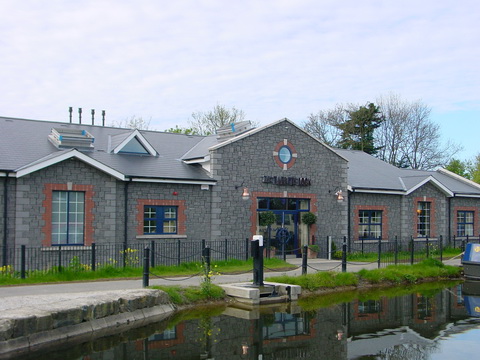
I see in the blatts — well, the Sunday Business Post, actually, although I do realise that other newspapers are read in the servants’ hall — that the Twelfth Lock Hotel at Blanchardstown, on the Royal Canal, is to be sold by public tender on 1 March 2012. No estate agent — the only contact details are for a solicitor and a FRICS FRICI, which means a surveyor (I think) — so there is nothing on tinterweb.

The Twelfth Lock Hotel

The hotel is described thus:

Unique Hotel Opportunity

‘THE TWELFTH LOCK HOTEL’, Castleknock Marina, Royal Canal, Castleknock

Purpose built, 10 Bedroom Hotel, with Loune Bar/Restaurant, private Lounge, Beergarden/Smoking Patio, outer garden and private car park. In unique setting alongside the picturesque Royal Canal Marina.

Older folk will note the link to this story.

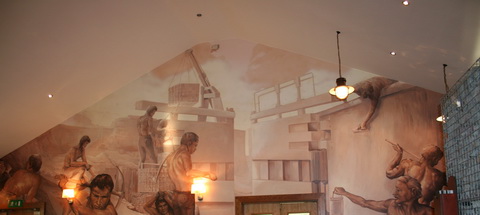
I stayed in the hotel once; it was fine. I’ve been in the bar a few times, and noted three things. The first was a range of beers that was wider and better than most Irish pubs serve (which is admittedly not saying much). The second was that the bar food was tasty and served in generous quantities. The third was the mural (I’ve cropped the lower part of the photo to omit the customers) of chaps building the canal.

Twelfth Lock Hotel mural

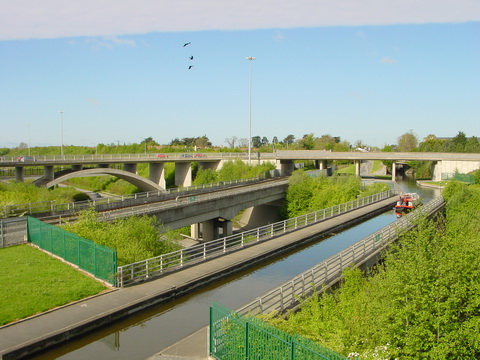
The hotel is in a wonderful location, off a quiet road but close to the railway, the M50 motorway and the Wonderful O of the junction with the Royal Canal crossing in the middle.

Crossing the Wonderful O


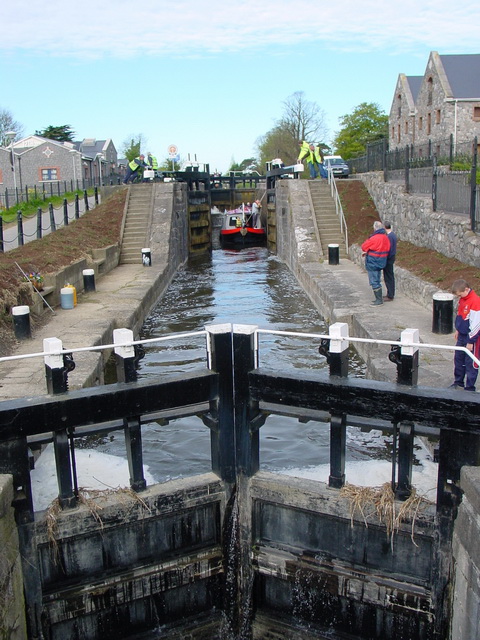
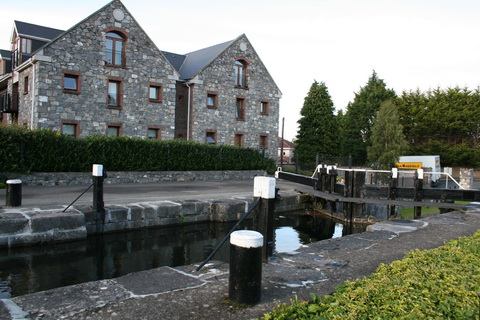
Boat descending the twelfth lock (a double). The building on the left at the top is the hotel


Across the canal are flats is where the Blanchardstown Mills stood; the site has unsuspected depths.

Flats

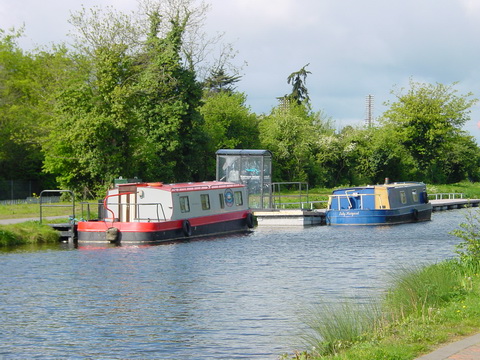
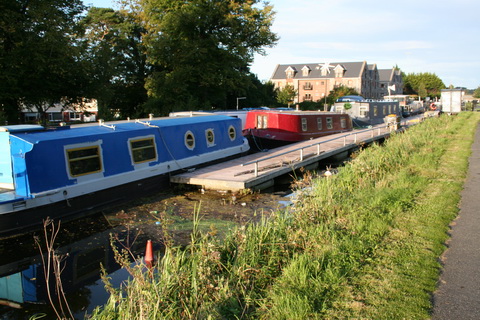
I don’t really know the status of the “marina”. It seems to consist of a short run of pontoons with gated access. I think it’s a good idea to have such an arrangement; perhaps something similar could be done on the Grand Canal.

The marina (2005)

The marina (2009)


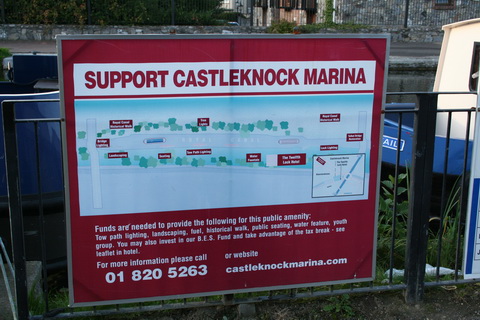
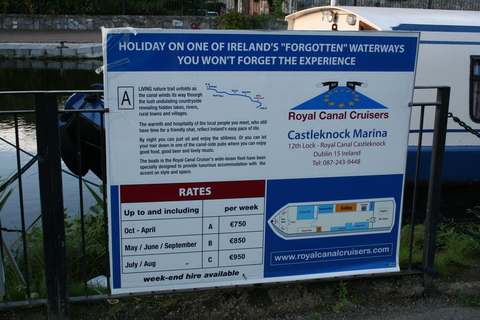
But who runs it and controls the allocation of spaces? I don’t know: although the gateway seems to have Waterways Ireland branding, there is also this sign:

Castleknock Marina sign

Its website doesn’t seem to have changed much for several years and the “How goes it” page, showing progress in raising funding, doesn’t seem to work. There is a hire firm too.

Hire firm

It would be nice if the hotel, marina and hire firm were to continue in operation.