Tag Archives: boats

What’s it oil about?

What with all those nasty chaps [PDF] doing whatever it is they do to diesel, thereby cheating the citizenry and polluting the countryside, it seems that the Revenue Commissioners, whom god bless and preserve, came up with a new scheme last year that might be made to look like a solution. (The real solution, of course, is to abolish green diesel, charge everyone full whack, and — if you really must, although personally I think they get too much subsidy as it is — give farmers back some money to shut them up … for a while.)

The new scheme is outlined here. As far as I can make out (but IANAL), anyone selling marked fuel oil (which I guess would include marinas selling it for private pleasure navigation, the category I’m interested in) has to pay €250 to get a Marked Fuel Trader’s Licence.

Actually, I may be simplifying it unduly: first they have to apply to be allowed to apply.

If this Application is approved the National Excise Licence Office will issue you with an Application Notice to apply for the Licence.

If the marina counts as a “forecourt retailer”, it also has to make a monthly electronic return of “oil movements”.

These requirements came into effect on 1 October 2012 and the Revenue website provides a 147-page PDF list of licence-holders as at 31 December 2012. I’ve had a quick look for a few Shannon marinas; I found none of them, although I confess I haven’t read the whole thing.

I haven’t been to any of the seminars (although I’ve looked at some of the PDFs available on that page) and I haven’t contacted the official sources of information (although I have emailed the Revenue press office). I have read the FAQ, though. There is no reference to boats or marinas or private pleasure navigation, so I assume that the scheme does apply to marinas. As far as I can see (again, IANAL), all traders in marked fuel must have licences, even if they sell only small quantities. However, for those selling under 2000 litres per customer per month, there is a simpler monthly return:

However, if you supply less than 2,000 litres per month per customer, you only need to notify Revenue of the number of customers you supplied during the month as well as the aggregate quantity of fuel supplied.

That would cover most marinas, I imagine, although the ROM1 procedure still has to be used.

The first return, in respect of oil movements during January 2013, must be submitted by 25 February 2013.

So does this apply to marinas? I’ve asked Revenue but I don’t expect to hear for a few days. If it does apply, what will the effect be? Is the increased cost (time to compile the application and meet any Revenue demands; €250; whatever the ROM1 system costs) likely to be significant? How are the marinas (and other waterways fuel retailers) responding?
An early narrowboat on the Royal Canal?

This photo, which is used in Ruth Delany’s Ireland’s Royal Canal, shows the Royal Canal harbour in Mullingar, from the bridge. Note the very large amount of timber lying around (could some of it belong to Russells of Portarlington?). The wooden barge in the foreground has had its tiller unshipped, but what’s all that kit on deck and in the hold?

Then look at the vessel in front of it, which seems to be more the sort of beam we’d expect on an English narrowboat. It’s very hard to see any details, but could it be a steam tug?

Carrying on the Royal Canal

This is a point I’ve come across in passing. It’s not central to my main concerns so I won’t pursue it further for the moment, but I’m posting it here in case it helps anyone else researching the subject.

It will be recalled that, until the passing of the Canal Carriers Acts 1845 and 1847, most canal companies carried passengers but not freight on their own canals. After the passing of those acts, the Grand Canal Company set out to take over the bulk of the freight business on their own canal (and, in consequence, on the rivers connected thereto). But what of the Royal Canal, which had been taken over by the Midland Great Western Railway in 1845?

Ruth Delany, in Ireland’s Royal Canal 1789–2009 [with Ian Bath; The Lilliput Press, Dublin 2010], says on page 192:

In 1871, despite its failure to show a profit on the Grand Canal lease, the MGWR decided to try acting as carriers on the Royal, which had been permitted by legislation since 1845. Horse-drawn boats were used until 1875 when five steamers were purchased: Rambler, Rattler, Mermaid, Conqueror and Pioneer.

In a note, she says

For this period, 1849–1906, the principal source of information is found in the minutes of evidence to the Shuttleworth Commission, HC 1907 (Cd 3717), XXXIII, Part 1, 9.

Peter Clarke, in his The Royal Canal: the complete story (ELO Publications, Dublin 1992), says:

It is important to recall that at this time, the carriage of goods on the canal was undertaken by a number of boat owners who paid tolls to the railway company. The failure to have these tolls increased was what most probably prompted the railway company to establish themselves as carriers on the canal in 1870. […] Until 1876 an unknown number of railway owned horse drawn barges were used. In that year, the service was expanded when four new screw propelled boats were purchased at a cost of £5000.

His source is the Waterways Commission of 1923, Minutes of Evidence nineteenth day, p13.

Ernie Shepherd in The Midland Great Western Railway of Ireland: an illustrated history (Midland Publishing Ltd, Leicester 1994), says

The MGW decided to operare its own carrying trade in 1871 and this lasted until 1886. Horse drawn boats were used until 1875 when steamers were purchased.

On 15 August 1853 The Freeman’s Journal and Daily Commercial Advertiser of Dublin carried this notice in the Railways column.

Midland Great Western Railway (Ireland) Company — Royal Canal

Haulage of boats

The Directors will receive Proposals for the Haulage of their Trade Boats to and from Dublin and Longford and the River Shannon, from and after the 12th November next. Parties are at liberty to tender for a part or the whole of the work. Security will be required for the fulfilment of the Contract; and further particulars may be had on application at this Office.

Tenders to be sent in on or before 10th September next.

By order, Henry Beausire, Secretary.
Dublin Terminus, 10th August, 1853

This suggests that, in 1853, the MGWR had its own trade boats (lumber boats, freight-carrying barges) at work on the Royal Canal. It would be nice to know more. I have said before that we do not know anything like the full history of the Royal Canal.

Where is this?

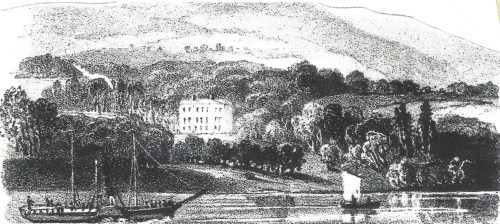
Paul Gauci's 1831 drawing of a Shannon steamer

Paul Gauci’s 1831 drawing of a Shannon steamer

This drawing of a steamer is from an 1831 book called Select Views of Lough Derg and the River Shannon by Paul Gauci. I haven’t seen the book myself, but this illustration is used in a couple of places, including Ruth Delany’s book The Shannon Navigation [The Lilliput Press Ltd, Dublin 2008]. Andrew Bowcock, in his article “Early iron ships on the River Shannon” in The Mariner’s Mirror Vol 92 No 3 August 2006, says of the steamer shown that

The funnel looks to be almost over the paddle shaft, which is artistic license.

But my question is not about the vessel but about the house in the background. If it is drawn without artistic licence, where is it?

It is a very large house, seven bays by three storeys, quite close to the water. Using the Historic 6″ Ordnance Survey map [~1840], I have followed the banks of the Shannon from Shannon Harbour down Lough Derg to Killaloe, then from Limerick down the estuary as far as Tarbert, across the estuary to Doonaha and back up on the Clare side to Limerick, then from Killaloe up the Clare and Galway shores back to Shannon Harbour. Anywhere I found a large house within what seemed the right distance of the shore, I looked it up in the Landed Estates Database and in the National Inventory of Architectural Heritage, with some supplementary googling.

I haven’t been able to find images of all the houses marked on the OSI map, but I found enough to show that houses of the size shown by Gauci were very rare. Within those few, I ruled out some (like Tervoe) because they didn’t seem to match Gauci’s drawing (although alterations could have accounted for that). I ended up with only one house that looked at all like Gauci’s, but the background may not match.

If you can identify the house, I would be glad if you could leave a Comment below.

Dick Gaughan and John Grantham …

… both had an interest in Erin-go-Bragh,

Ballycorick

I’ve updated my page on Ballycorick to take account of information provided in a Comment by Kenin Murphy, to whom I am grateful.

Some new things arise

First, I’ve checked all the linked sites listed at the bottom of the right-hand column and removed some that have died. If you know of others to which I should provide a link, do please let me know.

Second, I’ve added a link to the excellent Grace’s Guide to British Industrial History, and I take the opportunity to draw it to the attention of folk interested in who made what. I have received much useful information from its volunteers and I have been able to contribute photos of a few artefacts. It’s well worth exploring. I have also added a link to the Railway and Canal Historical Society.

Third, I am glad to see that the Irish Times‘s conversion to the benefits of civilisation continues: yesterday it featured an Intel Pentium chip from 1994, which provided the basis for an essay on Ken Whitaker’s 1950s report, globalisation, television, women, Northern Ireland and Viagra. If only some more of the nineteenth century industrialists, entrepreneurs, engineers and modernisers had been covered.

That, fourth, reminds me that I came across a couple of interesting articles by Roy Johnston on the Victorian Web site: they’re under the heading Science, Technology, and Politics, on this page, which has several articles about Ireland. They include articles on whether Ireland was a colony, although I must confess that I have yet to be persuaded that that is a question in which I should take an interest.


From Kilrush to Carlingford …

ferry interesting news.

The Rideau Canal

The Cedar Lounge Revolution has an article about those who worked on the construction of the Rideau Canal in Canada in the 1820s and 1830s. Readers will, of course, recall that Charles Wye Williams compared the Rideau and the Shannon in his 1835 […] speech on the improvement of the Shannon: being in continuation of the debate in the House of Commons, 12th May, 1835, giving a comparative view of the navigation of the Rideau Canal, in Canada, and the River Shannon in Ireland, with observations on the value of a connection by steam packets, with British America.

SESIFP

Read about the draft Strategic Integrated Framework Plan (SIFP) for the Shannon Estuary here. You can comment on it up to 15 February 2013.