Tag Archives: boats

Da new kidz in da hood

A couple of canally sites I hadn’t come across:

  • da corpo’s canal (h/t IndustrialHeritageIreland)
  • Dublin canal walks. I don’t know who is behind this site, which looks like a work in the early stages of progress, but I’m all in favour of folks’ walking along Dublin canals; my own effort at encouragement is here.

Industrial Heritage Ireland, by the way, has been watching the Clones Canal campaign. This suggests that the campaign is being cranked up, although I don’t know what the poor buggers from the NI Strategic Investment Board are doing in the group: pouring money into holes in the ground is not (pace Keynes) usually seen as an investment.

It is reported, nonetheless, that IWAI folk are confident that public money will be wasted on the ghastly project, thus subsidising their hobby. And it seems that a gang of Irish parliamentarians, following the tradition established in Grattan’s Parliament, are keen to distribute pork: there is nothing in the press release to suggest that any of the poor dears have any interest in assessing the costs and benefits of the Clones Canal proposal. In the unlikely event that any of them is interested, the pages starting here might be useful. And interested parliamentarians might like to check on any cost-benefit analyses done (or revised) since it was found that the canal would cost €45m, not €35m.


Coill an Eo

Arklow Marine Services reports:

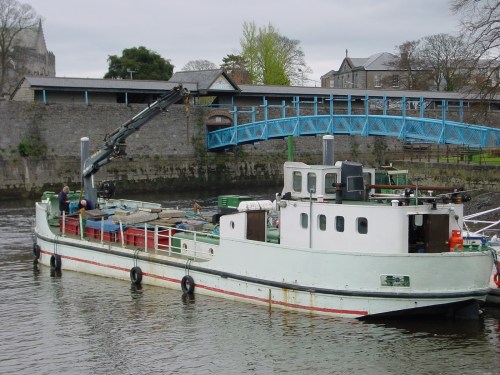
The “Coill an Eo” a 26 metre works barge, used in maintaining buoys and markers on the Shannon and owned by Waterways Ireland, has recently been docked in Rooskey, Co. Roscommon.

The first job the Yard had to do was carry out ultrasonic readings on the vessels hull, both internally and externally. A new main engine, tailshaft, propeller and bearings are to be fitted to the vessel and a complete electrical installation carried out.

Coill an Eo in Limerick in 2003

More photos of WI vessels here.

Pat Sweeney, in Liffey Ships and Shipbuilding Mercier Press, Cork 2010, says that Coill an Eo, launched in 1969, was the last vessel built on the Alexandra Basin slipways. He describes her as “a small grab hopper dredger” and says that the £40,000 cost was shared by the Commissioners of Public Works (then responsible for the Shannon) and Bord Fáilte.

How to collide

Cases, however, occasionally arise in river navigation, wherein it is not possible to avoid collision, either with vessels, barges, or boats; as, for instance, in the pool, near the Tower, &c, owing to the very crowded condition in which such places are generally found; being surrounded on every side by one or the other. In such a dilemma the only alternative is to stop the [paddle-]wheels, and let the vessels close together as easy as possible, taking care to guard the sides and paddle boxes with fenders, and using every endeavour to boom each other off; after which, let the Steamer drift with the tide, but watch an opening among the vessels for escape, and, so soon as it offers, set her on at rather better than half speed, in order to insure a command of her.

It is somehow consoling to know that even Commanders RN have been known to collide ….

The quotation is from Commander Robert Otway RN An Elementary Treatise on Steam, more particularly as applicable to the purposes of navigation, with a familiar description of the engine; Shewing the manner of its management in giving the Rotatory Motion; how started, eased, and stopped; the Nature and Properties of Steam, on both High and Low-pressure principles; its introduction into, and discharge from, the Cylinders, illustrated; as, also, how to ascertain the quantum of Actual Pressure at which the Engine is working; and the manner of Condensing Steam explained; together with a General Account of the operations of the Engine-Room; shewing the Accidents to which Steam Boilers are liable, and means of prevention; and, further, the Economy of Coals, how to be effected, &c, &c G Poore, Plymouth 1837.

This is a very readable book, available here as a free Google PDF, giving an interesting insight into the problems of the early naval steamers — and of their engineers.

The Broadstone in 1821

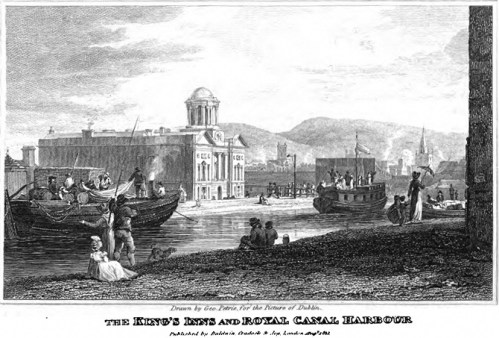
The Broadstone Harbour with King’s Inns in the background, early 1820s

This is a drawing by George Petrie, made for J. J. McGregor’s New Picture of Dublin of 1821. The details of the vessels are interesting. More on the Broadstone here.

Kilgarvan Quay

On 3 October 1906 Mr Hugh Delaney of Borrisokane, Co Tipperary, gave evidence to the Royal Commission appointed to enquire into and to report on the canals and inland navigations of the United Kingdom. Tipperary (North Riding) County Council had asked him “to give evidence on behalf of the quay at Kilgarvan.”

His evidence became rather confused, as he and his interlocutors misunderstood each other. The source of the problem seems to have been his using the term “the canal” to refer both to the Grand Canal Company and to the canal itself. The main points of his evidence were these:

  • Kilgarvan Quay was “only of recent date: it was only opened in [October] 1891 and it has had an extraordinary effect on the traffic of the district and brought down the railway rates [from Cloughjordan] very considerably”
  • there had been no quay at Kilgarvan before that; there was deep water at the quay
  • the grand jury of the North Riding of Tipperary gave £230 towards the cost and the Grand Canal Company paid the rest, about £579
  • although it was only 104 miles from Kilgarvan Quay to James Street harbour, it took five or six days for barley to reach Dublin
  • he felt that the trip should be done in two days, using steam launches
  • he thought that transhipment at Shannon Harbour caused undue delay
  • people at Terryglass had built a quay and it made a port of call for the Grand Canal Company.

The present quay at Kilgarvan is not on the ~1840 OSI map (though there is a smaller quay near the bend in the road) but it is on the ~1900. I have a photo of the crane on my page about Shannon cranes; I’m no expert, but I wonder whether the crane might be older than the quay.

Canal mooring rules

Waterways Ireland issued two press releases about moorings today. The first was the usual one about winter moorings on the Shannon and the SEW; the second was about the canals. Here, unedited, is the text of the second.

Canal Mooring Rules Coming into Force

Waterways Ireland announced in June 2012 that the Canal Bye-laws on the Grand & Royal Canal and Barrow Navigation are to be enforced from autumn 2012, with an accompanying change in the permit system allowing for year-long mooring permits and locations.

Part of bringing in this new location-based permit has been the identification of locations suitable for extended mooring. This process is now completed and work has begun in some areas to improve accessibility.

Waterways Ireland will roll out Extended Mooring Permit applications by area, rather than giving a date when applications for the permit will open. For boat owners this will mean that enforcement of the maximum stay rule will not commence in an area until after boat owners have had the opportunity to purchase an Extended Mooring Permit.

The initial 12 month Extended Mooring Permit will cost €152 and will only be available to boats already holding a valid annual Mooring and Passage Permit.

Boats that cruise and move (staying at a mooring for up to 5 days) will not be in breach of the Bye-laws or require an Extended Mooring Permit.

Waterways Ireland has proposed a small number of draft amendments to the current Bye-laws which date from 1988. These include proposals to provide a range of charges for mooring permits that reflect the location and services provided throughout the canals and also will take into account the size of boat. These proposals include low cost rural moorings on soft banks to ensure the canals are accessible for everyone who owns a boat and requires a mooring. Boat owners allocated an extended mooring location in key areas in villages or towns or with services should be aware that if the new Bye-laws are approved Waterways Ireland will increase the charges for moorings in the future to reflect the location, services, and size of boat.

Waterways Ireland recognises the current situation whereby a small number of boat owners use their boats as their sole or permanent residence. Proposals to make provision for this use of the navigation property have been included in the Bye-law changes.

Furthermore Waterways Ireland intends to work towards the provision of a small number of serviced house boat moorings on the canal network. Such provision will be subject to finance, land availability and compliance with requisite statutory approvals.

Waterways Ireland recognises that a transition period of a number of years will be required to implement this. In the interim these boat owners should apply for an Extended Mooring Permit.

The draft Bye Law amendments are currently being considered by Waterways Ireland’s sponsor Departments. When Waterways Ireland has Ministerial consent, it will proceed to public consultation on the proposed Bye-law amendments.

Waterways Ireland will continue to contact permit holders regularly to ensure they are kept up to date with the roll-out of the new permit. All queries about the enforcement of the current bye-laws or the Extended Mooring Permit should be directed to Shane Anderson, Assistant Inspector of Navigation: Tel no +353 (0)87 286 5726, Email shane.anderson@waterwaysireland.org . Queries about houseboats should be directed to Property & Legal Section Tel no +44 (0)28 6632 3004.

These changes are necessary steps to improve the management of the canals and waterway amenities for both the navigational and recreational user, so that investment in the new infrastructure and facilities which Waterways Ireland has undertaken is maximised for every user.

The Repealer

Here is a brief account of a trip from Waterford to new Ross by steamer in 1842.

One for liveaboards

A Polish/German artist is showing an exhibition in Chelsea about an English houseboat community. Indie story here and photos here; if googling for “What the water gave me”, include the artist’s name Dubno to avoid results about a song by a hip beat combo. WI can count its blessings.

Speeding on canals …

… and the perils thereof:

Having reached the highest level of the great table-land, we traversed a space of fifteen miles without a lock; and here a curious phenomenon, illustrating the incompressibility of water, arrested our attention. About every twenty or thirty minutes, the horses are obliged to stop for five or six minutes, to take breath, the cause of which was this: — The velocity of the boat impelled the water in the canal with such force that it gradually rose so as to approach the summits of the banks, when it began to recoil, so as actually to form a back-water or stream, when the horses were unable to make head, and therefore stopped till the equilibrium of the canal was restored.

James Johnson MD A Tour in Ireland with Meditations and Reflections S Highley, London 1844

Hunting Newbury

In his A Tour in Ireland with Meditations and Reflections [S Highley, London 1844], James Johnson MD describes a flyboat trip on the Grand Canal from Dublin. He says:

At Newbury, a station near Edenderry, I debarked, and spent two or three days at the hospitable mansion of Newbury Hall, with my excellent friend Mr Wolstenholme and family, where I also met my amiable friend, Mrs Evans, of Portrane.

I have been trying to find Newbury. So far, the most likely candidate seems to be Newberry Hall, in Carbury, Co Kildare; the spelling Newberry is given on the ~1840 [Historic 6″] OSI map whereas the ~1900 [Historic 25″] map gives Newbury.

The Hall is indeed fairly close to Edenderry, but if Johnson got off the boat in Edenderry I’d have expected him to refer to it as Edenderry harbour. Looking at the OSI map (link above), the only other sensible point of debarkation would (I think) have been at Ticknevin Bridge, from which there was a road towards Newbury, but I have no evidence that it was Newbury station.

I would welcome enlightenment.