Tag Archives: bridge

Down the Rockville

Some time ago I wrote three pages about the Rockville Navigation, which is linked to Grange on the Carnadoe Waters in Co Roscommon.

I recently revisited the area. I was horrified, first, to find that the bridge — built in June 1765 — has been severely damaged, with large chunks of masonry in the cut beneath and with a crude wooden repair. How many bridges of that age are there in Co Roscommon? How many that are associated with one of the oldest navigations in the country? Please, someone, restore the bridge!
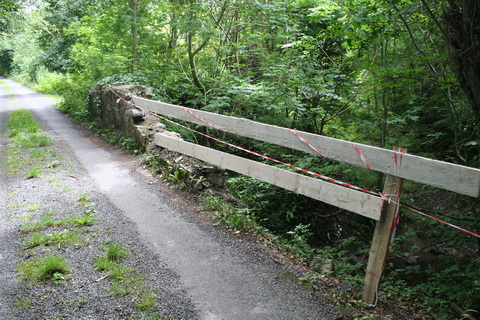
Damage to the bridge

Anyway, the more pleasant part of the day was the four hours that we spend descending, by dinghy and kayak, from the bridge to Grange. The route took us through artificial cuts, small lakes and sections of river, with very clear water and an extraordinary abundance of vegetation. This route would have been easily navigated by large wooden cots or similar boats, and it should be developed today as a canoe-and-small-boat trail. Even with very low water levels, we had no real problems, although someone has to end up with wet feet …. Here is an account of the trip.
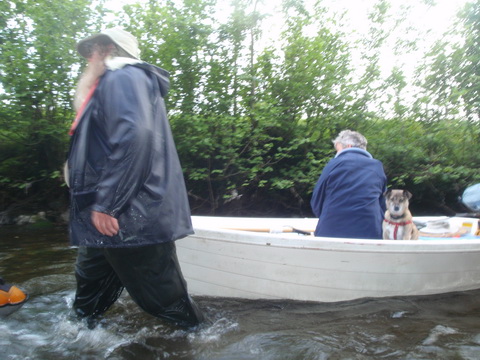
Wading in the water
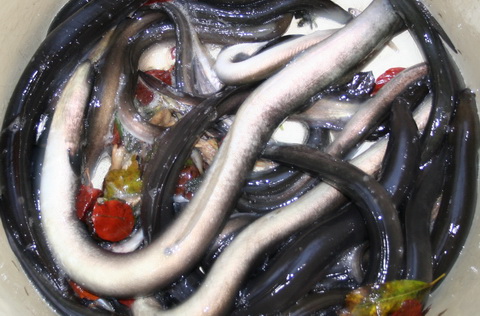
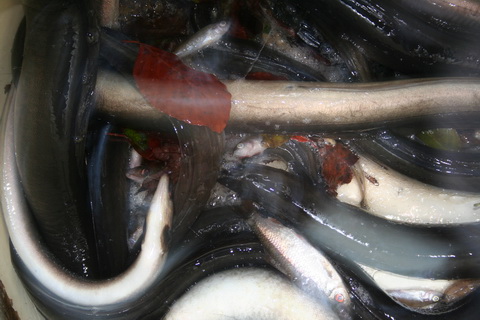
Anguilla anguilla: the ESB eel fishery

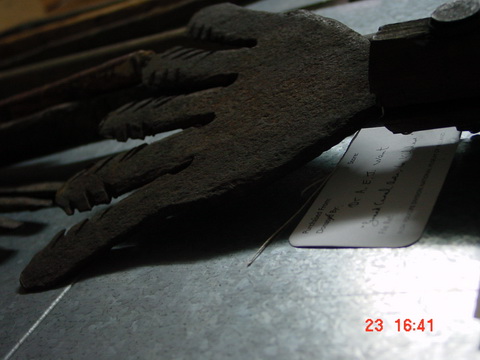
This photo shows an eel spear from the National Folklife Collection‘s overflow material, stored in the former “reformatory” at Daingean, on the Grand Canal in Co Offaly. There were many spears there, with different designs from different rivers. This one, to judge from the label underneath it, came from the extraordinarily prolific and observant Dr A E J Went.

If you look at pretty well any Irish river on the 1840s Ordnance Survey map (here’s the Shannon at Killaloe; switch to Historic 6″ if necessary), or indeed on the 1900s map (same URL but switch to Historic 25″), you’ll find evidence of eel weirs. Ireland’s shortest canal was built to allow the eel-boats of Anthony Mackey’s fleet to reach the trains at Banagher.

But the European eel is a “critically endangered species” and all eel fishing has been banned in Ireland. As far as I know, though, the Lough Neagh fishery, in Northern Ireland, continues.

The Electricity Supply Board (ESB) is in charge of the eel fishery on the River Shannon. It has nets and a storage unit (packing station) at Killaloe and, until recently, it also had nets at Clonlara on the headrace supplying the power station at Ardnacrusha; the Clonlara nets have just been removed. This page is about the Clonlara and Killaloe operations, but includes a look at an eel survey conducted for the ESB in 2008, before eel fishing was banned in Ireland. The aim now is to make it easy for eels to reach the sea to reproduce, and that sometimes involves “trap and transport”: catching the eels and moving them past obstacles, whether on their way to the sea or, for the young glass eels, on their way upriver.

The photos on this page are a tribute to what was an important activity on the Shannon. I hope that the European eel stocks can recover.

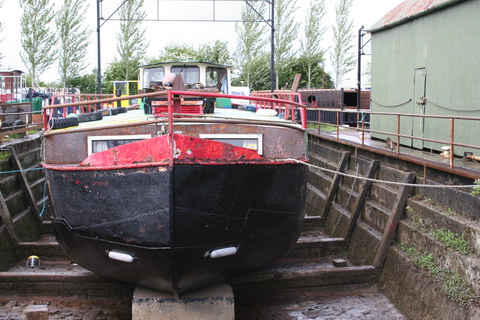
Shannon Harbour dry docks

My dry docks overview page had a bad link in it, which was my fault, but I hope that’s now fixed as the Shannon Harbour dry docks

34B in the dock

page is now up. Comments, corrections and suggestions for improvements and additions will be welcome.

From the Pierhead

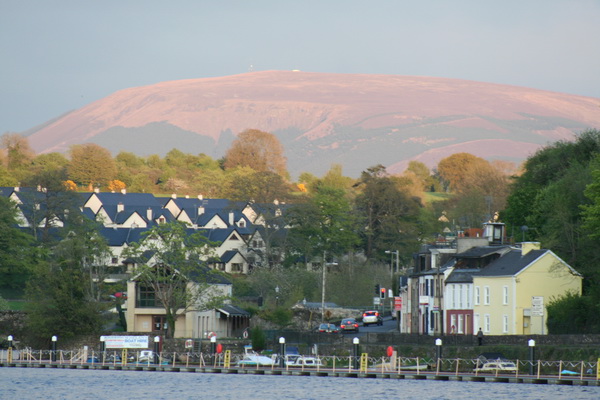
Ballina and Killaloe May 2010

Three German officers …

… didn’t cross the Rine, which is a river in County Clare, flowing into the estuary of the River Fergus which, in turn, joins the estuary of the River Shannon. The Rine is also known as the Quin and the Ardsollus and its downstream end is called Latoon Creek, no doubt because it flows by the townlands of Latoon North (which is to the east) and Latoon South (to the west). There is a quay there, hidden under one of the three road-bridges that cross the Latoon side by side. Sea-manure (seaweed used for fertiliser) was landed there and Samuel Lewis tells us that fifty-ton lighters were used, but more information is needed about their operations.

Read about it here.

Tralee Ship Canal

Tralee Ship Canal, about 2 km long, links the town of Tralee, in County Kerry, to the sea. It might be the most westerly canal in Europe (query Belmullet).

The canal was restored recently, courtesy of the taxpayer, but seems to be little used. It has a sea lock (but no other locks) and a swivel bridge. Here are some photos taken on a very wet and windy day.

Floods November 2009: kayaks at Curragour

One beneficial aspect of the floods is that there is lots of water for kayakists. Here are some pics taken at Curragour, on the Shannon in Limerick city, on 28 November 2009.

The Anner canal

Just east of the Bulmers factory in Clonmel, Co Tipperary, the Anner runs southwards to its confluence with the River Suir. A short distance north of the N24 (the road to Waterford), a canal separates off from the river and runs down the far side of a field, passing under the N24 a short distance to the east of the Anner. The bridge under which it passed is (or was, on the 1904 Ordnance Survey map) called Canal Bridge, which is the only information I have to suggest that this watercourse was thought of as a canal. I have a few photos of it here.