Tag Archives: canal

Hospital barge

Richard Hare, writing in Practical Boat Owner February 2014, drew my attention to this ww1 poem by Wilfred Owen..
Composite construction on Irish inland waterways

I wrote here about Watson’s Double Canal Boat, saying inter alia that, in 1839, William Watson, manager of the inland department of the City of Dublin Steam Packet Company, patented:

an improvement in the construction of ships, and which improvement is also applicable to all kinds of sea-going vessels; and also certain improvements in the construction of boats and other vessels intended to be used on canals and inland navigations. [1]

I quoted the Mechanics’ Magazine of December 1839, which said that:

Three canal barges have already been built upon Mr Watson’s plan of construction, of 60 tons burthen each, and with eminent success.[2]

I said that the size suggested that these canal barges were for the CoDSPCo’s Irish inland operations, but that I had no information about where they were built.  I have now found information about one builder.

SHIP BUILDING

On Thursday, the 22nd instant, a fine new trade boat, built with iron ribs, according to the patent of William Watson, Esq., and belonging to the City of Dublin Steam company, also a new smack, 50 tons measurement, were launched from the Brunswick dock-yard, Ringsend Docks.[3]

I would be grateful for more information.


[1] “List of patents granted for Scotland from 18th March to 18th June 1839” in The Edinburgh New Philosophical Journal , exhibiting a view of the progressive discoveries and improvements in the sciences and the arts Vol XXVII No LIII — July 1839; “List of English patents granted between the 25th of May and the 25th of June, 1839” in The Mechanics’ Magazine No 829, Saturday, June 29, 1839

[2] The Mechanics’ Magazine Vol XXXII No 855 28 December 1839

[3] The Freeman’s Journal Saturday 24 July 1841. An almost identical note appeared in the Dublin Evening Mail of Monday 26 July 1841.

Sending gunboats

From the Newcastle Courant 8 December 1843:

WARLIKE PREPARATIONS. — The Penelope steam-frigate has arrived in Kingstown harbour, loaded almost to the water’s edge with large gun-boats. They are intended for the Upper [ie non-tidal] Shannon, and the large lakes formed by that river in its progress towards the lower branch. A considerable number of persons were collected on the banks of the canal to witness their being towed to Portobello from the basin at Ringsend. They are immense boats, with great beam, capable of carrying two guns, and accommodating a large body of men. They are double banked, and each pulled by twelve rowers. As floating batteries they are most formidable, and furnish an important, as well as a novel, addition to the armament already existing in this country.

A threat to an existing navigation

I have a page here about the River Maigue, one of Ireland’s oldest improved navigations. Incidentally, the river’s name is locally pronounced Mag, to rhyme with bag.

In 2009 I wrote to the Powers That Be to suggest that the (much to be desired) bypass of Adare, a major bottleneck on the N21 Limerick–Tralee/Killarney road, should pass to the south of the town, thus avoiding the interference with the navigation that would undoubtedly have resulted from a northern bypass. It was no doubt the strength of my case, and a recognition of the importance of the navigation, that caused the Powers to opt for a southern bypass. A proposed link to a proposed M20 Limerick–Cork motorway may have been a minor factor in their decision: as nobody was going to build a motorway to Kerry, Adare would piggyback on the motorway to Cork.

However, An Bord Pleanála overturned the decision [PDFs available here] because the M20 proposal was withdrawn. The Irish Cattle and Sheep Farmers’ Association is pleased because it wanted a northern bypass of Adare, to be linked to a new road from Limerick to the port of Foynes; its submission on the matter is here [PDF]. A Limerick ICSA chap has a letter to the editor about the Foynes link in the current issue of the Limerick Leader, although it’s not yet available online.

Now, this proposal has the drawback that it might actually be slightly sensible: a better road to Foynes might stop people agitating for a restoration of the railway line and enable a speedy ending of port activities in Limerick, thus removing large piles of scrap from the riverside. But have the ICSA not considered the damage to the turf-boat traffic to Adare if a road bridge is added to the railway bridge downstream of Adare?

Draining Lough Derg

The ESB is currently letting more water down the old course of the Shannon, from Parteen Villa Weir through O’Briensbridge, Castleconnell and the Falls of Doonass. This channel gets the first 10 cubic metres per second from the Shannon; the next 400 go through Ardnacrusha and anything left over is sent down the old course.

The result is to help to reduce the water level on Lough Derg while raising it on the old course.

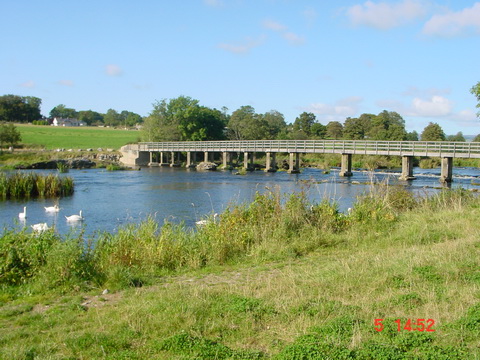
The footbridge in Castleconnell at normal summer level in 2002

The footbridge in Castleconnell at normal summer level in 2002

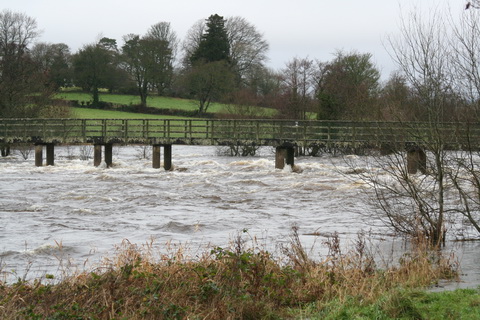
The footbridge on 1 January 2014

The footbridge on 1 January 2014

Before Ardnacrusha was built, the old channel took the entire flow of the Shannon, so it can take more than it has now.

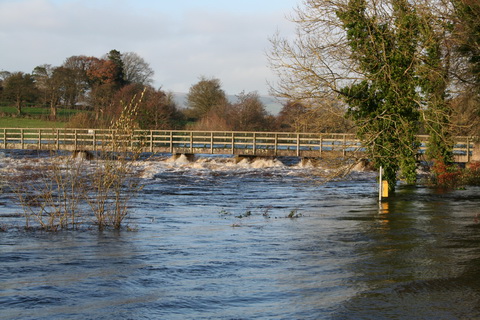
The footbridge in the floods of November 2009

The footbridge in the floods of November 2009

The level is still below that of 2009, when the land around the old channel flooded in several places. But much land is waterlogged: I saw yesterday that the upper reaches of the Nore, the Barrow and other rivers were in flood. And more rain is forecast.

Wouldn’t it be nice if some of that could be sent to Dublin instead? I see that some folk claim (on what looks like a website that hasn’t been updated for a while) that the evil Dublin folk want to extract 350 million litres of water from the Shannon every day; the original idea was to take it from Lough Ree but now it seems that Lough Derg is the preferred source.

Now 350 million litres sounds like a lot, but it’s 350 000 cubic metres per day, 14 583.3 per hour, 243.05 per minute, 4.05 per second, which is less than 1% of normal flow through the two channels draining Lough Derg. There’s a lot more at the moment, and the good citizens of Dublin are welcome to come down and fill their buckets. I suspect that Clare TD Michael McNamara has got things out of proportion.

Addendum: 350 million litres per day, over a lake whose area is 130 square kilometres, would lower the level of the lake (if my calculations are correct) by 2.69 millimetres. If no water entered the lake, the level would be down 983 mm after a year, ignoring evaporation and other abstractions and assuming that the Shannon and other tributaries no longer flowed in and that there was no rain.

Winter Quarters

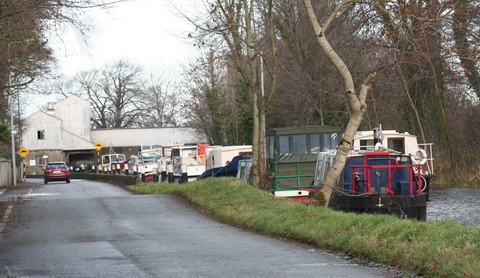
At Leinster Mills, Naas Branch, new year's eve 2013

At Leinster Mills, Naas Branch, new year’s eve 2013

Saving the nation part 97

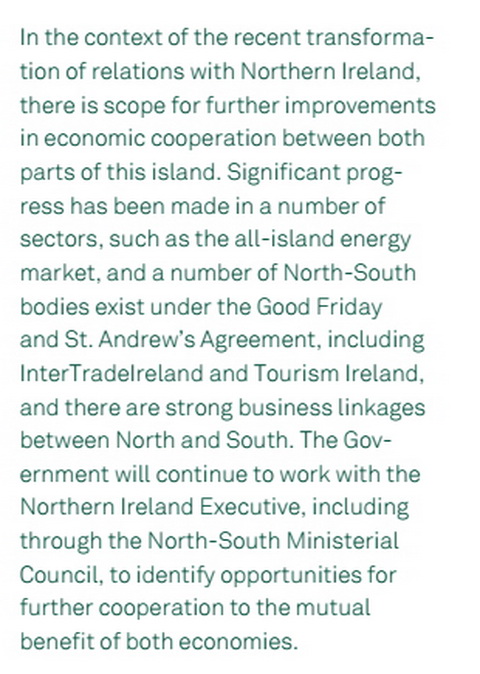
Clip_resizeThat’s from the government’s Medium Term Economic Strategy 2010 [PDF]. Not a word about the Clones Sheugh, which would undoubtedly save the economies of both jurisdictions on this island, but perhaps it will qualify for one of the new models of infrastructure funding mentioned hither and yon in the document.

Maybe the Sunbeds Bill would be more interesting – or more important.

PS Folk who write “between both” should be flogged naked through the streets before being hanged in the marketplace.

WI lifting boats

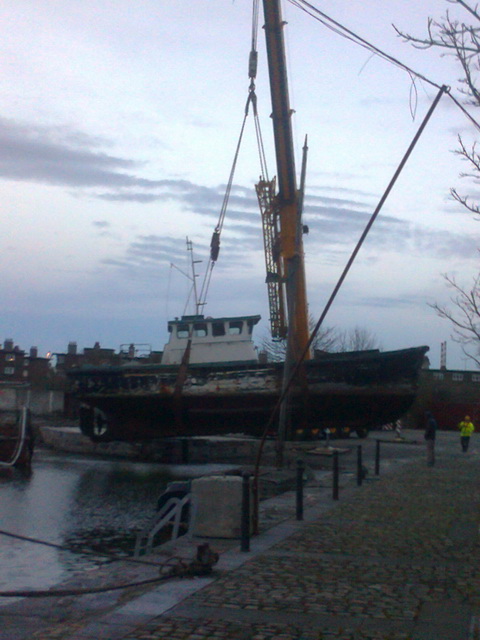
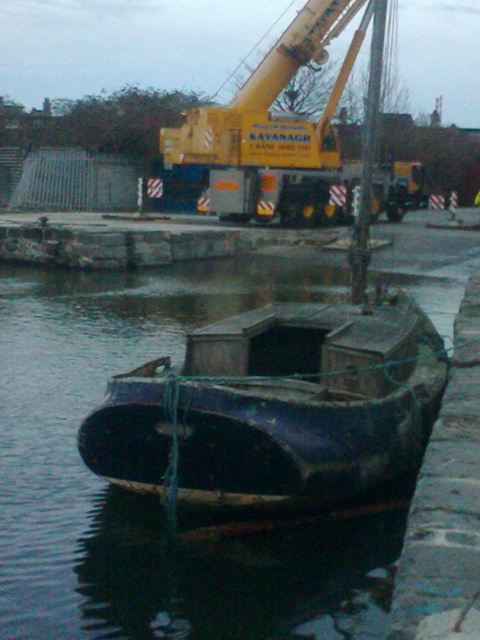
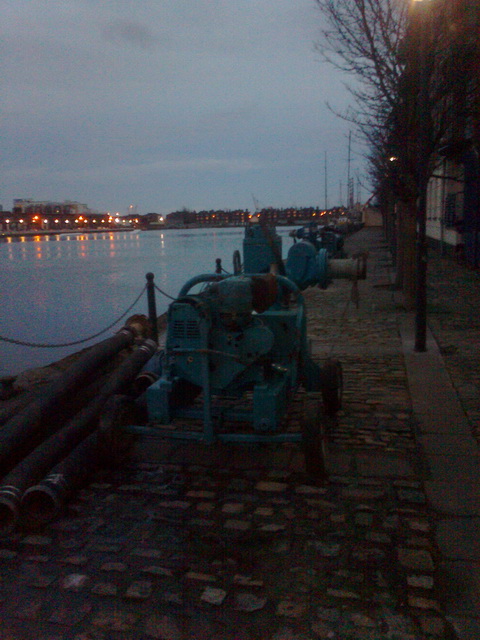
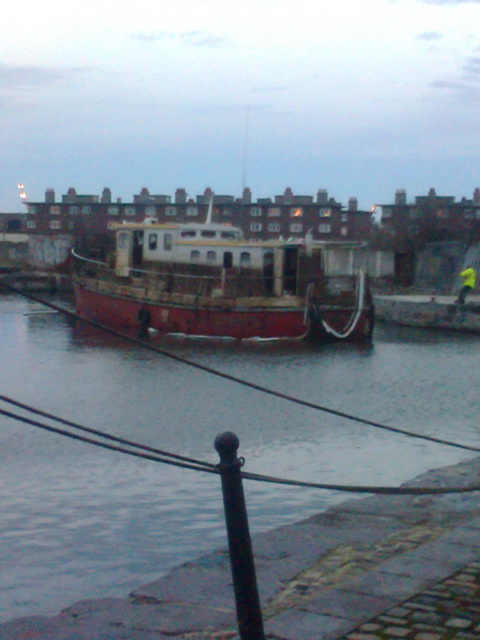
Waterways Ireland removed boats from Charlotte Quay in the Grand Canal Dock at Ringsend today.

being lifted_resize

Being lifted

getting ready_resize

Getting ready

pumps on quay_resize

Pumps on the quay

ready for the slings_resize

Ready for the slings

Thanks to Paul Quinn for the information and photos.

Money from the bog

To a small extent reclamation is now going on in Ireland; Mr M’Nab, of Castle Connell, county Limerick, has reclaimed 80 acres of the worst red bog, devoid of vegetation and 20 feet deep. It was drained, then coated with the subsoil, and the land which was not worth 2s 6d per acre is now worth 30s per acre.

Thus Robert Montgomery Martin in his Ireland before and after the Union with Great Britain third edition with additions; J D Nichols and Son, London; James McGlashen, Dublin 1848.

I have written here about Mr Macnab (that was how the spelling settled down) and his talent for extracting money from the bog at Portcrusha, which is between Castleconnell and Montpelier, Co Limerick. It seems that his achievements are still remembered — and emulated.

Incidentally, in the same work, published in 1848, Mr Martin refers to the

… large practical mind, great experience,  and Christian philosophy …

of Sir Charles Trevelyan.

“Ireland has no inland waterways …” says Minister for Transport

Those very words came from Leo Varadkar [FG, Dublin West], Minister for Transport, Tourism and Sport, in a written answer to a Dáil question on 3 December 2013.

I have, of course, quoted him selectively and out of context. The full sentence was

Ireland has no inland waterways within the definition of the EU legislation as Ireland’s inland waterways are not navigable for commercial traffic and we do not have any interconnected inland commercial transport for the purposes, or on the scale, envisaged by EU proposals in this area.

The poor man was responding to yet another question from the Pest of the Royal Canal, Maureen O’Sullivan [Ind, Dublin Central], who was continuing her misguided campaign to get public money from anywhere at all to replace Effin Bridge, the lifting railway bridge at Newcomen Bridge over the Royal Canal in Dublin 1. I reported on her campaign here, here and here, with the last of those showing that current demand for passages is less than the (admittedly restricted) supply. That being so, I cannot see how any expenditure on replacing Effin Bridge could be justified, especially in the country’s current situation and with Waterways Ireland desperate for money. I would, of course, have no objection to any voluntary fund-raising campaign that Ms O’Sullivan might initiate.

Ms O’Sullivan questioned two ministers on 3 December. She asked Leo Varadkar:

…  if his attention has been drawn to Inland Waterway Transport Funding, the Funding Guide for Inland Waterway Transport in Europe published by the European Commission’s Directorate General for Energy and Transport in 2008; the reason the 19 countries’ inland waterways systems referenced in the publication does not include Ireland; if he will ensure that any future edition of the guide will contain a country profile for Ireland including information on major inland waterways and ports together with an overview on the national inland waterways transport funding policy, funding programmes and institutions; and if he will make a statement on the matter.

The saintly and erudite minister replied:

The Funding Guide that the Deputy refers to was published following the launch of the 2006 NAIADES Action Programme, a multi-annual programme on the promotion of inland waterways transport. The Commission has recently decided to update and renew this programme until 2020. Ireland does not have a country profile in the Funding Guide as, in general, Ireland is exempt from EU inland waterways rules and proposals since they relate to waterways of a greater size and carrying a greater capacity of goods than exist in Ireland. The European Union’s inland waterway network spans 20 Member States with about 37,000 kilometres of inland waterways. Every year, these transport around 500 million tons of cargo, in particular in the densely populated and congested areas of Germany, the Netherlands, France and Belgium.

Ireland has no inland waterways within the definition of the EU legislation as Ireland’s inland waterways are not navigable for commercial traffic and we do not have any interconnected inland commercial transport for the purposes, or on the scale, envisaged by EU proposals in this area.

My Department is responsible for licensing all commercial inland craft in Ireland. There are no commercial cargo craft on Ireland’s inland waterways, apart from some small workboats. There are a number of domestic passenger boats and ships operating locally as tourist excursion vessels.

Ireland keeps a watching brief on EU inland waterways matters, mainly to ensure that any proposals do not conflict with, or overlap, the existing maritime safety regimes.

I expect that Ms O’Sullivan will be back shortly to propose the setting up of a horse-drawn barge fleet on the Royal Canal, returning Ireland to the late eighteenth century, to which the Irish left (and republicans) seem so devoted.

Her other questions were to Jimmy Deenihan [FG, Kerry North/West Limerick], Minister for Arts, Heritage and the Gaeltacht. She asked:

… if he will identify the various State agencies whose operations bear upon the management of the Royal Canal and the steps they are taking, individually or collaboratively; if he will increase commercial-leisure use of the Royal Canal since the reopening of Spencer Dock to navigation in 2010; and if he will make a statement on the matter.

… if the European Regional Development Fund has been considered as a possible source of funding towards the costs, estimated at over €5 million, of overcoming obstacles to navigation, namely, the lifting bridge and the fixed Spencer Dock bridge on the sea level of the Royal Canal; and if he will make a statement on the matter.

The patient and polite minister said:

[…] Waterways Ireland is the navigation authority for the Royal Canal and is responsible for the management, maintenance and development of the Royal Canal, principally for recreational purposes. Waterways Ireland undertook the work to re-commission the Royal Canal prior to its reopening in 2010 and continues to develop the canal and its facilities, and promote its use for recreation.

I am advised that Waterways Ireland has not sought funding to redevelop the lifting bridge referred to by the Deputy and has no plans to seek such funding at this time. Ongoing operation of the bridge continues to be kept under review with Iarnród Éireann, while Dublin City Council remains responsible for the operation of the Spencer Dock Bridge at Sheriff Street.

And rightly so.

Note that the €5 million figure referred only to Effin Bridge; replacing Sheriff Street Bridge would be another kettle of fish.