
A short, lavishly illustrated talk in Killaloe Cathedral, Co Clare, at 6.00pm on Sunday 29 April 2012, as part of the Waterways Ireland Discover Killaloe and Ballina thingie.
Posted in Ashore, Built heritage, Drainage, Economic activities, Engineering and construction, Forgotten navigations, Industrial heritage, Ireland, Operations, People, Politics, Sources, The turf trade, waterways, Waterways management
Tagged boats, bridge, canal, harbour, Ireland, Lough Key, Rockingham, Shannon, vessels, waterways, workboat
… here.
The IHAI AGM at the weekend, in Newtownabbey Borough Council’s splendidly restored Mossley Mill, included a tour of the premises and its museum. Then Professor Adrian Long of Queen’s University Belfast gave a short talk about the FlexiArch bridge, which his team have been developing since the 1990s.
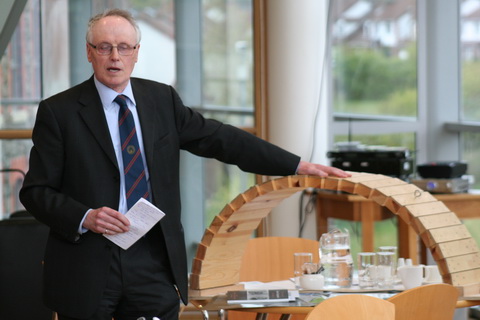
Professor Adrian Long with a wooden model of the FlexiArch bridge
He said that their work started by asking why nobody built arched bridges any more; they developed a system that used pre-cast voussoirs (the wedge-shaped blocks) linked by a polymeric flexible membrane. The voussoirs for any bridge are cast to give the correct taper for the span and rise required for that bridge.
Arch rings arrive on site stowed flat on the back of a truck; when they are lifted off, they fall into the correct shape and are lowered into position on previously-installed footings. Each arch ring is 1m wide; several of them can be placed side by side to give whatever width is required. The end walls are added and the structure is filled and given the appropriate surface (eg tarmac).
FlexiArch is manufactured by Macrete of Toomebridge (beside Lough Neagh); their website shows several examples of installation including one at a name familiar on Irish waterways. There is a brochure [PDF] and there is a video showing the installation of a 15-metre bridge.
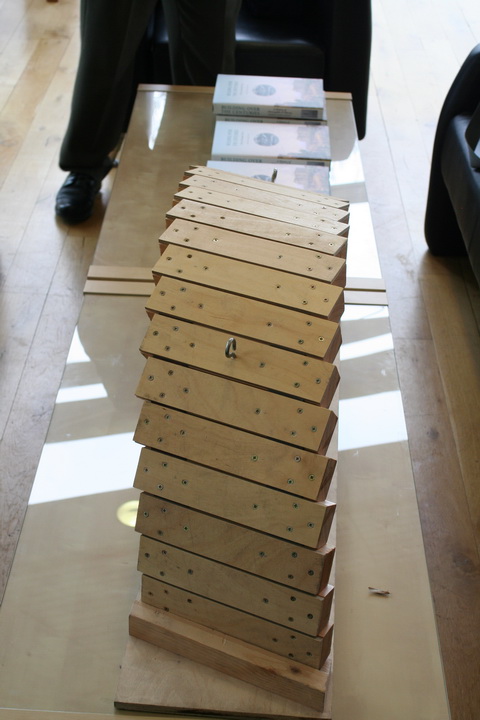
Wooden model as a skew arch
No, I haven’t any shares in it. I just thought it was interesting, for three reasons: first, the speed of construction is very impressive; second, there is a link to Lough Neagh; third, it might encourage the construction of more skew arch bridges over canals.
Posted in Ashore, Built heritage, Economic activities, Engineering and construction, Extant waterways, Foreign parts, Industrial heritage, Ireland, Irish waterways general, Operations, Restoration and rebuilding, Sources, waterways, Waterways management
Tagged Adrian Long, arch, bridge, canal, flexiarch, Grand Canal, IHAI, Ireland, Lough Neagh, macrete, QUB, Royal Canal, skew, span, Ulster Canal, waterways
At a Meeting of the Company of Undertakers of the Grand Canal, duly convened by public Advertisement, and held at the Company’s House in Dublin, on Monday, the 6th day of April, 1840,
WILLIAM MURPHY, Esq., in the chair,
The following Resolution, moved by James Pim, jun., Esq., seconded by James Dawson, Esq., passed unanimously in the afformative: —
Resolved — That the Court of Directors of this Company be authorised, if they shall see fit, to call the attention of the Government, of the Chamber of Commerce, of the Ballast Corporation, of the several Steam Companies, and of Capitalists generally, to the important advantages which the Grand Canal Company’s Floating and Graving Docks at Ringsend offer to all parties connected with the Shipping interests of the Port of Dublin, and to apprize them that this Company will at all times be ready to entertain any well considered proposition for increasing the general usefulness of these Docks, on the fairest and most liberal terms as regards the Public. Under the firm persuasion that by whatever well-arranged proceeding this important portion of the Company’s property can be best made available in increasing the Trade and promoting the prosperity of the City of Dublin, it will be rendered the most effectually conducive to the interests of the Company.
By order, JOHN McMULLEN,
Secretary of the Company.
From The Freeman’s Journal 8 April 1840.
Perhaps Waterways Ireland might follow the example of its predecessors and, rather than getting into bed with the DDDA, might consider some “well considered proposition for increasing the general usefulness of these Docks”.
Posted in Ashore, Built heritage, Economic activities, Engineering and construction, Extant waterways, Industrial heritage, Ireland, Operations, Restoration and rebuilding, Sources, Steamers, waterways, Waterways management
Tagged basin, boats, box in the docks, canal, DDDA, dry docks, Dublin, floating docks, Grand Canal, graving docks, Ireland, Ringsend, steam, waterways, Waterways Ireland
… has had its windows broken. More on the Lough Owel Feeder here.
Posted in Ashore, Built heritage, Drainage, Economic activities, Engineering and construction, Extant waterways, Industrial heritage, Ireland, Operations, Restoration and rebuilding, waterways, Waterways management
Tagged boats, bridge, canal, feeder, fishfarm, Ireland, Lough Ennell, Lough Owel, Mullingar, Operations, Royal Canal, supply, water level, waterways, Waterways Ireland, Westmeath County Council
I have uploaded an old article of mine based on an interview with Willie Leech of Killucan, whose father ran the last trading boats on the Royal Canal.
Posted in Economic activities, Extant waterways, Industrial heritage, Ireland, Irish inland waterways vessels, Operations, People, Sources, The turf trade, waterways
Tagged boats, bog ore, bridge, canal, Cloncurry, flyline, gas company, Grand Canal, horse, Ireland, Killucan, L T C Rolt, Leech, Royal Canal, Summerhill, timberhead, town gas, trackline, tug, vessels, waterways
His brief notes here.

 Irish waterways history