Tag Archives: department of arts heritage and the gaeltacht

War over waterways: Sinn Féin -v- the Free State

I reported here that, in June 2013,the North South Ministerial Council (in inland waterways format) approved, on the same day, Waterways Ireland’s business plan and budget for 2012 as well as its annual report and draft accounts for that year. In other words, it approved the budget and plan eighteen months after the start of the year to which they applied; it approved the plans for 2012 and, on the same day, approved the outcomes.

Furthermore, by November 2013, 88% of the way through 2013, it had not approved the budget for that year (I don’t know whether it has yet done so). And, as of today (22 January 2014), WI’s annual report for 2012 has not yet been published.

I wrote:

Is it possible that one minister wants to spend very much more or less on waterways than the other does? As the total current expenditure is fixed at 85%/15%, it seems to me that one side might very well come up with a figure that the other didn’t like.

Is it possible that DCAL, run by Mr Adams’s party colleague Carál Ní Chuilín, is more keen on cross-border bodies than is DAHG, run by Fine Gael minister Jimmy Deenihan? Or are both of them struggling to find savings to pay for the Clones Sheugh, or at least as a deposit for the SEUPB?

Or could it simply be that WI is having great difficulty in cutting its expenditure to fit within the limits imposed by the RoI budget?

I then sent enquiries to Waterways Ireland, the (NI) Department of Culture, Arts and Leisure (DCAL), the (RoI) Department of Arts, Heritage and the Gaeltacht and the North South Ministerial Council. From the repsonses, and from yesterday’s statement to the NI Assembly by Carál Ní Chuilín MLA, NI Minister of Culture, Arts and Leisure, it is clear that I was right in my first para; it is possible that the first sentence of the second para is right too.

There is a major disagreement between the northern and southern departments about the level of cuts to be applied to Waterways Ireland’s budget and it is not clear what mechanism can be used to resolve it. DAHG, applying Irish government policy, wants bigger cuts than DCAL does.

NSMC

After each North South meeting, the secretariat issues a rather bland communiqué; the inland waterways ones are here. I suppose that the secretariat can’t be expected to write “There was a blazing row at yesterday’s meeting, skin and hair flying, and the ministers aren’t speaking to each other”. I mean, they wouldn’t write that even if it were true, which I’m sure it isn’t.

On 9 December 2013 I wrote to NSMC (I omit salutations and irrelevancies here):

Are you able to say anything about why the NSMC Inland Waterways did not approve the 2012 business plan and budget for Waterways Ireland until eighteen months after the start of the year in question? As far as I can see from the minutes for meetings since 2007, that is a highly unusual degree of lateness.

NSMC replied on 11 December (with a copy to the RoI Department of Foreign Affairs):

[…] this is an issue for both Sponsor Departments and they can be contacted directly.

On the same day I asked:

Have you any responsibility for seeing that the terms of the WI Financial Memorandum [PDF] are observed? It seems to me that they have been ignored in this case.

Despite a reminder, I have not yet received a reply.

DCAL

I wrote to DCAL on 10 December 2013:

I would be grateful if you could help me to understand why the North/South Ministerial Council did not approve the 2012 budget and business plan until 18 months after the start of the year to which it applied.

DCAL responded on 11 December 2013:

Waterways Ireland had submitted a draft 2012 Business Plan detailing the activities required to achieve goals set out in their 2011/2013 Corporate Plan. Recognising the challenges presented by the economic climate there were extended negotiations to agree the 2012 budget. The DCAL Minister raised concerns about going beyond the required savings advised by both Finance Departments. Minister Ní Chuilín therefore sought, and received, assurances from Waterways Ireland that frontline services would be maintained.

I sent follow-up queries on 16 December:

I am not entirely clear on the implications of your third sentence: “The DCAL Minister raised concerns about going beyond the required savings advised by both Finance Departments.”

Do you mean that Waterways Ireland proposed to cut its spending by more than the percentage cuts suggested by the Finance Departments? Or to spend less than it received (or expected to receive), in euro, from the two sponsor departments? If so, why did WI want to do that?

I would also be grateful if you could tell me what WI’s “frontline services” are and why they are deemed to be more important than other services.

And I would be grateful for more information on the reason for the extended delay in approving the busiess plan and budget: eighteen months after the start of the year, which was presumably even longer after the plan was drafted. I would be surprised to find that seeking and receiving assurances took eighteen months.

Did the delay result in a breach of the terms set out in the Financial Memorandum governing WI’s affairs?

I would also be grateful if you could tell me what delayed the approval of WI’s 2013 budget. I note from the NSMC minutes that it was not approved in June 2013; the matter is not mentioned in the minutes of the November 2013 meeting but, on 19 November 2013, the RoI Minister for Public Expenditure and Reform replied to a written question from Gerry Adams TD saying, inter alia, that “The 2013 Budget allocation to the Body are subject to on-going discussion by the two Sponsor Departments.”

That suggests that approval of the 2013 budget is at least eleven months late. I note too that the 2014 business plan and budget, and the Corporate Plan 2014-2016, were not approved at the November NSMC meeting. And I note that An Foras Teanga [Foras na Gaeilge + Tha Boord o Ulstèr-Scotch], the other North-South body sponsored by your department and the Department of Arts, Heritage and the Gaeltacht, was also, in November, awaiting approval of its 2013 budget.

There are two further items on which I would be grateful for information:

(a) is it proposed that the Hutton recommendations be applied to Waterways Ireland (and other bodies in the North-South pension scheme)? If so, what is the expected effect on WI’s budget and on staff take-home pay?

(b) WI’s accounts for 2011 (the latest I have seen) suggest that your department paid less than 15% of the money WI received from its sponsor departments. Did your department pay 15% in 2012 and 2013 and will it do so in 2014? And how do you take account of the effect of currency fluctuations on WI’s income denominated in its working currency, the euro?

Despite a reminder, I have as yet received no reply.

DAHG

I wrote to DAHG on 26 November 2013 with several questions; I include below only that relevant to this posting.

On 19 November 2013, in a written answer to Gerry Adams, Jimmy Deenihan said […]: “The 2013 and 2014 Budget allocations to the Bodies are subject to ongoing discussion by the two Sponsor Departments and will require, of course, formal approval by the NSMC.”

I would be grateful if you could tell me (a) why Waterways Ireland’s budget had not been finalised when 88% of the year had passed and (b) how that affected budgetary management in the Body.

The department replied on 3 December 2013:

As you are aware, Waterways Ireland is co funded by the Department of Arts, Heritage and the Gaeltacht and the Department of Culture, Arts and Leisure, Northern Ireland.   The 2013 Business Plan and budgets have been discussed by Ministers at NSMC Inland waterways meetings and key priorities for 2013 identified.  Indicative budgets have been provided by the Departments to Waterways Ireland as a pragmatic measure for business planning and operational purposes and the body is operating within these indicative allocations.

On 9 December I replied:

Thank you. That answers my question (b) pretty well. However, you haven’t answered (a): why Waterways Ireland’s budget had not been finalised when 88% of the year had passed.

I would be grateful for information on the causes of this extraordinary delay.

I have been wondering whether the problems of WI’s budget were very difficult to resolve or whether there was some major disagreement between the northern and southern ministers. If there was such a major disagreement, what was it about?

The department replied on 17 December 2013:

The Departments are still in discussions to agree the budgets.  The position is The Department of Culture, Arts and Leisure in Northern Ireland is not prepared to agree a 2013 budget for the Body in excess of a minimum efficiency saving of 3% set out in the two Departments of Finance Funding Framework for the North South Bodies. As you are aware from the Parliamentary Question Reply this Department’s REV provision for Waterways Ireland for 2013 is €25.463m, a 6% efficiency saving on 2012. Given the pressures on the public finances and on the Departments budget allocation, the Department is not in a position to provide any additional funding that would maintain the proportionality of funding. 85% of current funding is provided by Department of Arts, Heritage and the Gaeltacht and 15% by Department of Culture,  Arts and Leisure, Northern Ireland.

I responded on 18 December 2013:

[…] Just to make sure I understand you properly: when you say “a 2013 budget for the Body in excess of a minimum efficiency saving of 3%” am I right to presume that the phrase “in excess” applies to the savings or cuts rather than to the budget itself?

I also asked three questions about items of background information relevant to this topic:

1. I am less familiar with the NI Executive’s budgetary process than perhaps I should be. I gather that there are multi-year budgets, linked to a programme for government, with annual estimates and possibly supplementary estimates. The multi-year element seems to be stronger than in Irish budgets, but I wonder whether (aside altogether from the current economic situation) it is difficult to make decisions within the constraints of the different budgetary timescales.

2. I have not yet checked all Waterways Ireland annual reports, but reading that for 2011 suggests that DCAL paid slightly under 14%, rather than 15%, of WI’s current expenditure. Are minor deviations from the 85/15 ratio unavoidable? Do they balance over time?

3. Do currency fluctuations affect the amounts actually paid by the two departments? If so, how are the effects taken into account?

I have not yet received a reply.

Waterways Ireland

On 6 January 2014 I wrote to WI:

I would be grateful if you could tell me the effect on Waterways Ireland of the continuing dispute between its sponsor departments over WI’s budgets and business plans.

On 8 January WI said:

Waterways Ireland enjoys a supportive and positive relationship with both departments.

On 14 January I said:

I am very glad to hear it, but I don’t recall asking a question about that.

I repeated my original question, to which I have not had a reply. As with NSMC, I don’t really expect WI to be able to say anything undiplomatic. However, I would have thought that there must be some inconvenience in working to “indicative allocations”. I wonder whether they are based on DCAL’s preferred level of cuts, DAHG’s preferred level or some compromise. And if compromise is possible on the indicative allocations, why can’t the main issue be sorted out?

Furthermore, the delay in publishing the 2012 accounts suggests that there has been some real difficulty in operating under the indicative allocations regime. Or perhaps there is some other row altogether.

NI Assembly

Reporting yesterday to the NI Assembly on the November NSMC meeting, the NI Minister confirmed that there was disagreement.

Karen McKevitt [SLDP, South Down]: […] The chief executive set out a strategic direction for Waterways Ireland for 2014-16. In that, she mentioned budget efficiencies. Can the Minister highlight to the House what those might be?

Carál Ní Chuilín [SF, Belfast North]: The Member is right: the new chief executive gave us a very good and detailed presentation. Indeed, the Member will be aware — if she is not, she will be when I finish my answer to her question — that there have been additional pressures on everybody across the board in achieving efficiencies. However, as I have repeated to the Member and to other Members, and despite the meetings that I have had with Minister Deenihan around any proposed additional efficiencies that the Irish Government are saying are required, I am totally reluctant to go above and beyond any efficiencies that we agreed previously, and I have stated that to the chief executive of Waterways Ireland. That is the position. Following that, the Finance Departments and, indeed, officials and Ministers will hopefully be submitting additional or new budget plans very soon. I think that issues relating to any agreement to additional efficiencies lie beneath the Member’s question, but I can categorically state that I have not agreed to those.

“Efficiencies”, by the way, means “cuts”.

The importance of waterways to Sinn Féin

I have remarked several times here that Sinn Féin asks many Dáil questions about waterways, notably the Clones Sheugh, with Maureen O’Sullivan providing recent competition. I wrote elsewhere recently:

Waterways Ireland is a political creation: its very existence reflects a nationalist and republican desire to show the benefits of all-Ireland institutions — and a unionist desire to confine such institutions to areas of minor importance. […]

In prosperous times, managing recreational waterways is a feelgood activity, combining opportunities for local and national politicians to get their photos in the papers with relatively low risk of political controversy. Nonetheless, WI had to tread warily, especially in its early years; it has almost (but not quite) entirely avoided such controversy.

Timing

I don’t know if there is ever a good time for disputes between your paymasters, but it’s not as if Waterways Ireland, and its new CEO, didn’t already have enough to worry about. To quote again from the same piece:

Compared with British Waterways and C&RT, Waterways Ireland has very little real property from which it might derive an income — and very few other sources of income. According to its accounts for 2011 (the latest available), its total income was over £38 million but it earned less than half a million pounds from licences, property, interest, operating income (including charges to waterways users) and other sources. The rest came from its two sponsor departments.

Charges to boaters have traditionally been low or non-existent: zero for a boat kept on the Erne or on one of the Shannon lakes, with modest charges for passing through Shannon or Shannon–Erne Waterway locks; on the Grand, Royal and Barrow, an annual charge of €128 covered lock passages and mooring. There was no licence fee. Waterways Ireland has begun to impose slightly higher larger charges but may meet resistance.

But there is no immediate prospect of imposing charges high enough to make a significant difference to Waterways Ireland’s budget. That budget is set by the North South Ministerial Council: each government pays for capital works (eg harbour improvements) carried out in its own jurisdiction, while the running costs are paid in a ratio intended to reflect the proportion of the waterways in each: 15% by the Northern Ireland Executive and 85% by the republic’s Government.

Some difficulty may be caused by different timings of the budgetary processes in the two jurisdictions, but a greater problem is that the fixed ratio can lead to deadlock. WI’s budget for 2012 was not set until July 2013, eighteen months late: its budget, business plan, annual report and draft accounts for 2012 were all set on the same day. Final accounts for 2012 had not been published and WI’s budget for 2013 had not been agreed by December 2013.

The cause of the delay was that the republic’s government wanted to cut the budget by more than the Northern Ireland Executive did. The Irish economy has had severe problems in recent years and the government was unable to honour its undertaking to pay for the restoration of the Ulster Canal from Lough Erne to Clones (a short stretch that crosses the border several times). Public expenditure has been cut for all government departments and public bodies but the scale of the cuts is larger than the Northern Ireland minister wants to see. If the republic’s government gets its way, by 2016 WI’s budget will be one third lower than it was in 2010.

That is not the only financial problem that WI faces. Staff transferred to it from Irish government departments carried with them their entitlements to pensions of half of final salary plus retirement lump sums of one and a half times final salary. And, as is the norm in the civil service, the pension system was unfunded. WI had quite a few staff in their fifties and, as they now retire, their pensions and lump sums have to be met out of WI’s normal income from its sponsor departments. The pace of retirement may even by accelerated by a desire to avoid charges arising from the Hutton pension proposals.

During the era of the Celtic Tiger, Waterways Ireland prospered: it acquired much new equipment, built new offices and developed and improved facilities for boaters and other users. It now faces a much more difficult financial future and it is hard to see how it can avoid reducing its level of service. At the same time, its new CEO is — rightly — determined to continue widening the appeal of the Irish waterways to more types of users: walkers, cyclists, anglers, canoeists and others.

Maybe the two ministers might get their act together.

I will report later on other items covered in Ms Ní Chuilín’s statement; the bad (if unsurprising) news is that she is still stuck on the sheugh, but perhaps she can persuade the Imperial Treasury to pay for it.

Waterways Ireland’s pensions burden

Let us suppose that you are an Irish civil service department, whose staff are employed on standard Irish civil service terms.

And let us suppose that your Secretary General’s 65th birthday was on 31 December 2013, by which time she had 40 years’ pensionable service. Her salary was €250,000 a year, so that’s the amount you (the department) paid to her in y/e 31 December 2013. Because of cutbacks, she is replaced, from 1 January 2014, by someone earning half that amount. So what is the cost of SecGens in 2014? Keep it simple: ignore employer’s PRSI and allowances and travel expenses and anything else.

Civil service pensions

In 2014, you will pay the new SecGen €125,000, half the old rate, but you will pay the retired SecGen €500,000, so your total expenditure on SecGens will rise from €250,000 to €625,000. [The timing may not be quite thus, but never mind.]

In 2015, the new SecGen will continue to get €125,000, but so will the old SecGen. So, even though your new SecGen gets half what the old one earned, the total cost to you remains the same.

And so on until the old SecGen dies. But if the new SecGen retires before that, you will have two retired SecGens drawing pensions and one even newer SecGen getting a salary ….

Under ordinary Irish civil service terms, someone who retires is entitled to a pension of one eightieth of final salary for every year of service, up to a maximum of forty years. So a SecGen who started, say, as a graduate entrant at the age of 25, stayed in the civil service and retired at age 65, would be entitled to a pension, for life, of half her final salary.

She would also be entitled to a lump sum of one and a half times her final salary. That’s why, on retiring, she gets an amount equal to twice her final salary: 1.5 times salary as a once-off lump sum plus 0.5 times as pension.

You could argue that that is an absurdly generous arrangement, but that’s not my point here: someone who started work 40 years ago under those conditions can’t be criticised for taking the money they’re entitled to, and it will be a long time before any revisions could take effect.

These pensions are defined benefit, non-contributory and unfunded: no money is put aside by either employees or the employer to meet pension payments in future years. It is assumed that the taxpayer will continue to meet the increasing costs.

Now, that’s all very well for the main-line civil service: it has been in existence for a long time; it’s very large, with a large pay bill; it has had SecGens retiring before and another retirement or two won’t greatly affect the overall cost.

But if you’re a relatively small organisation, dependent on the exchequer for most of your income but without any of getting extra money to pay for pensions, the retirement of one or two senior officials, or of larger numbers of lower-paid employees, could significantly increase your costs while doing nothing to improve your income or the amount of work you do.

That is happening to Waterways Ireland at the moment. I’ll give some details shortly, but first I want to get the pension scheme out of the way.

The woodchuck pension fund

Here is Wikipedia’s version of the tongue-twister about the woodchuck:

How much wood would a woodchuck chuck
if a woodchuck could chuck wood?
A woodchuck would chuck all the wood he could
if a woodchuck could chuck wood!

Coverage of the Waterways Ireland pension scheme in its annual reports reminds me of the woodchuck. I should say immediately that that is not a criticism of WI: it’s down to an accounting standard called FRS 17.

As far as I can make out, this standard requires WI to show in its accounts the entries that it would make for its pension fund, if it had a pension fund, even though it doesn’t have one. It does have a pension scheme, which I imagine sets out the rules about who is entitled to get what, but there is no pot of money put away, guarded by fierce trustees, to ensure that the pensioners of the future will get their money. Here is how I understand it; if I’m wrong (which wouldn’t be surprising), do please correct me in a Comment below.

WI’s balance sheet shows (for 2011) a liability of €66,432,000 and a balancing asset of the same amount; both of them are imaginary figures. Similarly, the income and expenditure account shows the amount that WI (in theory) should have paid in 2011 for the pension benefits that its staff accumulated in that year, along with an imaginary interest charge on its total liability. Those are then balanced by a figure called “Net deferred funding for pensions” which, at €4385000, is by far the largest component of WI’s “Other operating income”.

Obviously that lot would look better if it had corroborative detail to provide artistic verisimilitude, so the accountants or the pensions bods or someone did other calculations of currency translation charges and transfers in and out of the scheme and service costs and so on, all on a non-existent pension fund.

Now, as far as I can see, we can ignore all that. But there are two cash figures that are real and important:

  • one is that WI staff paid (was it under the public service pension levy? or something else?) €230,000 in contributions in 2011, for which they will receive benefits of €2,744,000, ie twelve times what they put in
  • the other is that in 2011 WI paid out €934,000 in actual pension
    benefits to people who had retired by then. That presumably includes
    any retirement lump sums.

Incidentally, WI’s 2011 accounts (the most recent available) make no mention of the North South Pension Scheme (see below), of which WI is a member. Perhaps the stuff in WI’s accounts is about its imaginary portion of a combined but equally imaginary fund under the North South Pension Scheme. The meetings of the NSPS CEO Pension Committee, which “exercises trustee-like functions” [seriously: see below], must be fun.

Not being an accountant (I feel I lack the necessary creativity), I am interested in the actual cost to WI of the benefits it pays out to folk who retire.

Retirements

I asked WI how many people retired in 2012 and 2013 and how many were expeected to retire in the next three years.

WI retirements 2012–2016

Figures for 2012 and 2013 are actual; those for later years are expected. Source: Waterways Ireland

Those who retired were:

  • 2012: 3 lockkeepers, 1 boatperson, 1 director of marketing, 1 mechanical fitter, 1 general operative [GO] plant operator B, 1 preserved pensioner
  • 2013: 1 chief executive, 1 clerical officer, 1 GO, 2 GO chargehands, 3 GO plant operator As, 1 GO plant operator B, 1 boatperson, 1 boatperson/skipper, 1 lockkeeper.

WI could not say what grades were expected to retire in 2014, 2015 and 2016. If they did, of course, I’d be able to guess which senior managers were about to retire; as it is, I have to rely on rumours. WI was able to predict the lump sum and pension payouts for 2014–2016, so I suspect it has a good idea who intends to retire.

The total number retiring in those five years is 81, which is about a quarter of the entire WI staff (currently 325). That’s a big proportion of the staff. No doubt it reflects the age profile of staff who transferred into the organisation but the figure may be boosted by the Hutton Push [see below].

Lump sums

Here is what WI expects to pay out in retirement lump sums in 2014, 2015 and 2016, and what it actually paid out in 2012 and 2013. Note the big increase in 2014. These sums are paid on retirement and are not recurring: in other words, they are made only to those who retire in the year in question.

Actual amounts for 2012–2013; predicted amounts for 2014–2016. Source: Waterways Ireland

Actual amounts for 2012–2013; predicted amounts for 2014–2016. Source: Waterways Ireland

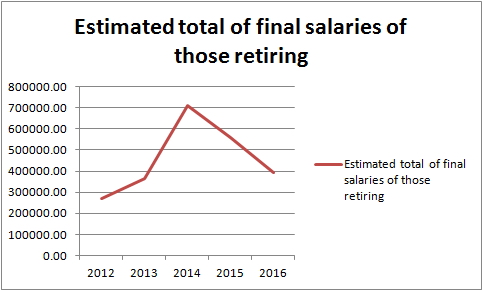
If all lump sums are 1.5 times final salary [something of which I can’t be certain], then we can work out the total of the final salaries of the retiring employees.

Source: actual and forecast lump sum payments divided by 1.5

Source: actual and predicted lump sum payments divided by 1.5

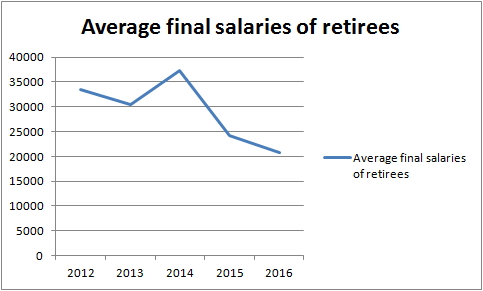
And, as we know the number of people expected to retire in each year, we can work out the average final salary for each year.

Source:  estimated total final salaries divided by expected numbers of retirees

Source: actual and predicted total final salaries divided by numbers of retirees

It looks as if some senior staff may be expected to retire in 2014.

Annual pension payments

The lump sum amounts are paid only to those retiring in the year in question, whereas the annual pension payments include those to people who started drawing pensions in 2011 and earlier years. But the lump sums are once-off, whereas the annual payments will continue to increase as more people retire.

Source: Waterways Ireland figures for total pension pay-outs less lump sums

Source: Waterways Ireland figures for actual and predicted total pension pay-outs less lump sums

The effect on WI’s finances

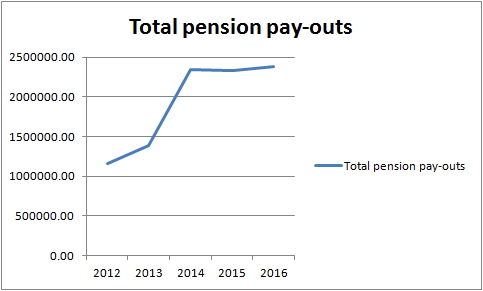
The totals of the lump sums and annual pension payments show how much WI has to pay out in each of the five years.

WI totals of actual and predicted pension pay-outs

Totals of actual and predicted pension pay-outs. Source: Waterways Ireland

The figure shown in the 2011 accounts was €934000. By 2016, the total will be two and a half times that: €2377000.

Remember that this is an unfunded pension scheme, so the increase comes out of WI’s ordinary allocation of money from its sponsor departments. And that allocation will not be increased: both governments want to cut WI’s income, although one government wants to cut more than the other does. If the RoI government has its way, by 2016 WI’s income will be just under 66% of the 2010 figure: a cut of one third in six years.

According to the last available accounts, WI’s main cost is staff: €21,903,000 in 2011. But that figure includes €5769000 in pension costs, €934000 of which was benefits paid out while the rest was special magical imaginary payments to the pension fund; the real staff cost (excluding agency staff and employer PRSI/NIC contributions) was €14411000.

Between 2011 and 2016, the increase in pension costs means that an extra €1443000 has to be found and, as staff costs form the main element of WI’s expenditure, it is likely that the staff budget will bear much of the burden.

The Hutton push

One factor that may be prompting some WI staff to retire as soon as they can, thus pushing up the lump sum payments in 2014, is the possibility that some changes, recommended by the UK’s Independent Public Services Pensions Commission [the Hutton Commission], might be applied to the North South Pension Scheme that covers Waterways Ireland. On 30 April 2013 Martin McGuinness [SF, Mid-Ulster, Deputy First Minister] reported to the Northern Ireland Assembly on the North/South Ministerial Council [NSMC] institutional meeting held on the previous day.

Jim Allister [Traditional Unionist Voice, Antrim North] asked him about the pension scheme:

The pension scheme for those bodies entails lavish employer contributions. In one case, over 31% of salary is contributed by the employer and a mere 1·5% is contributed by the employee. When will that lavish squander be addressed by bringing the scheme into line with what exists in the Civil Service scheme? Is it good enough for it simply to be pushed back for another six months? Why not address it now instead of looking at it further down the road?

The ever-patient Martin McGuinness responded:

At the NSMC meeting on 28 March 2013, we noted that the NSMC approved an amendment to the North/South pension scheme, which means that increases to the scheme for benefits paid in the northern currency will be in line with the consumer price index. Prior to that, they were increased in line with the retail price index. The amendment ensures that the North/South pension scheme follows public sector pension policy, as agreed by the Executive.

We also noted that the two Finance Departments are in discussion about how to further amend the scheme. These amendments will ensure that northern members are not immune from pension reform. The first amendment will increase employee contributions on average from 1·5% by 3·2 percentage points. That will align with the employee rates payable from April 2014 in the principal Civil Service pension scheme here in the North. The second amendment will introduce, by April 2015, the wider Hutton reforms, such as the introduction of a career average revalued earnings scheme and a linkage between the North/South pension scheme age and the state pension age.

The scheme was raised in the Dáil on 17 December 2013 in a written question to the Department of Public Expenditure and Reform.

Dara Calleary [FF, Mayo] asked the minister:

[…] the discussions he has had in relation to the North/South pension scheme; if the proposed amendment rules as notified from officials in the Department of Finance and Personnel and his Department will apply to southern based employees of Waterways Ireland; and if he will make a statement on the matter.

The minister, Brendan Howlin [Labour, Wexford] replied:

Five of the six North/South Implementation Bodies, including Waterways Ireland, along with Tourism Ireland, operate the North/South Pension Scheme (NSPS). The Scheme is unique in covering public sector staff employed on both sides of the border; staff of the affiliated employers in this jurisdiction are automatically members of the Scheme. The Chief Executive Officers of the relevant NSPS bodies and Tourism Ireland meet as the NSPS CEO Pension Committee, which exercises trustee-like functions in relation to the Scheme.

As Minister for Public Expenditure and Reform, I am jointly responsible, along with the Northern Ireland Minister for Finance and Personnel, currently Mr Simon Hamilton, for the rules of the North/South Pension Scheme, and in particular for approving amendments which may be proposed to those rules. In exercise of my responsibilities in relation to the Scheme, I and my officials have engaged in correspondence and discussion about reforms to the NSPS rules with my counterpart Northern Ireland Minister and his officials.

Review and reform of existing pension arrangements, including public sector pension arrangements, has been an ongoing feature of the pensions landscape in Ireland and the UK over recent times. In this context it is natural that reforms to the North/South Pension Scheme would arise for consideration, and proposals in this regard have been discussed with the NSPS CEO Pension Committee.

Pending further development of these proposed reforms, and mindful that there is ongoing discussion with trade union interests on the proposed changes, I do not intend to elaborate at this juncture on the possible final specific content of the rule amendments which may arise. I can however confirm to the Deputy my intention that the changes will, to the extent that is consistent with legal norms in each jurisdiction, apply to southern and northern NSPS members alike, including staff of Waterways Ireland in this jurisdiction. This uniformity of application would reflect the fundamental all-Ireland character of the Scheme, to which successive Governments have been committed.

That doesn’t tell us much about the likely effects on the take-home pay of WI staff, or the pensions and lump sums of retired staff, and I have no inside information about what is proposed or likely. But you can see why WI staff who are near retirement age might be tempted to get out before their conditions are worsened.


Saving the nation part 97

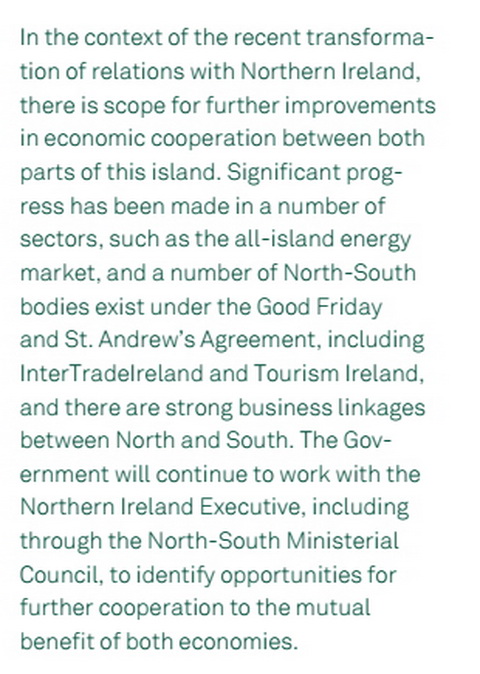
Clip_resizeThat’s from the government’s Medium Term Economic Strategy 2010 [PDF]. Not a word about the Clones Sheugh, which would undoubtedly save the economies of both jurisdictions on this island, but perhaps it will qualify for one of the new models of infrastructure funding mentioned hither and yon in the document.

Maybe the Sunbeds Bill would be more interesting – or more important.

PS Folk who write “between both” should be flogged naked through the streets before being hanged in the marketplace.

“Ireland has no inland waterways …” says Minister for Transport

Those very words came from Leo Varadkar [FG, Dublin West], Minister for Transport, Tourism and Sport, in a written answer to a Dáil question on 3 December 2013.

I have, of course, quoted him selectively and out of context. The full sentence was

Ireland has no inland waterways within the definition of the EU legislation as Ireland’s inland waterways are not navigable for commercial traffic and we do not have any interconnected inland commercial transport for the purposes, or on the scale, envisaged by EU proposals in this area.

The poor man was responding to yet another question from the Pest of the Royal Canal, Maureen O’Sullivan [Ind, Dublin Central], who was continuing her misguided campaign to get public money from anywhere at all to replace Effin Bridge, the lifting railway bridge at Newcomen Bridge over the Royal Canal in Dublin 1. I reported on her campaign here, here and here, with the last of those showing that current demand for passages is less than the (admittedly restricted) supply. That being so, I cannot see how any expenditure on replacing Effin Bridge could be justified, especially in the country’s current situation and with Waterways Ireland desperate for money. I would, of course, have no objection to any voluntary fund-raising campaign that Ms O’Sullivan might initiate.

Ms O’Sullivan questioned two ministers on 3 December. She asked Leo Varadkar:

…  if his attention has been drawn to Inland Waterway Transport Funding, the Funding Guide for Inland Waterway Transport in Europe published by the European Commission’s Directorate General for Energy and Transport in 2008; the reason the 19 countries’ inland waterways systems referenced in the publication does not include Ireland; if he will ensure that any future edition of the guide will contain a country profile for Ireland including information on major inland waterways and ports together with an overview on the national inland waterways transport funding policy, funding programmes and institutions; and if he will make a statement on the matter.

The saintly and erudite minister replied:

The Funding Guide that the Deputy refers to was published following the launch of the 2006 NAIADES Action Programme, a multi-annual programme on the promotion of inland waterways transport. The Commission has recently decided to update and renew this programme until 2020. Ireland does not have a country profile in the Funding Guide as, in general, Ireland is exempt from EU inland waterways rules and proposals since they relate to waterways of a greater size and carrying a greater capacity of goods than exist in Ireland. The European Union’s inland waterway network spans 20 Member States with about 37,000 kilometres of inland waterways. Every year, these transport around 500 million tons of cargo, in particular in the densely populated and congested areas of Germany, the Netherlands, France and Belgium.

Ireland has no inland waterways within the definition of the EU legislation as Ireland’s inland waterways are not navigable for commercial traffic and we do not have any interconnected inland commercial transport for the purposes, or on the scale, envisaged by EU proposals in this area.

My Department is responsible for licensing all commercial inland craft in Ireland. There are no commercial cargo craft on Ireland’s inland waterways, apart from some small workboats. There are a number of domestic passenger boats and ships operating locally as tourist excursion vessels.

Ireland keeps a watching brief on EU inland waterways matters, mainly to ensure that any proposals do not conflict with, or overlap, the existing maritime safety regimes.

I expect that Ms O’Sullivan will be back shortly to propose the setting up of a horse-drawn barge fleet on the Royal Canal, returning Ireland to the late eighteenth century, to which the Irish left (and republicans) seem so devoted.

Her other questions were to Jimmy Deenihan [FG, Kerry North/West Limerick], Minister for Arts, Heritage and the Gaeltacht. She asked:

… if he will identify the various State agencies whose operations bear upon the management of the Royal Canal and the steps they are taking, individually or collaboratively; if he will increase commercial-leisure use of the Royal Canal since the reopening of Spencer Dock to navigation in 2010; and if he will make a statement on the matter.

… if the European Regional Development Fund has been considered as a possible source of funding towards the costs, estimated at over €5 million, of overcoming obstacles to navigation, namely, the lifting bridge and the fixed Spencer Dock bridge on the sea level of the Royal Canal; and if he will make a statement on the matter.

The patient and polite minister said:

[…] Waterways Ireland is the navigation authority for the Royal Canal and is responsible for the management, maintenance and development of the Royal Canal, principally for recreational purposes. Waterways Ireland undertook the work to re-commission the Royal Canal prior to its reopening in 2010 and continues to develop the canal and its facilities, and promote its use for recreation.

I am advised that Waterways Ireland has not sought funding to redevelop the lifting bridge referred to by the Deputy and has no plans to seek such funding at this time. Ongoing operation of the bridge continues to be kept under review with Iarnród Éireann, while Dublin City Council remains responsible for the operation of the Spencer Dock Bridge at Sheriff Street.

And rightly so.

Note that the €5 million figure referred only to Effin Bridge; replacing Sheriff Street Bridge would be another kettle of fish.

Our Glorious Leader …

is to address, on Sunday night, anyone who watches television but doesn’t have a choice of television channels. There will be a medium term economic strategy too, promising a new and better future for all our people. But as Finfacts says:

… past experience coupled with signals so far, suggest that [the strategy] will be a promotional brochure for an international audience with some questionable claims and omissions. The expected plunge in services exports by as much as €50bn during the time horizon is not likely to be acknowledged.

There is an urgent need for a credible growth strategy that has an unvarnished assessment of the challenges with an honest analysis of strengths, weaknesses, opportunities and threats, using data that is free of the outsize impact of the foreign-owned exporting sector.

I wonder whether the strategy will include any sheughs.

Lowtown Canal Yard is for sale

Details here.

If I won the lottery I’d buy it myself. Sad to see Robert and Caroline Few selling, after many years of service to the canal; I wish them all the best in the future.

Sheughery

I wonder why Sinn Féin asks questions when it does. This one [h/t KildareStreet.com] seems to have been asked at a time that the minister might have welcomed.

Sandra McLellan [SF, Cork East]:

To ask the Minister for Arts, Heritage and the Gaeltacht the position regarding the Ulster Canal restoration project; the steps that must be taken to complete the project; the indicative timeline for the completion of the project; and if he will make a statement on the matter.

Jimmy Deenihan [FG, Kerry North/West Limerick] [the third para is the interesting one]:

As the Deputy will be aware, in July 2007 the North/South Ministerial Council (NSMC) agreed to proceed with the restoration of the section of the Ulster Canal between Clones and Upper Lough Erne. The then Government agreed to cover the full capital costs of the project, which were estimated at that time to be of the order of €35m.

It was always the intention that the Ulster Canal project would be funded from the Waterways Ireland annual allocations, as agreed through the annual estimates processes in this jurisdiction, as well as the deliberations of NSMC in relation to annual budgets. It was a key consideration throughout the process that the Ulster Canal project would be supported by a significant level of projected income from the commercialisation of certain Waterways Ireland assets. However, the economic downturn has had a negative impact on those plans.

I am continuing to explore all possible options to advance this project within the current fiscal constraints. In this regard, I established an Inter-Agency Group on the Ulster Canal to explore ways to advance the project and to examine possible funding options for it, including existing funding streams and the leveraging of funding from other sources. The Inter-Agency Group last met on 9th October and will meet again next week, on 9th December.

In the meantime, the Ulster Canal project is progressing on an incremental basis. Planning approvals have now been received for the project in both jurisdictions. Compulsory Purchase Order land maps are in preparation and consideration is being given to how the construction work and other technical aspects of the project will be structured once the necessary lands have been secured. The timeline for completion of the project will be determined when these preparatory steps have been completed.

I welcome these developments, which, I am sure the Deputy will agree, are a significant milestone for the project.

Hmm. The inter-agency group first met on 20 September 2012 and its second meeting was to take place in May 2013 or thereabouts. Now it’s going much faster, with meetings on 9 October and today, 9 December. Does this suggest that the group has found a pot of gold? Is there any link to the cancellation of SEUPB funding for the Narrow Water project?

And what has been going on in (and around) the North/South Ministerial Council? At its June 2013 meeting the Council approved or noted:

  • the business plan for 2012 (which had ended six months earlier)
  • the budget for 2012
  • the annual report for 2012
  • the draft accounts for 2012.

That suggests to me that there was either a major disagreement between the northern and southern ministers or a serious problem that rendered ministers unable to approve the WI budget and business plan until 18 months after the documents were required. Could it be that the northern minister, Carál Ní Chuilín [SF], like other NI politicians, had been looking for something from the waterways sector that hasn’t been delivered so far?

Note also that Jimmy Deenihan said

[…] consideration is being given to how the construction work and other technical aspects of the project will be structured once the necessary lands have been secured.

I understand that the design and construction of the Clones Sheugh was to be put out to tender but I wonder whether keeping the work in house might help WI to meet its increasing wage costs with a declining budget.


Waterways Ireland’s purpose in life

Waterways Ireland is currently (I presume) implementing its Corporate Plan 2011–2013 [PDF], which still has a month to run. That plan set out, inter alia, a mission:

Our mission is to provide a high quality recreational environment centred on the inland waterways in our care, for the benefit of our customers.

It also had core values, which is nice, and a vision:

Our long term vision is to create an interrelated waterways network which will provide accessible recreational benefits and opportunities for all.

We wish to create facilities and services which will attract and impress visitors from home and aboard, supporting and encouraging the tourism and recreational industries in Northern Ireland and Ireland and promoting sustainable economic growth across the island of Ireland. We seek to protect and enhance the natural environment in and along our waterways for the enjoyment of future generations.

For the period of this plan we intend to focus on the consolidation, improvement and promotion of existing waterways in order to maximise their use. We will progress toward our long term vision by focusing development on the Ulster Canal.

And it had strategic objectives:

To deliver the benefits and opportunities the waterways can provide across a range of areas, Waterways Ireland has identified 6 strategic objectives which will drive the delivery of our Mission and Vision and the objectives set out in this Corporate Plan. These Strategic Objectives are to:

1. Manage and maintain a reliable and high quality waterways network.
2. Develop and restore the waterways network.
3. Enhance the existing waterways network to widen its appeal to users.
4. Promote increased use of our waterways resource principally for recreational purposes.
5. Assess, manage and develop the assets of Waterways Ireland.
6. Develop an organisation of excellence.

Reading that lot, it seems to me that the focus was inward rather than outward, perhaps more in line with traditional engineering-led waterways management than with the new and exciting marketing-led organisation of the future.

The mission is de haut en bas, with waterways coming before customers, and the first sentence of the vision continues the theme. The second sentence does mention economic affairs, but “supporting and encouraging the tourism and recreational industries” suggests that tourism and recreation are something that other people do, not something that WI does: it does not seem to see itself as part of the “tourism and recreational industries”.

The intro to the strategic objectives is pure management gobbledegook, but the really revealing bit is the list of objectives. The last two are inward-looking, but note the ordering of the first four and what the balance of elements says about the corporate focus: WI is going to

  • manage and maintain the waterways network
  • develop and restore the waterways network
  • enhance the waterways network
  • and after that promote increased use.

This is what used to be called a sales model: design and build your widgets first; then go and flog them to the punters. There is an alternative approach: start by finding out what the potential punters might want and then design and build your widgets to meet their needs. In reality, of course, you do something in between, because you’re not starting with a blank slate: your factory can make one particular kind of widget, not all possible kinds. And, similarly, WI’s main asset is a collection of waterways, not of (say) amusement parks or bookshops.

But a marketing focus could help an organisation to think about how its widgets are to be used. The result doesn’t have to be as crude as adding the word “solutions” to everything; it can be used to shape how the organisation presents its widgets and to whom it presents them. And, in my view, WI needs to do that because, according to the only reliable (and admittedly inadequate) measure we have, the Shannon traffic figures, waterways usage has been declining for at least ten years. [I know that there are other waterways, and many other types of activities thereon, but I don’t know of any published statistics about the extent of usage.] WI needs to reimagine the waterways.

When Jimmy Deenihan spoke in the Dáil on 16 October 2013, he said:

The [budgetary] provision will enable Waterways Ireland to deliver on its core activities and targets, which include keeping the waterways open for navigation during the main boating season and promoting increased use of the waterways resource for recreational purposes. This expenditure should also assist in developing and promoting the waterways, attracting increased numbers of overseas visitors and stimulating business and regeneration in these areas. Capital funding of almost €4 million will be made available to Waterways Ireland to facilitate the ongoing maintenance and restoration of Ireland’s inland waterways, thereby increasing recreational access along the routes of waterways.

My attention was attracted by the phrase about keeping waterways open “during the main boating season”, which suggests a new, restrictive policy. However, the rest of the list is pretty much in line with the existing objectives. I hope that something more radical will come out of the corporate planning process in which WI tells me it is currently engaged.

By the way, note that there was no mention of either heritage, which was the excuse for nicking the waterways from the OPW, or northsouthery.

Waterways budgets: cut by one third in six years

I wrote here and here about the RoI budgetary allocations to Waterways Ireland for 2014, here about the difficulty of establishing exactly what WI’s budget is and here about some questions I have put to the Department of Arts, Heritage and the Gaeltacht on the matter.

But, while a focus on the procedural woods is important, I may have been neglecting the implicational trees. I am recalled to a consideration of the details by two written Dáil questions asked by Gerry Adams [SF, Louth] on 19 November 2013, one of Brendan Howlin, Minister for Public Expenditure and Reform, and the other of Jimmy Deenihan, Minister for Arts, Heritage and the Gaeltacht. Reading the runes is reminiscent of Kremlinology, but it seems to be possible that Waterways Ireland will have to make significant cuts in its spending, cuts that will reduce the services it provides to waterways users.

The questions and the answers

This is what Gerry Adams asked Brendan Howlin:

To ask the Minister for Public Expenditure and Reform the total budget for each All Ireland Body established under the Good Friday Agreement for the years 2010 to date in 2013; and any proposed budget reductions to the these bodies currently being considered.

And this is what he asked Jimmy Deenihan:

To ask the Minister for Arts, Heritage and the Gaeltacht the total budget for each of Waterways Ireland, Fóras na Gaeilge and Ulster-Scots Agency for the years 2010 to date in 2013; and any proposed budget reductions to these bodies currently being considered.

Ignoring the details given for bodies other than Waterways Ireland, we learn that its allocations from its two “sponsor departments”, DCAL in NI and DAHG in RoI, were:

2010 €38.99 million
2011 €35.18 million
2012 €31.15 million

These figures appear to include capital and current expenditure.

For some reason,

The 2013 Budget allocation to the Body are subject to on-going discussion by the two Sponsor Departments.

But Jimmy Deenihan said

My Department’s REV provision for Waterways Ireland for 2013 is €25.463m, a 6% efficiency saving on 2012. My Department’s Estimates provision for 2014 is €24.183m, a 5% efficiency saving on 2013.

The extent of the cuts

I don’t know how to get from a REV provision, or indeed an Estimates provision, to WI’s total budget for 2013 or 2014. One possibility is that the figures include capital and current expenditure. In that case, the RoI contribution to WI’s 2013 budget would be €21.383 million current and €4.080 million capital [PDF; see p160]; adding the NI 15% contribution to current would bring that to about €25.156 million; the €4.080 million capital makes €29.236 million. Perhaps there might be a small amount extra for NI capital spending. By the same logic [and I repeat that I don’t know whether this is the way to do it], the 2014 Estimates provision gives €27.752 million plus NI’s capital spending. Without NI capital spending, the total is 71% of the 2010 figure, so WI will have had its total spending cut by 29% in four years.

Another crude calculation is that the 2012 figure of €31.15 million is 80% of the 2010 figure. Knock off Jimmy Deenihan’s 6% in 2013 and 5% in 2014; the 2014 total comes out again at 71% of the 2010 figure.

But that’s not all. Brendan Howlin said:

In common with other public sector bodies North and South, the North South Implementation Bodies are expected to deliver their objectives in a cost effective and efficient manner. In order to provide a framework for this, my Department and the Department of Finance and Personnel, have issued guidance to the North South Implementation Bodies requiring them to achieve a minimum of 4% efficiency savings per annum in 2014, 2015 and 2016.

So we have to cut another 4% in 2015 and 4% in 2016, by which stage the total will be just under 66% of the 2010 figure: a cut of one third in six years.

Coping

The brunt of the cuts has been borne by the capital budget; we have no figures for expected NI capital spending from 2013 onwards, but on the RoI figures capital spending by 2016 will have been cut by 70%. That seems to have been the general pattern in the Irish public service: cut capital spending first, cut staff costs last.

WI’s operating income is negligible: in 2011 it was €71,000 from licences, €120 from property and €193,000 from permits, lock charges etc, as well as a few other bits and pieces; it is almost entirely reliant on its sponsor departments. So if it is to cope with reduced departmental income, it must either devise new and significant earning opportunities quickly or make serious cuts to its services.

WI’s spending is categorised under five headings, one of which (currency gains or losses and interest) involves a tiny amount. The other four are depreciation, which can’t readily be cut, staff costs, “programme costs” and “other operating costs”.

The “other operating costs” are:

Travel
Recruitment costs
Training and conferences
Contracted in services
Compensation/provision for liability claims
Premises running costs including utilities
Health and safety
Communications
Other operating lease rental
Printing and stationery
Computer running costs
Rent
Audit fee
Marketing and promotions
Insurance and legal fees
Pension administrator costs
General expenditure.

The 2011 total was €5,026,000. None of the individual items looks as if it could provide huge savings, although I imagine each category is being shaved.

The programme costs are allocated to individual waterways; in 2011 (the latest available accounts) the total was €8,082,000, and 63% of those were incurred on the Grand, Royal and Barrow. The Royal’s programme costs were up in 2011, with the reopening, but the Grand’s were cut by 25% and the Barrow’s by 17%. You can’t keep cutting at that sort of rate every year, but I suspect that the Grand, Royal and Barrow will continue to be cut more than the Shannon, Erne and SEW (the Lower Bann cost is tiny).

WI’s main cost is staff: €21,903,000 in 2011, up very slightly on the previous year. I don’t know what cuts have been made in hours or rates (I have heard that there is an overtime ban) but I suspect we haven’t seen the last of them.

At this stage, I imagine that the easy cuts have been made; further cuts may require some combination of

  • reductions in services to users
  • major changes in work practices
  • cuts in staff costs.

There are interesting times ahead.

One small pointer

I noted that, when Jimmy Deenihan spoke in the Dáil on 16 October 2013, he said that WI’s “core activities and targets” included

… keeping the waterways open for navigation during the main boating season.

The last five words [emphasis mine] may be significant: Mr Deenihan may have been hinting that boating is no longer to be regarded as a year-round activity.

Modern management

I’ve just read the minutes (they call ’em joint communiqués, to be posh) of all the North South Ministerial Council Inland Waterways meetings since northsouthery got going again in 2007.

After a bit of catching up in the first couple of years, the NSMC has usually managed to “note” WI’s Annual Reports and Accounts about six months after the end of the year to which they refer: the accounts for 2008 were noted in 7 months, 2009 in 5, 2010 in 7, 2011 in 7 and 2012 in 6. But “noting” doesn’t mean approving: various other bods, including two Comptrollers and Auditors General, then have to look at them, so the citizenry doesn’t get to see the accounts for many months afterwards: the report and accounts for 2012 are still not available.

Nothing to see there, then: both WI and the NSMC appear to be doing their bit as fast as could reasonably be expected. But what is odd is the delay in noting or approving plans and budgets. Knowing litle of management science, I had the naive idea that managers would be working to approved plans and budgets from the start of the year, but WI usually doesn’t get approval until the year is almost over. I do not know why that is.

WI’s business plan for 2008 was approved in October 2007, which is reasonable, although it seems to have been revised in July 2008. But the plans for 2009 and 2010 were not approved until 11 months into the year, that for 2011 until 10 months and that for 2012 until June 2013, six months after the end of the year. I realise that forecasting is difficult, but retrospective planning is surely less than useful.

The same delays apply to the budgets for 2010, 2011 and 2012. So the June 2013 meeting of the NSMC approved or noted:

  • the business plan for 2012 (which had ended six months earlier)
  • the budget for 2012
  • the annual report for 2012
  • the draft accounts for 2012.

I do hope that someone checked to ensure that all the documents accorded with one another: it would be really embarrassing if they didn’t. But as a management exercise this seems to be somewhat less than useful.

The same meeting also

… noted progress on the development of the 2013 Business Plan and budget. Following approval by Sponsor Departments and Finance Ministers the plan will be brought forward for approval at a future NSMC meeting.

It is good to know that, six months into the year, there was progress on the business plan and budget for that year. The minutes of the November meeting don’t mention the 2013 business plan and budget (but do, I am pleased to note, mention the 2014 versions), but there was a disturbing item of information on the previous day, 19 November 2013. Brendan Howlin, Minister for Public Expenditure and Reform, replied to a written question from Gerry Adams [SF, Louth], saying inter alia

The 2013 Budget allocation to the Body are subject to on-going discussion by the two Sponsor Departments.

This is November; 88% of the year has passed and the Irish budget for 2013 was approved long ago — yet WI still hasn’t been told its budget for 2013. WTF is going on?

I note that the same applies to the other north-south body or bodies that share the [RoI] Department of Arts, Heritage and the Gaeltacht and the [NI] Department of Culture, Arts and Leisure as sponsors. An Foras Teanga, which includes Foras na Gaeilge and Tha Boord o Ulstèr-Scotch, likewise still has its 2013 budget under discussion by the two departments.

I have asked DAHG about this, and will no doubt receive a full and frank reply in due course. In the meantime, I can only speculate. Is it possible that one minister wants to spend very much more or less on waterways than the other does? As the total current expenditure is fixed at 85%/15%, it seems to me that one side might very well come up with a figure that the other didn’t like.

Is it possible that DCAL, run by Mr Adams’s party colleague Carál Ní Chuilín, is more keen on cross-border bodies than is DAHG, run by Fine Gael minister Jimmy Deenihan? Or are both of them struggling to find savings to pay for the Clones Sheugh, or at least as a deposit for the SEUPB?

Or could it simply be that WI is having great difficulty in cutting its expenditure to fit within the limits imposed by the RoI budget?