Tag Archives: ESB

Diesel, gas, turf or battery?

The Irish Times tells us that Endesa, a Spanish company, intends to sell its Irish operations. They include two water-side sites, at Great Island in Co Wexford and Tarbert in Co Kerry, as well as a near miss in Rhode, Co Offaly, and a fourth in Co Mayo.

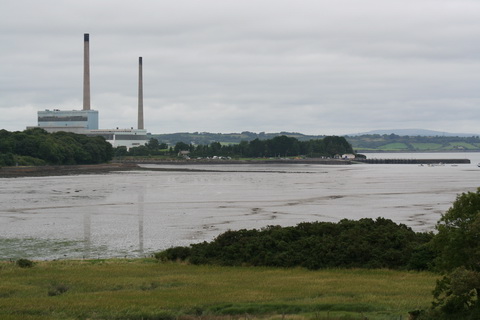
The Great Island power station on the Suir opposite Cheekpoint

The Irish Times says that Endesa had intended to change Great Island and Tarbert from diesel to natural gas. The Tarbert project received planning permission in December 2010; the Irish Times report was probably inaccurate in suggesting that a submarine cable from Tarbert would supply the ESB generating station at Moneypoint which, being a generating station, would be able to generate its own.
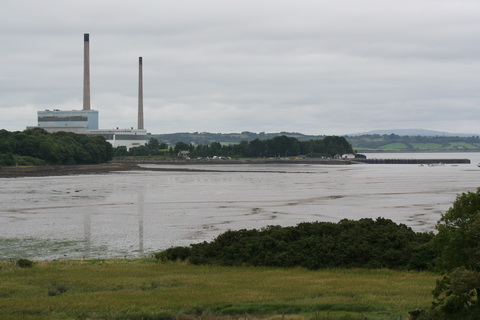
The old Tarbert power station

However, I had heard that Tarbert might have received its natural gas from the proposed storage plant at Ballylongford, near Saleen Pier whence Trinity College turf was sent to Limerick. A pipe from Tarbert might have supplied Moneypoint. I don’t think construction has yet begun.

The old Tarbert power station was built on the site of the Tarbert battery, the largest of the six Shannon estuary batteries and the only one to mount seven guns.
 

Rowing

Big it up for the Irish Amateur Rowing Union (aka Rowing Ireland), which will be descending the Lower Shannon in May. Good to see that they’ll be doing the estuary, as fas as Bunratty, and are not confining themselves to non-tidal waters.

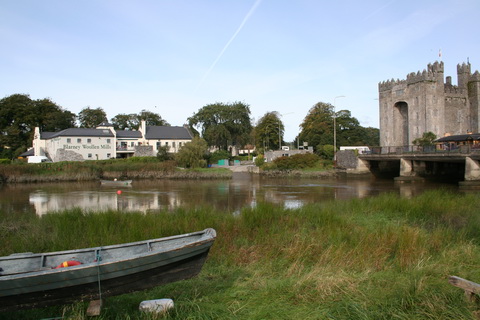
Bunratty

F E Prothero would be proud of them: he himself thought it best to see the estuary from the deck of the steamer to Kilrush.


All SEWn up?

Last week the Clones Regeneration Partnership Chairman called for politicians to support Craggy Island’s Canal to Clones. That’s the scheme being pushed by the Department of Community, Equality and Gaeltacht Affairs (which funds the Partnership’s Project Coordinator).

Then Brian Cassells, former President of the Inland Waterways Association of Ireland, joined the campaign, with an article in the Northern Standard. Happily, its Comments section is working (it was my fault that my comment was posted twice: I tried to edit it but ended up with two almost identical versions).

Brian says:

The phenomenal success of the Shannon/Erne waterway is largely down to the far sighted vision of the late Charles Haughey who had the dream of what has become an enormous tourist success.

I have argued that the success of the SEW is often over-stated and that much of the prosperity of the region is attributable to the businesses set up by Sean Quinn.

But there is another point that the Clones Canal’s fans overlook. According to askaboutireland.ie,

The £30 million funding [for the Shannon–Erne Waterway] came mainly from the European Union Regional Development Fund, the International Fund for Ireland and the E.S.B.

I have not been able to find any exact breakdown of who contributed how much, but it does seem that some large proportion of the costs was not paid by the taxpayers of either Ireland or Northern Ireland. That makes for a much better return on whatever amount of capital they employed.

This time, though, that’s not going to apply. The days of free Euroloot are over, and I haven’t heard that either the IFI or the ESB will be contributing.

Maybe the good people in Craggy Island are relying on winning the lottery?


Something in the water?

Readers may have realised that I don’t think much of the proposal to restore or rebuild the Ulster Canal. But I have to admit that it is not the most insane canal restoration proposal to have been made in the last few years. Even the restoration of the Strabane Canal doesn’t merit that accolade.

No: the outright winner has to be the Erne Canal proposal. Happily, despite support from Mary Coughlan, TD for the area and Tánaiste (deputy prime minister), the proposal doesn’t seem to have got anywhere.

What do all three of these proposals have in common?

Northsouthery, that’s what.

Old photos of Parteen Villa Weir and barges

Thanks to Sam and Brian Grubb, I have been able to put up some photos, taken in 1930, of Parteen Villa Weir. The scanning of the photos was done at such high resolution that it is possible to see several vessels moored in the headrace below the weir.

Waterways restoration? No thanks

An article in the Irish Times about railway restoration has prompted me to set out my views on waterways restoration. Essentially, I don’t believe public funds should be spent on projects that won’t provide a decent return, but I do favour small-scale conservation, opening up walking and cycling routes along waterways and marketing them to industrial heritage enthusiasts (and others).


Ephemera 9: the flash lock at Killaloe

As part of its new mooring scheme at Killaloe, Waterways Ireland has commissioned contractors (L&M Keating Ltd) to carry out various works including the installation of a lock at the upper end of the canal, beside the Phoenix boathouse and just downstream from the Pierhead. The lock is to control access to the canal; presumably the stop planks in the existing lock chamber will be removed, allowing boats to pass down under the bridge.

The lock under construction

As I understand it, this lock is to have a single pair of gates. Boats wishing to pass through will tie up temporarily and use a squawk-box (or similar technological marvel) to communicate with the bridge-keeper at Portumna, who will cause the gates to be opened and then, presumably, closed after the boat has passed through. This system will prevent the use of the canal by cads and bounders using jetskis, speedboats and other excrescences.

Stanked off and pumped out

However, the water through Killaloe Bridge has a gradient or slope, especially in flood and when Ardnacrusha power station is running. The canal above the lock will be at the higher level; the canal below the lock will be fed from the bottom end, where it rejoins the river. So is there not likely to be a difference in height at the lock? Is this the equivalent of a flash lock?

I’m sure there is an engineering answer to this; I would welcome enlightenment.


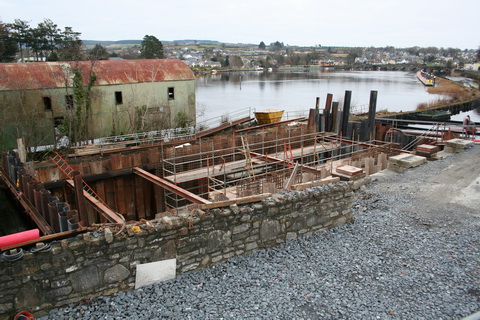
Ephemera 8: Tarbert

Tarbert Island

The Irish Times reports that:

AN BORD Pleanála has approved the application by Endesa Ireland, part of the Spanish energy company, to build a combined-cycle gas turbine power plant on the former ESB station at Tarbert, Co Kerry.

I presume that, when it says that “A submarine cable is to supply Moneypoint.” it means that a submarine pipe will do so: I imagine that the power station at Moneypoint is more likely to want gas than electricity from its rival across the estuary.

Tarbert is now the southern station for the ferries that cross the Shannon Estuary, but it has had a long history as an estuary port. Even before the first of the piers was built, Tarbert Roads provided a sheltered anchorage, and the estuary steamers adopted ingenious methods to get passengers and cargo from shore to steamer and vice versa.

Tarbert was also an important administrative centre and Tarbert Island (as was), which now houses piers and power station, had a Coast Guard station, a lighthouse, a signal mast and the largest of the six forts that guarded the Shannon Estuary. The ESB power station is built on the Ordnance Ground, right on top of the seven-gun battery, as you can see if you play with the Overlay feature on the Historic 6″ Ordnance Survey map.

Moneypoint had a large quarry; it may have been from there that Charles Wye Williams got the “marble” that he polished in the marble mill at Killaloe.

Saleen Pier at Ballylongford is covered here.

Killaloe to Limerick Docks via Ardnacrusha

Join the ex-Grand Canal Company motor-barge 68M on its trip from Killaloe to Limerick Docks, carrying barrels of stout for Dolan’s Pub. The trip marked two occasions: Arthur’s Day, the annual Guinness marketing opportunity, and the fiftieth anniversary of the last commercial cargo on the Grand Canal and the Shannon, which was a shipment of stout to Limerick.

This page provides a slide-show of 300 photos taken from 68M on its journey. If you can’t make the trip in person, do it this way.

Note that the page takes some time to load. And, even clicking through pretty fast, the show is likely to take at least ten minutes.

Click on the first photo to bring up the controls. If you have any problems with it, leave a Comment to let me know. I haven’t done this before. I may not be able to fix any problems, but I can at least look into them.

Who took the arch? A Shannon whodunnit

O’Briensbridge is a village in Co Clare, islanded between the headrace of the Ardnacrusha hydroelectric power station and the River Shannon. Up to 1929 the river was the navigation between Limerick and Lough Derg (and eventually Dublin), and the bridge itself was something of an obstacle to navigation.

In 1832 the engineer Thomas Rhodes drew a sketch of the bridge with 14 arches, whereas nowadays it has only 12. We know when the seven arches on the Co Limerick side were reduced to six, but it has not been clear when an arch was removed from the Clare side. I think I know the answer; you can read it here.