Tag Archives: Royal Canal

Royal Canal: unprecedented speed

From the Freeman’s Journal of 5 December 1833:

The Broadstone, from The Tourist’s Illustrated Hand-Book for Ireland 3rd ed David Bryce, London 1854

 UNPRECEDENTED SPEED ATTAINED IN TRAVELLING UPON THE ROYAL CANAL

The Court of Directors of the Royal Canal hereby give Notice, that the present Day-Boat will cease running on Friday, the 6th, and that an Iron-Boat, capable of conveying Seventy Passengers, will leave the Broadstone harbour, at Nine o’Clock, on the Morning of Saturday, the 7th inst, for Mullingar, where it will arrive at Five o’Clock in the Evening; and Notice is further given, that at Nine o’Clock upon each Tuesday, Thursday, and Saturday, a Boat will leave Dublin for Mullingar, and return from thence at the same hour upon Monday, Wednesday, and Friday. By the foregoing arrangement a saving of three hours and a half will be effected. The Night-Boat will, for the present, continue to leave Dublin for Longford, each day, at Two o’Clock, and a Boat will depart from thence, for Dublin, each Morning, at Eleven o’Clock.

By Order,
SAMUEL DRAPER, Secretary.
Royal Canal-house, 2d Dec., 1833.
 

Lough Ennell and the Royal Canal

Here is an account of the background to, and the main features of, the proposed supply of water from Lough Ennell to the summit level of the Royal Canal. It does not discuss the amounts of water involved; I intend to cover that on a separate page.

“It’s worth a bit of suffering to create some good memories”

… or why taking a boat into Dublin by canal, or to Limerick via Ardnacrusha, is a Good Thing, even if it’s a hassle at the time.

The surprising importance of the Shannon steamers in the 1830s

A short, lavishly illustrated talk in Killaloe Cathedral, Co Clare, at 6.00pm on Sunday 29 April 2012, as part of the Waterways Ireland Discover Killaloe and Ballina thingie.


Skew arch bridges

The IHAI AGM at the weekend, in Newtownabbey Borough Council’s splendidly restored Mossley Mill,  included a tour of the premises and its museum. Then Professor Adrian Long of Queen’s University Belfast gave a short talk about the FlexiArch bridge, which his team have been developing since the 1990s.

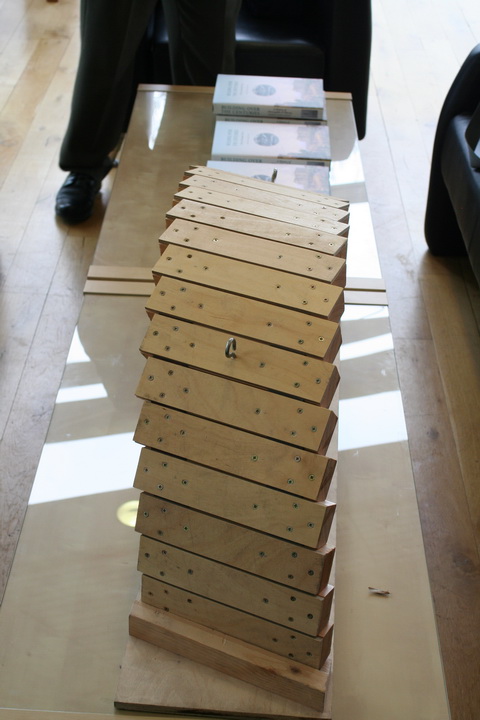
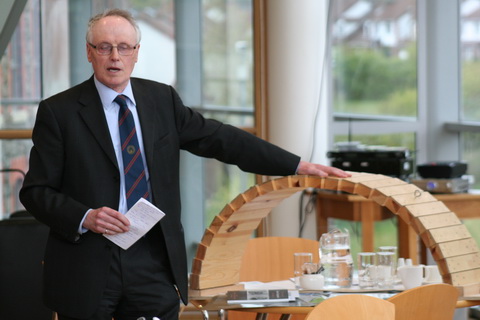
Professor Adrian Long with a wooden model of the FlexiArch bridge

He said that their work started by asking why nobody built arched bridges any more; they developed a system that used pre-cast voussoirs (the wedge-shaped blocks) linked by a polymeric flexible membrane. The voussoirs for any bridge are cast to give the correct taper for the span and rise required for that bridge.

Arch rings arrive on site stowed flat on the back of a truck; when they are lifted off, they fall into the correct shape and are lowered into position on previously-installed footings. Each arch ring is 1m wide; several of them can be placed side by side to give whatever width is required. The end walls are added and the structure is filled and given the appropriate surface (eg tarmac).

FlexiArch is manufactured by Macrete of Toomebridge (beside Lough Neagh); their website shows several examples of installation including one at a name familiar on Irish waterways. There is a brochure [PDF] and there is a video showing the installation of a 15-metre bridge.

Wooden model as a skew arch

No, I haven’t any shares in it. I just thought it was interesting, for three reasons: first, the speed of construction is very impressive; second, there is a link to Lough Neagh; third, it might encourage the construction of more skew arch bridges over canals.


The sluice house at Lough Owel …

… has had its windows broken. More on the Lough Owel Feeder here.

Dublin or bust

If you’re not already a reader of Barge Hawthorn’s blog, may I suggest that you start now? The account of the descent into Dublin along the Royal Canal, over three days, features mounting tension, a really superb photo of the M50 aqueduct and a happy ending when Effin Bridge lifted when required.

You can work your way backwards through earlier posts to find the how and the why.

Willie Leech and the Royal trade

I have uploaded an old article of mine based on an interview with Willie Leech of Killucan, whose father ran the last trading boats on the Royal Canal.

F E Prothero on the Royal Canal in the 1890s

His brief notes here.

Mirabile dictu …

… it’s raining.