
From Robert Mallett MRIA, MSCEI “On certain improved Methods of constructing Valves or Sluices, as applied to Canal and Dock Gates, &c, and similar Works of Hydraulic Engineering” in The Architectural Magazine 1837.
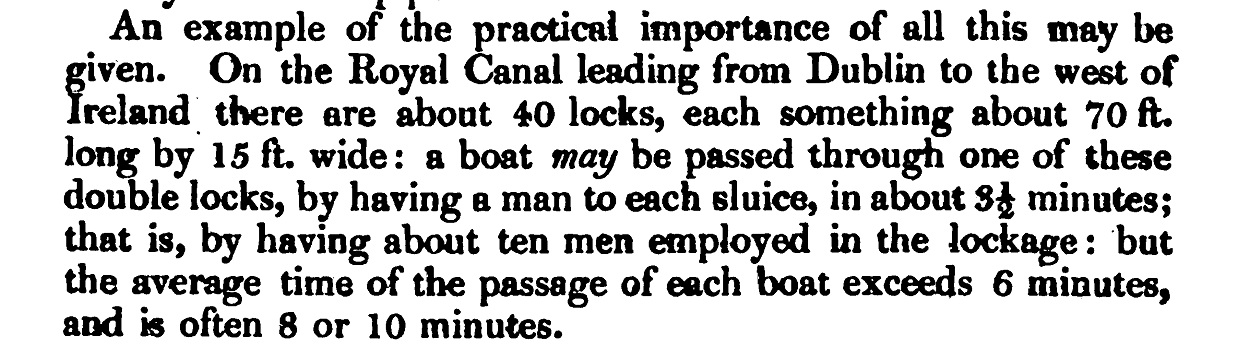
A target for WI to aim for?
From Robert Mallett MRIA, MSCEI “On certain improved Methods of constructing Valves or Sluices, as applied to Canal and Dock Gates, &c, and similar Works of Hydraulic Engineering” in The Architectural Magazine 1837.
A target for WI to aim for?
You will be pleased to learn that, on 28 May 2010, Arthur Scott (Director of the Culture Division) and Rosalie Flanagan (Permanent Secretary) of the Department of Culture, Arts and Leisure each received from Waterways Ireland a waterways mug and a book on the Royal Canal, total value £20 each. Later in the year, however, Rosalie Flanagan declined an invitation, estimated to be worth £8, to the opening of the Royal Canal on 1 October 2010.
Mrs Flanagan and husband are members of the Belfast Boat Club but do not hold any position on the Club’s Committees or Council. Orla Bateson, Head of DCAL’s Research & Statistics Branch, is a committee member of Intercity Paddlers, a Belfast canoe club.
A correspondent writes:

Trees in the cut (photo reproduced by kind permission of the copyright owner)
I walked the stretch of the Royal Canal from Drumcondra to Leixlip last Sunday. Just before Callaghan Bridge there was considerable work being done felling trees along the bank. Hopefully no boater tried to pass this way over the weekend […]. Several trees lay across the width of the canal, and a very large section of what looked like plywood was also floating on the surface.
I understand from WI’s website that winter closures affect locks from the 8th eastwards, but no Marine Notice suggests closures just west of the 12th (although closures were expected from the 33rd westward). Perhaps anyone planning to navigate on the long level between the 12th and 13th should check with Waterways Ireland.
Posted in Ashore, Engineering and construction, Extant waterways, Ireland, Irish inland waterways vessels, Natural heritage, Operations, Scenery, waterways, Waterways management
Tagged 12th, Blanchardstown, Callaghan Bridge, deep sinking, Dublin, Leixlip, long level, Royal Canal, trees, Waterways Ireland
The lake level seems to be down about a foot. Two rumours purport to account for this: either (a) the powers-that-be want us to get used to a new, lower level, so that we won’t notice when Dublin starts extracting water, or (b) the ESB is generating as much electricity as it can before it starts getting charged for water. Such charges would be covered by the same European Commission reasoned opinion as that mentioned here that might see Waterways Ireland being charged to fill the Grand, Royal and SEW.
Or, of course, it could just be that there hasn’t been much rain. According to Met Éireann’s seasonal summary for winter 2012 [two-page PDF]:
Majority of rainfall totals were below normal for winter across the southern half of the country and in some parts of the east. Rainfall totals were below average in the majority of these parts during December and January, while all stations reported dry conditions in February. Most stations the east and south reported a below average number of wetdays (days with 1 mm or more) and the driest winter since 2006 (6 years).
Ardnacrusha usually runs fewer turbines in summer.
Posted in Ashore, Built heritage, Economic activities, Engineering and construction, Extant waterways, Industrial heritage, Ireland, Irish waterways general, Non-waterway, Operations, Politics, waterways, Waterways management, Weather
Tagged Dublin, ESB, Grand Canal, Ireland, Lough Derg, Royal Canal, Shannon-Erne Waterway, waterways, Waterways Ireland
There has been such interest in my posting on Stakhanovite homoeroticism that I thought I would post a few close-ups of the mural. The light fittings get in the way a bit, but you can pretend that they represent the fires of passion.


The chap at the bottom of that last one may represent Diogenes addressing a meeting of the directors of the Royal Canal Company.
Posted in Ashore, Built heritage, Economic activities, Engineering and construction, Extant waterways, Industrial heritage, Ireland, People, waterways
Tagged Blanchardstown, canal, Castleknock. art, construction, Diogenes, engineer, homoeroticism, Ireland, lock, mural, Royal Canal, Stakhanov, Twelfth Lock, waterways
I see in the blatts — well, the Sunday Business Post, actually, although I do realise that other newspapers are read in the servants’ hall — that the Twelfth Lock Hotel at Blanchardstown, on the Royal Canal, is to be sold by public tender on 1 March 2012. No estate agent — the only contact details are for a solicitor and a FRICS FRICI, which means a surveyor (I think) — so there is nothing on tinterweb.
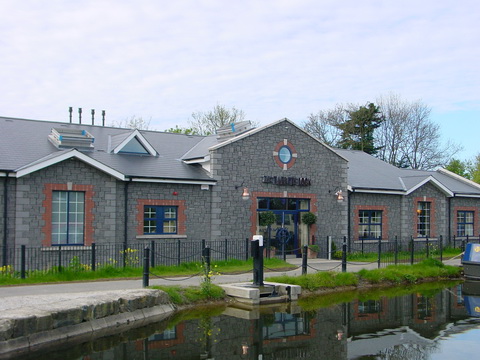
The Twelfth Lock Hotel
The hotel is described thus:
Unique Hotel Opportunity
‘THE TWELFTH LOCK HOTEL’, Castleknock Marina, Royal Canal, Castleknock
Purpose built, 10 Bedroom Hotel, with Loune Bar/Restaurant, private Lounge, Beergarden/Smoking Patio, outer garden and private car park. In unique setting alongside the picturesque Royal Canal Marina.
Older folk will note the link to this story.
I stayed in the hotel once; it was fine. I’ve been in the bar a few times, and noted three things. The first was a range of beers that was wider and better than most Irish pubs serve (which is admittedly not saying much). The second was that the bar food was tasty and served in generous quantities. The third was the mural (I’ve cropped the lower part of the photo to omit the customers) of chaps building the canal.
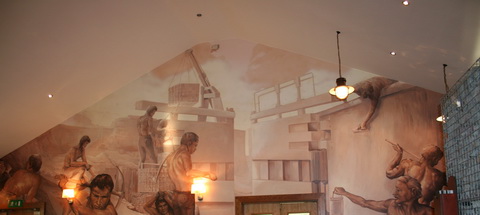
Twelfth Lock Hotel mural
The hotel is in a wonderful location, off a quiet road but close to the railway, the M50 motorway and the Wonderful O of the junction with the Royal Canal crossing in the middle.
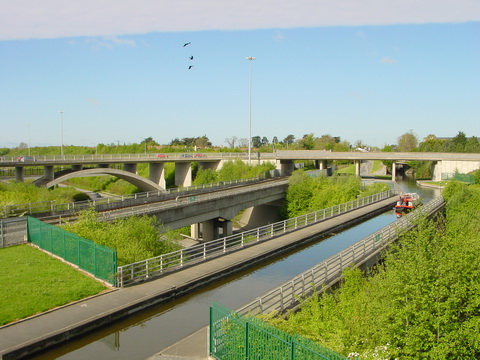
Crossing the Wonderful O
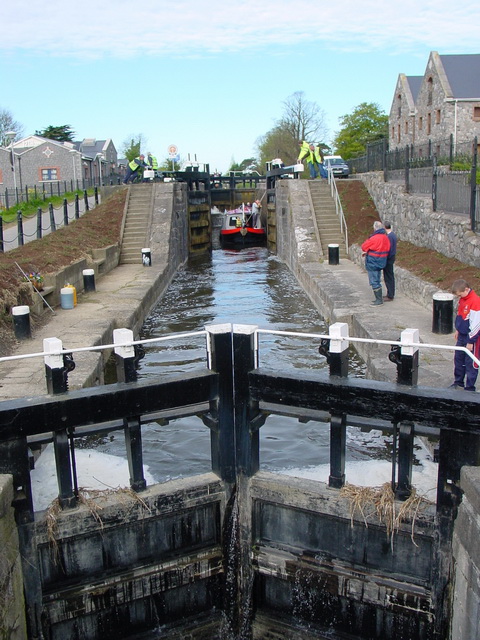
Boat descending the twelfth lock (a double). The building on the left at the top is the hotel
Across the canal are flats is where the Blanchardstown Mills stood; the site has unsuspected depths.
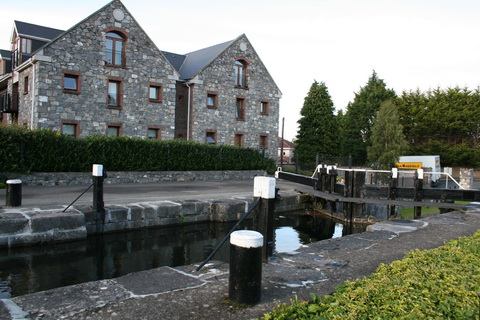
Flats
I don’t really know the status of the “marina”. It seems to consist of a short run of pontoons with gated access. I think it’s a good idea to have such an arrangement; perhaps something similar could be done on the Grand Canal.
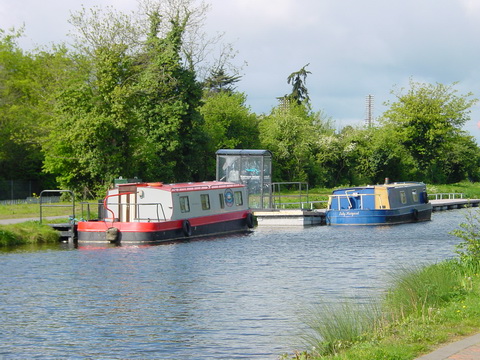
The marina (2005)
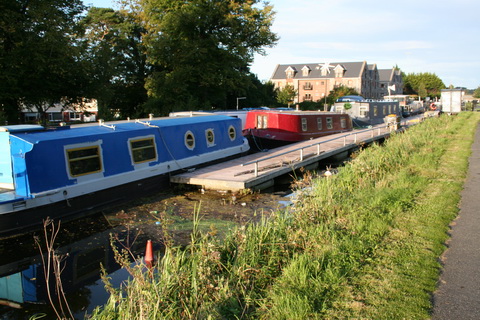
The marina (2009)
But who runs it and controls the allocation of spaces? I don’t know: although the gateway seems to have Waterways Ireland branding, there is also this sign:
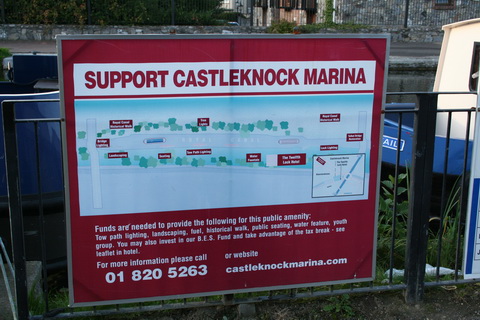
Castleknock Marina sign
Its website doesn’t seem to have changed much for several years and the “How goes it” page, showing progress in raising funding, doesn’t seem to work. There is a hire firm too.
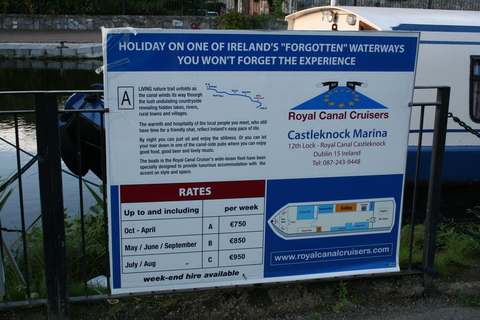
Hire firm
It would be nice if the hotel, marina and hire firm were to continue in operation.
Posted in Ashore, Built heritage, Economic activities, Engineering and construction, Extant waterways, Industrial heritage, Ireland, Irish inland waterways vessels, Operations, People, Rail, Restoration and rebuilding, Tourism, Uncategorized, waterways, Waterways management
Tagged Blanchardstown, boats, bridge, canal, Castleknock, Dunsink, hire firm, hotel, Ireland, marina, railway, Royal Canal, Stakhanovite, Twelfth Lock, vessels
Nice PQ from Éamon Ó Cuív here:
Éamon Ó Cuív (Galway West, Fianna Fail). Question 446: To ask the Minister for the Environment, Community and Local Government if Waterways Ireland will have to pay for the abstraction of water for use in the Royal Canal, the Grand Canal, the Shannon-Erne Waterway and other man-made waterways as a result of the reasoned opinion from the European Union in November 2011; the reply sent by him regarding same to the Union; and if he will make a statement on the matter. [8122/12]
Here is the European Commission’s press release on the subject.
Posted in Drainage, Economic activities, Engineering and construction, Extant waterways, Ireland, Irish waterways general, Non-waterway, Operations, Politics, Shannon, Sources, waterways, Waterways management
Tagged abstraction, Éamon Ó Cuív, canal, Grand Canal, Ireland, Royal Canal, Shannon-Erne Waterway, use, water, waterways, Waterways Ireland

 Irish waterways history