Tag Archives: waterways

Killaloe

The installation of the new pontoon, the flood control gates (flash lock) and the walkway continues apace.

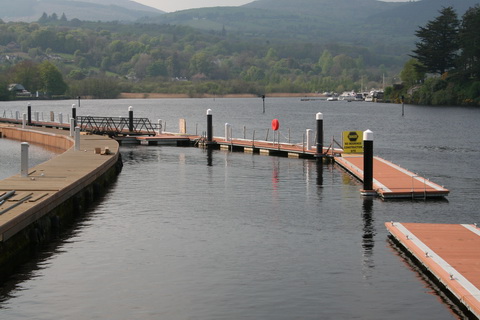
Walkway (left) and pontoon from the lockhouse

The lower (nearer) section of pontoon may be for the lakeboat hire business

Boats mooring on the lower end of the pontoon, and turning to approach upstream, may get quite close to the bridge. The navigation markers may confuse too: perhaps they’ll be relocated.

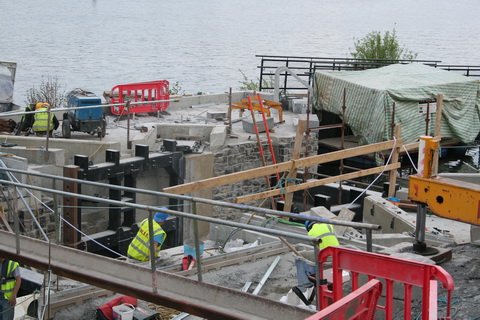
The flood control gates (flash lock?)

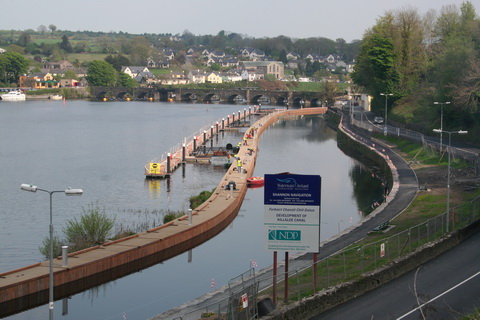
From upstream (and uphill)

It all looks very nice. There are lots of people working on site.

Alliance Party (NI) backs Ulster Canal

From the party’s 2011 manifesto:

Inland waterways and fisheries
Alliance calls for recognition of the needs to sustainably develop our inland waterways and fisheries – protecting and enhancing their bio-diversity while at the same time developing their recreational and leisure potential.

Alliance supports the regeneration and development of our inland waterways system, including the re-opening of the Ulster Canal. We recognise that funding needs to be explored on a partnership basis with interested bodies.

Alliance believes that improving water quality, including the revision of pollution controls, and appropriate planning measures are priorities for the effective and efficient management of inland waterways, recreational angling and commercial fisheries. We believe that increased co-operation between angling organisations and other environmental bodies would be beneficial, for example in meeting the challenge of biodiversity.

Alliance is committed to supporting the work of the North/South Body on Inland Waterways, to ensure a co-ordinated approach in border areas and to develop their potential throughout both areas.

Clontarf to Clondra II

Maark Gleeson of Clontarf Yacht & Boat Club has kindly given me details of the Club’s recent trip along the Royal, with notes on the time taken and some useful advice, especially about the tides in Dublin.

Keeping Galway dry

A page about the ESB pumping stations on the embankments above Portumna.

The Ulster Canal and the NI Assembly elections

The importance of the Ulster Canal is shown in the number of times it is mentioned in the election manifestos of the political parties.

Number of mentions of Ulster Canal in DUP manifesto: 0
Number of mentions of Ulster Canal in SDLP manifesto: 0
Number of mentions of Ulster Canal in Sinn Féin manifesto: 0
Number of mentions of Ulster Canal in TUV manifesto: 0
Number of mentions of Ulster Canal in UUP manifesto: 0

Clontarf to Clondra

The Clontarf Yacht & Boat Club, recreating the Club’s 1925 trip, entered the Royal Canal sea lock from the Liffey on Saturday morning, 16 April 2011; some boats have reached Abbeyshrule this evening, and they hope to reach Clondra tomorrow evening, which will be four days from the Liffey.

That’s very fast: for Blanchardstown to/from Clondra, IWAI Dublin Branch estimated 5 days X 8 hours and I estimated 6 days X 7 hours, plus another day from the Liffey to Blanchardstown (12th Lock). I understand that CYBC has been doing very long days; I’ll get details later. In the meantime, well done CYBC.

Royal steam

How many steamers were used on the Royal Canal? The standard answer is five, but the right answer might be nine or ten. Read about Fishbourne, the unknown carrier, here.

Lough Ree

Unlike Loughs Derg, Erne and Neagh, Lough Ree does not have a Coast Guard approved declared-resource rescue service, although Athlone Sub Aqua Club, Waveline/Quigley’s and no doubt others have provided help to boats in trouble. Now, it seems, Damien Delaney is hoping to set up a formal, approved service, according to the Wesstmeath Examiner.

The Liffey before the Lagan

According to the Heritage Boat Association, the Guinness jetty on the Liffey was built in 1873, but the first steamer, the Lagan, was built in 1877. The Guinness Storehouse‘s fact sheet confirms the 1873 date, but is vague about when the first boats were built. So why the four-year gap? Why would Guinness build the jetty before it had the boats to use it?

At the half-yearly meeting of the proprietors of the Midland Great Western Railway Company, held on 7 September 1876, the Chairman (Sir Ralph Cusack) said that the largest trader on the Royal Canal (owned by the MGWR) was about to retire from business because of ill health. Sir Ralph said:

[…] it might be very inconvenient to persons in the country, who carry on the canal materials that are not exactly suited for a railway, such as coals, timber, slates, bricks, etc. […] it is therefore our intention to commence — perhaps in a small way at first — carrying with a couple of boats on the canal, so as to relieve the railway of this rough kind of traffic, and at the same time to benefit the country through which the canal runs. [Irish Times 8 September 1876]

Sir Ralph said that the company had ordered a small steamer:

We don’t propose that the steamer shall carry goods, but we propose to have a few small tugs similar to those used by Sir Arthur Guinness on the Liffey to draw laden boats. […] we will begin in a small way and see what way the thing will do. We cannot lose very much by it. We are getting one small tug, and I suppose we will get another.

So in 1876, one year before the Lagan was built, Guinness was using dumb barges, towed by small tugs, on the Liffey.

 

Not at all boring

A Shannon Commissioners quay that is not at all boring. Shipbuilding,
barges, mud: what’s not to like?