
Category Archives: Charles Wye Williams

Please, sir, I want some more

I have written from time to time about the Heritage Council and the budget cuts it has suffered. Here’s a comment from December 2010; here I said that the Council’s vigorous lobbying campaign had succeeded in ensuring its own survival; last month it became clear that, although the Council had survived, its main grants scheme had not.

The dauntless Michael Starrett returns to battle in today’s Irish Times [incidentally, if the Irish Times tries to charge me for linking to their site, I’ll set McGarr Solicitors on them]. He argues that natural and cultural heritage are the core of the tourism product and that they are being damaged by the withdrawal of (inter alia) the Council’s programme of (mostly small) grants to (mostly small) community projects.

This line of argument accords with that used by the Council in its successful campaign to ensure its own survival. It was made explicit in the report Economic Value of Ireland’s Historic Environment [PDF] produced by Ecorys and Fitzpatrick Associates for the Heritage Council and launched in May 2012. However, there are some difficulties with its use in the present context.

The first is that some folk might feel that heritage (natural or built) should be appreciated for itself, not for its economic value. That’s fine as long as people do it on their own time; I lose sympathy when that argument is used to extract money from taxpayers while hiding the economic cost and distracting attention from the beneficiaries of that spending.

The second difficulty is that the Economic Value of Ireland’s Historic Environment concentrates on larger sites and attractions:

Reflecting these various criteria, Ireland’s historic environment has been defined for the purposes of this study as comprising the following sets of built heritage assets – those which are statutorily protected, together with components of the broader built heritage:

– World Heritage Sites
– Recorded Monuments, as defined by the Department of Arts, Heritage and the Gaeltacht
– Protected Structures included in planning authorities’ development plans
– Architectural Conservation Areas included in planning authorities’ development plans
– Designed landscapes surveyed by the Inventory of Architectural Heritage, and
– Other structures erected pre-1919, of which a note says “This is an increasingly accepted definitional component for the broader built heritage, although it is  acknowledged that some Protected Structures may have been built post 1919. Up to 1919 most houses in Ireland and Great Britain were built by skilled craftsmen using traditional indigenous building materials. Although the majority of older buildings are not listed/ statutorily protected, the majority provide flexible domestic and office accommodation. Major investment in money, energy and materials is embodied in these structures.”

The economic impact of the sector is the sum of three things:

  • Direct repair and maintenance output in relation to pre-1919
    building stock
  • Direct tourism expenditure by tourists principally attracted to
    Ireland by the Historic Environment (HE)
  • Direct employment, expenditure and income by the public sector (eg the Office of Public Works), subtracting overlap with the repair and maintenance category and the tourism expenditure category.

Eight of the ten case-studies considered in the report are about large sites, some of them commercial operations and others state-owned. The two exceptions are the Irish Landmark Trust and the Heritage Council’s grant scheme for traditional farm buildings.

Now, as far as I can make out, a lot of the recipients of Heritage Council grants (generally, not just those for farm buildings) would have fallen into the “Other structures erected pre-1919” category. I have not been able to discover, from the report, how much of the Historic Environment’s contribution to Gross Value Added is attributable to that category, or to any other category that might include the Council’s recipients of small grants.

In effect, the report seems to me to made some very broad-brush claims about the annual value of the Historic Environment, and those claims are being used to cast a halo effect over the entire sector. But it is not, it seems to me, proven that spending on any particular sub-sector is a good investment. (If I am wrong on that, I would welcome comments.)

Furthermore, I suspect that most of the contribution of the small projects supported by Heritage Council grants would come from the spending on repair and maintenance (where the total contribution is arrived at after some pretty heroic assumptions) rather than from that by tourists. Approaching it from the bottom up, I suspect that very few tourists are attracted to Ireland by the fact that the Heritage Council has grant-aided the clearing of an individual graveyard or the removal of rhododendron from a woodland.

So the argument that is being presented today, that (to quote the headline) “Tourism will suffer without real support for heritage” where “heritage” means “small local projects”, is not convincing. And it is rendered even less convincing by the fact that Heritage Council grants schemes explicitly gave low priority to tourism projects. But that is not to say that the small schemes are without value: there could and, I would argue, should be an effort to use them as part of the tourism marketing effort.

But there is a real difficulty here. How do you market small-scale tourism attractions? How does a small enterprise, or a small community, sell its heritage? How do the overseers of the national tourism product get tourists out of the well-known areas and off the beaten track, to places where they can meet real people and see real stuff? Maybe that’s what The Ghastly Gathering is about [I’m sorry: I can’t bring myself to read it].

Towards the end of his article, Michael Starrett talks in terms of landscapes, and I think he is right to use a term that is broader than a single site or location for a project. To have an impact, to be marketable, small projects need to be linked. Some of those links could be geographical, within a single area or landscape; some could be temporal, some familial, yet others commercial or otherwise thematic (for instance, the fascinating history of the Irish egg trade). I think that the small projects can help to attract tourists, but they need to be organised.
 

Melancholy loss of life on the River Shannon

Last Wednesday we were witness to a most melancholy spectacle. We saw three bodies floating on that part of the river Shannon which lies opposite to Castle Lough, in this county. Having rowed in to shore, we gave notice to some persons there, who, without hesitation, prepared themselves, and joined in the sad task of snatching from the watery element the livid bodies of three unfortunate fellow creatures. When we stretched them on the bank they were recognised by one of the Steam Packet Company to be the bodies of Thomas Minshoe, George Halbert, and Robert Williams, three of the unfortunate five that were drowned some few days ago, while on a party of pleasure. The bodies were far advanced in a state of putrefaction and were a revolting spectacle to look on.

A messenger being despatched to Nenagh for the coroner, James Carroll, Esq, that officer, with his usual promptness, reached here in a short time; and having empanelled a jury, “Accidentally drowned during a squall” was the verdict.

It appeared from evidence that the deceased, with others, left Killaloe on Sunday, the 20th ult, for the purpose of having a day’s amusement on the Upper Shannon. They put in at Castle Lough to take refreshment; during the time they were on shore, the wind freshened and blew a gale, upon which they determined to leave the boat at anchor, and proceed home by land, which they accordingly did. On the following morning they returned and found that the ropes, which were for the purpose of lowering the sails, had been stolen. The day being fine and the weather not likely to change, they made light of the inconvenience, and ventured homeward.

After hoisting sails and reaching the centre of the river (which, at this point, is not two miles broad), a squall came on. Having endeavoured in vain to lower sails, which was completely impracticable, on account of the loss of the ropes, the boat suddenly ducked beneath the weight of canvass, and consigned the poor fellows to an early grave. Thomas Minshoe and George Halbert are natives of Liverpool, and Williams from Wales.

No coffins being convenient, three fishermen were appointed to watch the bodies on the shore until the next day. When we saw them coffined, we observed that the ear had been eaten off Williams by, we suppose, a dog, and a part of Minshoe’s left leg. They were interred at Killaloe on the afternoon of Thursday.

1 September 1837

Carrying on the Royal Canal

This is a point I’ve come across in passing. It’s not central to my main concerns so I won’t pursue it further for the moment, but I’m posting it here in case it helps anyone else researching the subject.

It will be recalled that, until the passing of the Canal Carriers Acts 1845 and 1847, most canal companies carried passengers but not freight on their own canals. After the passing of those acts, the Grand Canal Company set out to take over the bulk of the freight business on their own canal (and, in consequence, on the rivers connected thereto). But what of the Royal Canal, which had been taken over by the Midland Great Western Railway in 1845?

Ruth Delany, in Ireland’s Royal Canal 1789–2009 [with Ian Bath; The Lilliput Press, Dublin 2010], says on page 192:

In 1871, despite its failure to show a profit on the Grand Canal lease, the MGWR decided to try acting as carriers on the Royal, which had been permitted by legislation since 1845. Horse-drawn boats were used until 1875 when five steamers were purchased: Rambler, Rattler, Mermaid, Conqueror and Pioneer.

In a note, she says

For this period, 1849–1906, the principal source of information is found in the minutes of evidence to the Shuttleworth Commission, HC 1907 (Cd 3717), XXXIII, Part 1, 9.

Peter Clarke, in his The Royal Canal: the complete story (ELO Publications, Dublin 1992), says:

It is important to recall that at this time, the carriage of goods on the canal was undertaken by a number of boat owners who paid tolls to the railway company. The failure to have these tolls increased was what most probably prompted the railway company to establish themselves as carriers on the canal in 1870. […] Until 1876 an unknown number of railway owned horse drawn barges were used. In that year, the service was expanded when four new screw propelled boats were purchased at a cost of £5000.

His source is the Waterways Commission of 1923, Minutes of Evidence nineteenth day, p13.

Ernie Shepherd in The Midland Great Western Railway of Ireland: an illustrated history (Midland Publishing Ltd, Leicester 1994), says

The MGW decided to operare its own carrying trade in 1871 and this lasted until 1886. Horse drawn boats were used until 1875 when steamers were purchased.

On 15 August 1853 The Freeman’s Journal and Daily Commercial Advertiser of Dublin carried this notice in the Railways column.

Midland Great Western Railway (Ireland) Company — Royal Canal

Haulage of boats

The Directors will receive Proposals for the Haulage of their Trade Boats to and from Dublin and Longford and the River Shannon, from and after the 12th November next. Parties are at liberty to tender for a part or the whole of the work. Security will be required for the fulfilment of the Contract; and further particulars may be had on application at this Office.

Tenders to be sent in on or before 10th September next.

By order, Henry Beausire, Secretary.
Dublin Terminus, 10th August, 1853

This suggests that, in 1853, the MGWR had its own trade boats (lumber boats, freight-carrying barges) at work on the Royal Canal. It would be nice to know more. I have said before that we do not know anything like the full history of the Royal Canal.

Where is this?

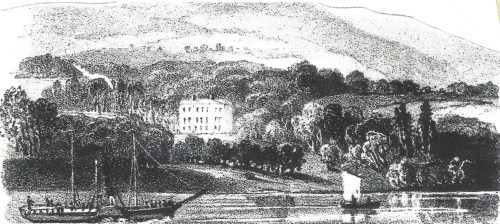
Paul Gauci's 1831 drawing of a Shannon steamer

Paul Gauci’s 1831 drawing of a Shannon steamer

This drawing of a steamer is from an 1831 book called Select Views of Lough Derg and the River Shannon by Paul Gauci. I haven’t seen the book myself, but this illustration is used in a couple of places, including Ruth Delany’s book The Shannon Navigation [The Lilliput Press Ltd, Dublin 2008]. Andrew Bowcock, in his article “Early iron ships on the River Shannon” in The Mariner’s Mirror Vol 92 No 3 August 2006, says of the steamer shown that

The funnel looks to be almost over the paddle shaft, which is artistic license.

But my question is not about the vessel but about the house in the background. If it is drawn without artistic licence, where is it?

It is a very large house, seven bays by three storeys, quite close to the water. Using the Historic 6″ Ordnance Survey map [~1840], I have followed the banks of the Shannon from Shannon Harbour down Lough Derg to Killaloe, then from Limerick down the estuary as far as Tarbert, across the estuary to Doonaha and back up on the Clare side to Limerick, then from Killaloe up the Clare and Galway shores back to Shannon Harbour. Anywhere I found a large house within what seemed the right distance of the shore, I looked it up in the Landed Estates Database and in the National Inventory of Architectural Heritage, with some supplementary googling.

I haven’t been able to find images of all the houses marked on the OSI map, but I found enough to show that houses of the size shown by Gauci were very rare. Within those few, I ruled out some (like Tervoe) because they didn’t seem to match Gauci’s drawing (although alterations could have accounted for that). I ended up with only one house that looked at all like Gauci’s, but the background may not match.

If you can identify the house, I would be glad if you could leave a Comment below.

The music of the Shannon steamers

On my page about PS Erin-go-Bragh I’ve provided a link to a performance of the song of that name. It would be wrong, therefore, to omit Garryowen. There is a “Fantasy on Dover Castle” by David Fanshawe, the African Sanctus chap, but I can’t find a free legal recording.

Dick Gaughan and John Grantham …

… both had an interest in Erin-go-Bragh,

Some new things arise

First, I’ve checked all the linked sites listed at the bottom of the right-hand column and removed some that have died. If you know of others to which I should provide a link, do please let me know.

Second, I’ve added a link to the excellent Grace’s Guide to British Industrial History, and I take the opportunity to draw it to the attention of folk interested in who made what. I have received much useful information from its volunteers and I have been able to contribute photos of a few artefacts. It’s well worth exploring. I have also added a link to the Railway and Canal Historical Society.

Third, I am glad to see that the Irish Times‘s conversion to the benefits of civilisation continues: yesterday it featured an Intel Pentium chip from 1994, which provided the basis for an essay on Ken Whitaker’s 1950s report, globalisation, television, women, Northern Ireland and Viagra. If only some more of the nineteenth century industrialists, entrepreneurs, engineers and modernisers had been covered.

That, fourth, reminds me that I came across a couple of interesting articles by Roy Johnston on the Victorian Web site: they’re under the heading Science, Technology, and Politics, on this page, which has several articles about Ireland. They include articles on whether Ireland was a colony, although I must confess that I have yet to be persuaded that that is a question in which I should take an interest.


The Rideau Canal

The Cedar Lounge Revolution has an article about those who worked on the construction of the Rideau Canal in Canada in the 1820s and 1830s. Readers will, of course, recall that Charles Wye Williams compared the Rideau and the Shannon in his 1835 […] speech on the improvement of the Shannon: being in continuation of the debate in the House of Commons, 12th May, 1835, giving a comparative view of the navigation of the Rideau Canal, in Canada, and the River Shannon in Ireland, with observations on the value of a connection by steam packets, with British America.

SESIFP

Read about the draft Strategic Integrated Framework Plan (SIFP) for the Shannon Estuary here. You can comment on it up to 15 February 2013.

Newcomen Bridge

Mick Farrell of the HBA has pointed out that, on the Historic 6″ Ordnance Survey map (~1840), the first lock on the Royal Canal is downstream of Newcomen Bridge whereas on the Historic 25″ (~1900) the lock is upstream of the bridge.

Industrial Heritage Ireland has created a page giving the history of the railway crossing at Newcomen Bridge. However, it would be nice to have some documentary evidence about the resiting of the lock — and about the headroom under the bridge before the lock was moved.