Category Archives: Foreign parts

Races on Lough Erne

To the Editor of the Erne Packet

Me Editor — The stir visible amongst the seamen of the Lake, assures a most interesting contest. Four new boats are to enter the lists — their prowess will best prove the merit of those which have on former occasions been exhibited.

To the amateur, the scene cannot fail of proving most interesting, as well from the unrivalled beauty of the sailing ground, as from the superiority of the boats, some of which, built on the Thames, are considered to be superior to any other vessels of any size, for lake sailing.

The mariners of Donegal Bay will not, it is to be hoped, sleep on their oars; if rumour is to be credited, they are not to yield the palm so easily as they did last year. Four boats besides those already mentioned, are reported to be in readiness to invade the lake, from the sea, to assert the superiority of the Donegalian over his fresh-water competitor.

Some experiments are to be tried upon scientific principles,where lightness of draught of water, and form, altogether differing from what, for centuries, has been in use, are to be put into competition with bulk and beam. The well established speed of the Lough Erne cot is also to be tried, a boat being in preparation; these rivals to be pulled by Gentlemen of the lake. Great confidence is expressed by the owners, and any money for hands with good beam and bottom. NB — Dandies not admitted.

To cheer the toils of the seamen, two Balls are in contemplation, where all the rank and fashion of a wide extended country have engaged to attend. A very distinguished party from London, òn a visit to the Lakes and Bundoran, will also be present, and gratify the eye, as they have already done the mind’s eye of most of us.

Besides the beauty of the Lakes, much speculation exists to account for their visit, whether an examination into the minerals and collieries of the neighbourhood, or the general capabilities of Lough Erne, an extension of the navigation, and perhaps a decision of a question which has long barred up our Lake; the choice between a canal to Lough Neagh and Belfast, or one from Ballyshannon. In giving information to these sagacious explorers, Gentlemen will do well to bear in mind, that their evidence should be divested of any private favour, for should it be found to contain more affinity for party purposes than the general object, the benefit of the country, it will instantly, and perhaps not civilly, be rejected as unfit matter to enter into such an important digest.

NOTUS

Enniskillen Chronicle and Erne Packet
12 August 1824
Momentous day on the Ulster Canal

The day work finally began on the Ulster Canal, after many years of planning and consideration. The opening ceremony was attended by many of the local gentry; the royal standard was hoisted, a 21-gun salute was fired, hundreds of people had turned up to see it and “the country people were liberally supplied with ale”. That evening, those most involved dined together in Caledon with toasts to the king, to the queen and the rest of the royal family and to the army and navy.

I suppose that similar festivities would attend the start of work on any canal nowadays, but that was back in 1835, and the canal was the real Ulster Canal.

The K&A in slow time

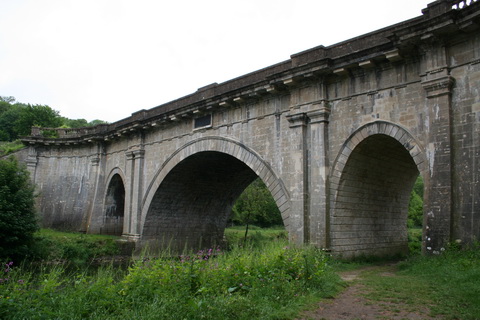
The Dundas aqueduct

The Dundas aqueduct

There is a television station or channel called BBC 4. On Tuesday next, 5 May 2015, it will broadcast

A two-hour, real-time canal boat journey down one of Britain’s most historic waterways, the Kennet and Avon Canal, from Top Lock in Bath to the Dundas Aqueduct. Using an uninterrupted single shot, the film is a rich and absorbing antidote to the frenetic pace and white noise of modern life.

More info here. I do not know whether folk outwith HM Realm can watch the programme on television or on tinterweb.

Early water transport

In a piece about the Augustinian Priory at Athassel, near Golden in Co Tipperary, I wrote

But the really extraordinary thing about Athassel, at least from the waterways viewpoint, is that Dundry stone was used for sculptural (but not for structural) work.

Now, that may mean as little to you as it did to me, until I looked it up and found that Dundry is in Somerset, on the Bristol Channel. The stone could have been taken from there to Waterford by sea and it must have been hauled up the Suir from there.

In the last century, the horse-drawn traffic up the Suir to Clonmel ceased, and Carrick-on-Suir became the effective head of the navigation. But Athassel is at least another twenty miles upstream from Clonmel, and cargoes were brought up there seven hundred or so years ago.

However, traffic in materials for religious establishments was not all one way, and I am indebted to John Ditchfield for the information that some of the oak used in the roof of Salisbury Cathedral was felled in Ireland, on or near the east coast, in the spring of 1222 and used by 1225. Timber from 75 trees has been identified and at least one shipment, by William of Dublin, is recorded in 1224.

Inside Salisbury Cathedral (courtesy of John Ditchfield 2015)

Inside Salisbury Cathedral (courtesy of John Ditchfield 2015)

A 2003 story in the Telegraph says

The wood was bought from “William of Dublin” and carted from Bristol or Southampton.

However, in the English Heritage [now Historic England] report from 2002 on The Tree-Ring Dating of the Roof Carpentry of the Eastern Chapels, North Nave Triforium, and North Porch, Salisbury Cathedral, Wiltshire [PDF], I found nothing about how the timber got from the English coast to Salisbury, which is some distance inland.

It may be, of course, that the Patent Rolls for AD 1224 say what English port was used and how the timber was transported from there to Salisbury. I do not, alas, have a copy of the Patent Rolls to hand and Messrs Google don’t seem to have been able to get hold of them for digitising.

But if the Patent Rolls don’t provide evidence to the contrary, my guess would be that the timber was carried up the Avon. And that might enable Rollalot to insert another date between the first and second in the history of Avon navigation on this page; Rollalot, like me, has read Douglas Caffyn on the right to navigate on rivers.


News from the Windsor and Eton Express

A memorial to the lord lieutenant from the gentry and landed proprietors of Sligo, Leitrim, Fermanagh, and Cavan, lies in Enniskillen for signatures. It prays that a canal may be formed which will connect Lough Earne [sic] with Lough Allen, and that again with Lough Gill, which is navigable to Sligo. This, with the canal already sanctioned between Lough Erne and Neagh, will open a communication across the kingdom, from Sligo to the ports of Newry and Belfast. In a commercial point of view, this undertaking is of the greatest importance to Ireland.

Windsor and Eton Express Saturday 28 May 1825

Interesting information about the Ulster Canal …

… as distinct from ministerial reelection photo opportunities.

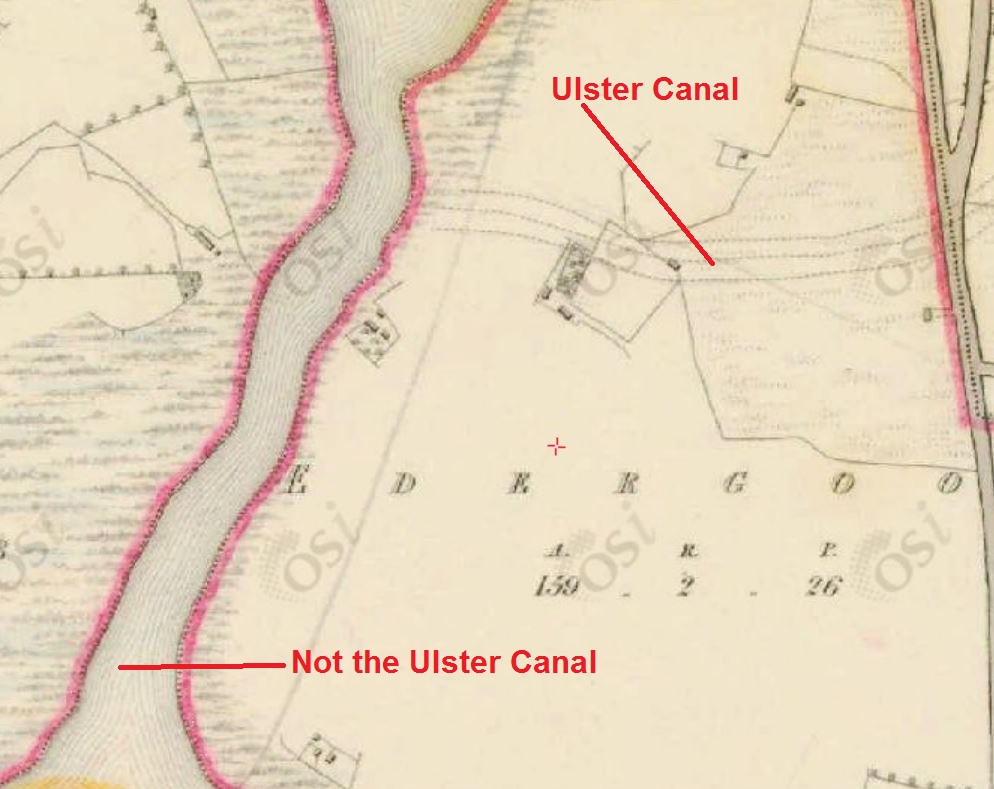
By the way, some folk get confused about the location of the Ulster Canal; this map may help:

Saunderson's Sheugh -v- the Ulster Canal (OSI ~1840)

Saunderson’s Sheugh -v- the Ulster Canal (OSI ~1840)

Anyway, for folk who are interested in weightier matters than ministers talking through portions of their anatomies that they can’t distinguish from their elbows, here is some speculation about opening bridges on the Ulster Canal.

That’s the Ulster Canal Ulster Canal, not the Saunderson’s Sheugh “Ulster Canal”, by the way.

My OSI logo and permit number for website


For railway enthusiasts

The economics of the current Irish railway system have received insufficient attention. If they had, the entire system (with the possible exception of some commuter lines) would have been closed down years ago and we wouldn’t have the current mad proposal to reopen the railway line to Foynes [h/t COM] at the same time as a road improvement scheme is being studied.

Happily, however, the railways of the neighbouring island have recently been the subject of considerable attention. Duncan Weldon considers here the “economic, financial and business questions raised” by the railway systems of the island of Sodor, concluding:

Economists do not fully understand the long term drivers of productivity growth. But the lesson of Sodor is this: over investing in a technologically backward, sheltered and protected from competition railway is not the road to prosperity.

And yet despite stagnant living standards the people/engines of Sodor appear content. Indeed it is unclear if they get paid at all — instead they seek meaning and joy in a Stakhanovite desire to be “really useful engines”. The great trick of Sir Toppham is employ engines who essentially evoke the image of the New Soviet man in the service of a proto-capitalist, semi-feudal enterprise.

Responding, James Kwak said:

Sodor Railways seems to be the epitome of a fat, dumb, and happy company. Labor is incompetent, yet management does nothing about it, and in return labor is eternally loyal to management. Who loses? Customers and shareholders.

However, Dan Davies offers a different perspective here. But Tracy Van Slyke has spotted other issues. I wonder whether any university offers courses in TtTE Studies.

But back to Foynes. I see that Councillor Emmett O’Brien believes that

[…] the tourism potential of this line could be explored with the possibility of steam train tourism linking Adare to Askeaton and Foynes.

The appropriate information is here.

The importance of Saunderson’s Sheugh

Back in the days when nitwitted Irish governments believed the state had found the secret to permanent wealth, Sinn Féin was promised the Clones Sheugh, a rebuilding of part of the line of the Ulster Canal. For reasons that are not clear to me, the reason for the project was concealed by a lot of nonsense about economic regeneration.

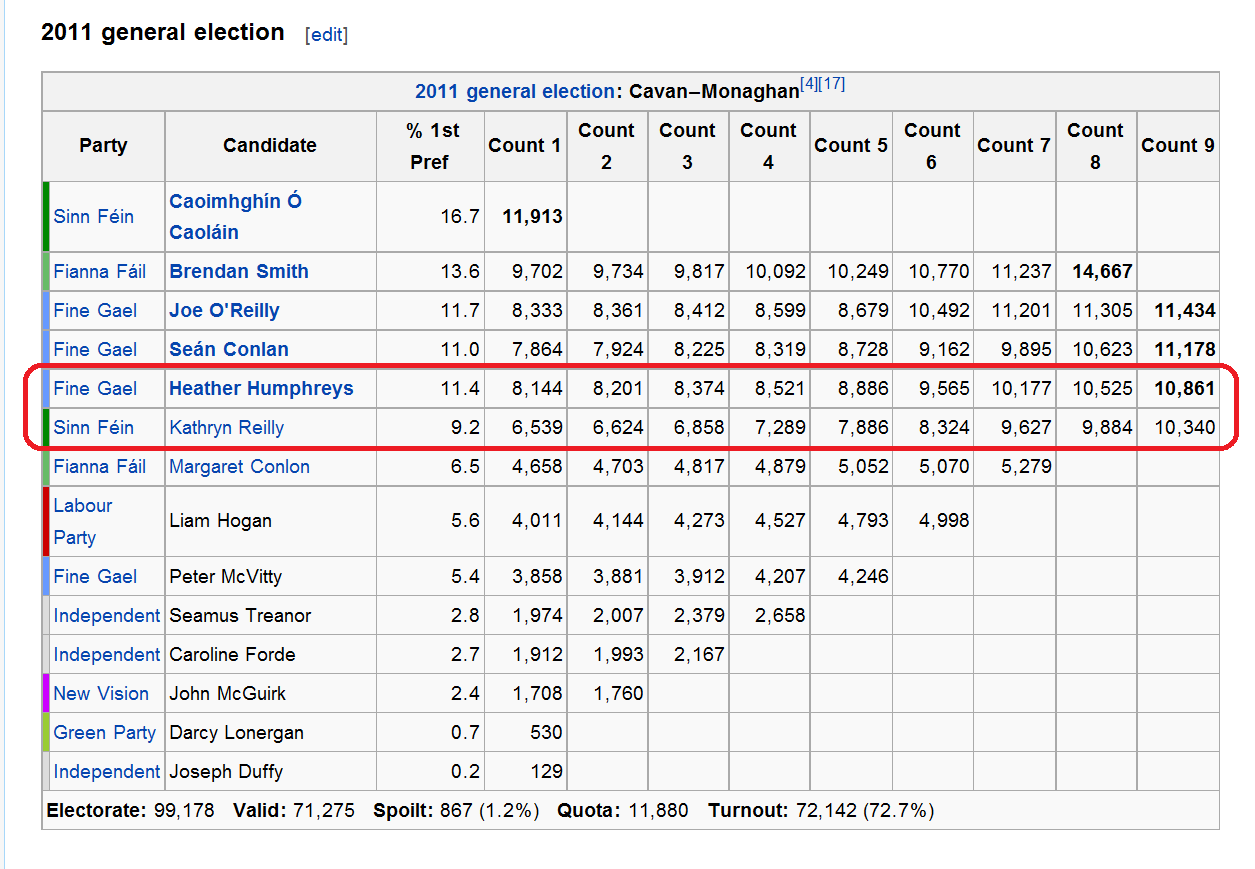
Sinn Féin still want their sheugh, and have continually asked questions about it. They own the Northern Ireland department currently responsible for waterways. And they have, I believe, forced its southern counterpart to pretend it will deliver the sheugh. Admittedly it’s really just going to dredge the River Finn — Saunderson’s Sheugh — and call it the Ulster Canal, which is better and cheaper than doing anything about the real Ulster Canal, but we might wonder why the current southern minister, Heather Humphreys, a TD for the Cavan-Monaghan constituency wherein Clones lies, is quite so keen on sheughery.

Perhaps Wikipedia can help.

Cavan-Monaghan constituency, general election 2011

Cavan-Monaghan constituency, general election 2011

Unmodified text released under the Creative Commons Attribution-ShareAlike 3.0 Unported License (CC BY-SA); no endorsement by the licensor is expressed or implied.

Where is it?

A correspondent is anxious to identify the location shown in a painting of a bridge over a canal.

It is most likely that the scene is somewhere on the wider waterways of northern England. It is just conceivable that it might be in Ireland, though, so I said I’d put a copy up here and see if anyone can identify it. If you can, please leave a Comment below.

Unidentified canal bridge

Unidentified canal bridge. Click to enlarge

Fair faa ye

The March 2015 edition of The Ulster Scot [PDF] is now available for downloading from the Ulster Scots Agency website (or wabsteid, as they say in Scots Scots).

I do miss the old days, when the Chief Executive of Waterways Ireland was known in Ulster Scots as the Heid Fector. Parity of esteem for the hamely tongue, that’s what I say.

I think my favourite word is bumfly.