Category Archives: Industrial heritage

Selling the Shannon

We have purchased the steamer Ballymurtagh on favourable terms, and have placed her on the river Shannon, for the purpose of facilitating your trade in that district. This steamer carries its own cargo, and can be worked with economy in conjunction with your steamers already plying on the Shannon. The arrangement so made places at your disposal the steamer Shannon, which has been employed heretofore in towing boats between Carrick-on-Shannon and Killaloe. We purpose selling the steamer Shannon, when a suitable price can be obtained.

From the report of the directors of the Grand Canal Company, to be presented at its half-yearly meeting on Monday 24 August 1868, reported in the Galway Vindicator, and Connaught Advertiser
22 August 1868

SCREW STEAMER FOR SALE BY AUCTION

FOR SALE BY AUCTION, on Tuesday, the 21st July 1868, at Ringsend Docks, Dublin, at One o’Clock, By order of the Directors of the Grand Canal Company,

Their powerful and strong-built Towing Steamer

SHANNON

She is 71 feet long, 15 feet 6 inches beam, iron-built, and fitted with Marine condensing engines, 45 horse power. Her machinery is in excellent repair, and a large sum of money has been recently laid out on her boiler.

She can be seen at Ringsend Dock, Dublin, and further particulars may be had from Mr Samuel Healy, Grand Canal Harbour, James’s-street, Dublin; William Digby Cooke, Esq, Secretary, or JAMES FOXALL, Broker.

Freeman’s Journal 18 July 1868

Before the Guinness Liffey barges

During the past half-year also — within the last two months — Messrs Guinness and Co have finished the very extensive stores both here [at Grand Canal Harbour] and at our docks [Grand Canal Docks, Ringsend], and have commenced to carry their whole import and export trade upon our canal between these points. They have purchased boats, and are carrying on the trade with great zeal and efficiency, and we expect it will form a very considerable addition to your revenue from the tolls.

From the address of the Chairman, William Digges La Touche Esq, to the half-yearly meeting of the Grand Canal Company on 31 August 1867, reported in the Dublin Evening Post 4 September 1867


Tarmonbarry 1851

To the Editor of the [Dublin] Evening Mail

Sir

In your impression of the 3d instant, under the head of “The Famine Advances and the English Press”, I find a reference to the (so called) improvement of the Shannon; that of the sum of £313009 advanced by government, £230325 has been repaid. In this case you say (and most truly say) “the jobbing was most flagrant, and the reckless waste of the public money unparalleled”.

So far you are correct, but you are, no doubt, labouring under a very common mistake when you say the works have very recently been completed, such not being the case. Some handsome bridges, with swivel arches, and spacious locks — one in this neighbourhood too small to admit an ordinary river steamer. Nor was the level properly taken, there not being sufficient water to carry tonnage drawing more than 5 feet 6 inches, during the greater part of the summer.

Now, I should wish to know, through your well informed medium, to what cause is to be attributed the present state of the weir, or lock dam, adjoining Tarmonbarry, a span of nearly 500 feet. Owing to the improper manner in which the same has been executed, upwards of 60 feet have given way, and when examined by the engineer of the board, the entire is found in such a state as will involve the rebuilding.

In justice to this gentlemen, I am bound to say he was not the engineer under whom it was constructed, nor do I think, until very lately, he had anything to do with the Shannon Commission, every work in which he has been engaged, being acknowledged to be well executed.

I am not aware whether you are in possession of this fact, that in order to make the Shannon improvements available or remunerative, it has been considered necessary to construct a canal to “Lough Erne”, adjoining Belturbet, and thence to communicate with Belfast, by “the Ulster canal”. You will, I am sure, agree with me in the old adage, that “this would be going round the world to look for a short cut”; but the cut I allude to is not so short, as it involves, I am informed, thirty miles of new canal, and several large and expensive locks.

But, Sir, I must inform you, that the tolls of the river Shannon, from Carrick-on-Shannon to Limerick city, are barely sufficient to pay the lock-keepers’ salaries. The Shannon Commission I would henceforth style “the Shannon job”.

I remain, Sir, though a bad dancer, one who must

Pay the Piper

[Dublin] Evening Mail 17 November 1851

From the British Newspaper Archive

Railway horse power

From the result of inquiries, which the Directors have caused to be made, into the system of Scotch railways, it is the intention of the Board to use animal power exclusively until the line is finished half way to Drogheda; and even when finished to Drogheda, it is intended that all the goods will be carried by horse power, and in the intermediate hours, when no steam train shall start for Drogheda; that a horse train shall run from Dublin to Malahide, and another from Malahide to Dublin, as this division of the line must be supplied with extra means for its own peculiar traffic, which will not be required on the rest of the line.

Report to the Proprietors of the Dublin and Drogheda Railway in The Railway Magazine; and Annals of Science No XXVI April 1838

Costs on the Royal and the Grand 1843 and 1844

The second half-yearly meeting of the Grand Canal Company in 1844 seems to have been an extended affair. It was adjourned to allow the directors to amend their report on “the state of the company’s works” and, when it reassembled on Saturday 23 November, there was an unusually large attendance and a fractious debate, with several criticisms of the accounts and their “ambiguity and unintelligible nature”. The inconclusive meeting was eventually adjourned until 14 December, to allow proprietors [shareholders] to examine the accounts.

Amongst the critics of the directors was Mr H Bruce, who was unhappy with several aspects of the management of the company, one of them the extravagance of the directors. He said

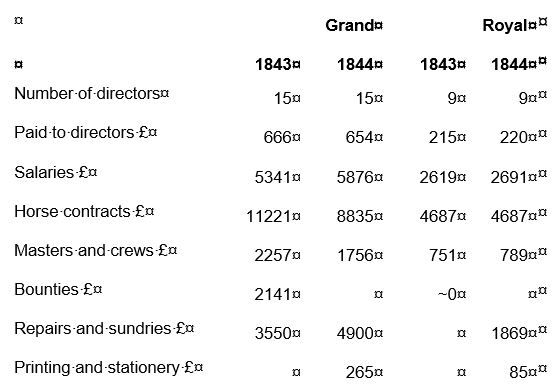
He had taken the trouble of comparing the Grand Canal with the Royal Canal Company for two consecutive years, and he would give the meeting the result of that comparison.

Here are the elements of that comparison in tabular format.

Those with a keen interest in the Royal Canal Company will no doubt have been surprised to find its management being complimented for anything, but the comparison is interesting even if, as Sir John Kingston James pointed out, the Royal Canal Company had fewer [passenger-carrying] boats “and consequently they had to pay less for horse power”: it would have been fairer to compare the costs per mile.

On repairs, Mr Bruce said that

Every one knew that the Royal Canal was a much more perishable canal than the Grand Canal, for instead of being excavated, a great part of it was built. No canal was more liable to the danger of an outbreak on the country, and of being bored through, than the Royal Canal, consequently it required more money to keep it in repair than the Grand Canal […]. Yet, what was the amount charged for repairing the Royal Canal in 1844, though in that year a serious breach took place in it? — why, only £1869.

Note that salaries cost considerably more than did the boat crews and that horse contracts, for hauling the boats, were about four times the cost of masters and crew on the Grand and aboout six times that cost on the Royal.

Dublin Evening Post 26 November 1844

Spencer Harbour

Excellent article about the Lough Allen Clay Company on the Dromahair Heritage website, though the schoolboy speculation on the naming of the harbour is not, I think, to be relied upon: the fifth Earl Spencer, twice Lord Lieutenant of Ireland, is I think the source of the name.

h/t COM for the link

Jamestown and the Longford

Jamestown [Co Leitrim] Heritage Festival starts on Friday 25 May and runs until Sunday 3 June 2018. The programme is here.

Apart from the presence of numerous barges and other vessels, the festival will feature these events of historical interest:

  • Saturday 26 May: talk by Alf Monaghan on Doon to Diesel, a review of the importance of Drumsna and Jamestown in Transport History
  • Sunday 27 May: talk on the sinking of the Royal Canal passage-boat Longford [in which fifteen people died] in 1845
  • Monday 28 May: bus trip to Arigna Mining Experience
  • Tuesday 29 May: talk by Alf Monaghan on Monastic Ireland — a gift from the Nile and display by Carrick-on-Shannon Historical Society
  • Wednesday 30 May: walking tour of Jamestown led by historian Mary Butler
  • Saturday 2 June: talk by Donal Boland on The Shannon’s hidden locations and gems and, in the afternoon, “traditional method demonstrations”.


Railway archaeology

Ewan Duffy’s chapter “Royal Canal bridges in Dublin”, in The Royal under the Railway: Ireland’s Royal Canal 1830–1899 [Railway & Canal Historical Society, Derby 2014], drew attention to the hitherto neglected effects of the Midland Great Western Railway’s ownership on the physical structures along the Royal Canal in Dublin.

Ewan’s latest venture is a Railway Archaeology of Ireland, which he is publishing online, at the rate of one chapter per week. The introduction and Chapter 1 are now available. The focus is on “railway-related architectural and engineering structures”, not on trains or rolling stock.

It is possible to sign up to an RSS feed and thus get notified automatically when new chapters appear.


Peril at Parker’s Point

Great storm on Lough Derg

40 tons of porter lost

All over the course of the Shannon the snowstorm was of the utmost severity. The Grand Canal Company had practically to suspend traffic, and steamers arriving at Portumna from Killaloe and Limerick report the roughest weather yet experienced on Lough Derg.

The steamer Dublin, bound from Shannon Harbour to Limerick with three barges in tow, loaded with 40 tons each of porter for Messrs A Guinness and Co’s stores, Limerick, was almost wrecked on Wednesday, but for the promptitude and presence of mind of the steamer’s crew.

She was nearing Parker’s Point, on the Clare [sic] side of the lake, when the storm was raging fiercest, and this being one of the most unsheltered spots in the course of the Shannon, heavy waves came rolling over the tug and barges and tossed them about. The strain broke the ropes which kept them in tow, and two boats with their crews broke away and went adrift, and were at the mercy of the waves.

The captain of the steamer Dublin (Patrick Moran), seeing the perilous position of the boats and crews, steered with the one boat which he had then in tow to the Tipperary side, and anchored her there in shelter, and again set out to the rescue of the two drifting barges, and after a severe struggle succeeded in getting to their rescue just as they were drifting on to the rocks at the point mentioned.

There were twenty tons each of porter stowed on the decks, and this was promptly secured by covers and lashed by ropes to rings, but notwithstanding this the barrels of porter, from the tossing about of the boats, broke through the covers and lash lines, and were lost on Lough Derg. The steamer’s master again got the barges in tow, and succeeded in bringing them on to Killaloe.


The Irish Times 31 December 1906

The Limerick steam ferry

Wanton outrage

The steam ferry barge, the property of Messrs J R Russell and Sons, which plies across the Shannon from Russell’s-quay to Lansdowne spinning mills, and which was got up for the convenience and conveyance of the factory operatives in the employ of the firm, was boarded during last night (Sunday) as she lay at the north side of the river, by some person or persons unknown, and maliciously injured to a considerable extent. She was not only scuttled, but the machinery was broken and some of the gear removed and taken away, so that the barge has become temporarily disabled. Portions of the machinery are said to have been found in the river, where they were thrown by the miscreants. This is the second attempt that has been made to damage this ferry since she was put on the river.

Cork Examiner 27 April 1869