Category Archives: Non-waterway

Waterways restoration? No thanks

An article in the Irish Times about railway restoration has prompted me to set out my views on waterways restoration. Essentially, I don’t believe public funds should be spent on projects that won’t provide a decent return, but I do favour small-scale conservation, opening up walking and cycling routes along waterways and marketing them to industrial heritage enthusiasts (and others).


No news is good news … perhaps

Extracts from the Joint Communiqué issued after the 11th Plenary Meeting of the North South Ministerial Council on 21 January 2011:

3. Ministers discussed a range of common challenges and shared views on the economy, the banks and NAMA. They recognised the constraints on budgets in both jurisdictions and the ongoing discussions between the two Finance Ministers to identify potential cost savings through co-operation and sharing were welcomed. There was a desire to maximise access to EU funding and
resources.

6. Ministers noted the Progress Report on the ten NSMC meetings which have been held since the last Plenary meeting in July 2010 and welcomed the mutually beneficial co-operation taken forward including that:

[…] The restoration of the Royal Canal to reconnect it to the Shannon has  been completed and a preferred route for the Clones to Upper Lough Erne section of the Ulster Canal has been identified.

No exciting announcement there, so the bulldozers have not yet been set rolling on the Clones Canal. Phew. Maybe we’ve had to choose between the canal to Clones and the road to Londonderry/Derry and the road has won ….

Ephemera 8: Tarbert

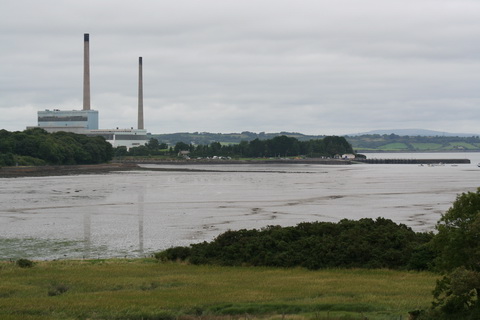
Tarbert Island

The Irish Times reports that:

AN BORD Pleanála has approved the application by Endesa Ireland, part of the Spanish energy company, to build a combined-cycle gas turbine power plant on the former ESB station at Tarbert, Co Kerry.

I presume that, when it says that “A submarine cable is to supply Moneypoint.” it means that a submarine pipe will do so: I imagine that the power station at Moneypoint is more likely to want gas than electricity from its rival across the estuary.

Tarbert is now the southern station for the ferries that cross the Shannon Estuary, but it has had a long history as an estuary port. Even before the first of the piers was built, Tarbert Roads provided a sheltered anchorage, and the estuary steamers adopted ingenious methods to get passengers and cargo from shore to steamer and vice versa.

Tarbert was also an important administrative centre and Tarbert Island (as was), which now houses piers and power station, had a Coast Guard station, a lighthouse, a signal mast and the largest of the six forts that guarded the Shannon Estuary. The ESB power station is built on the Ordnance Ground, right on top of the seven-gun battery, as you can see if you play with the Overlay feature on the Historic 6″ Ordnance Survey map.

Moneypoint had a large quarry; it may have been from there that Charles Wye Williams got the “marble” that he polished in the marble mill at Killaloe.

Saleen Pier at Ballylongford is covered here.

Up the Suir

I don’t know if you remember, but a few months ago we had sunshine, and it was warm outside. Back then, at the end of May in fact, I went on the Industrial Heritage Association of Ireland‘s tour of Carrick-on-Suir, Clonmel and areas in between.

In Carrick, Ralph O’Callaghan showed us some of the sights and addressed the group in the Heritage Centre. Here are some of the things he showed us.
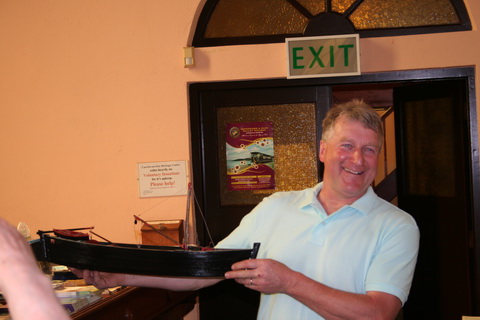
Ralph O'Callaghan shows a model of a yawl (a horse-drawn boat used to carry goods between Carrick and Clonmel)
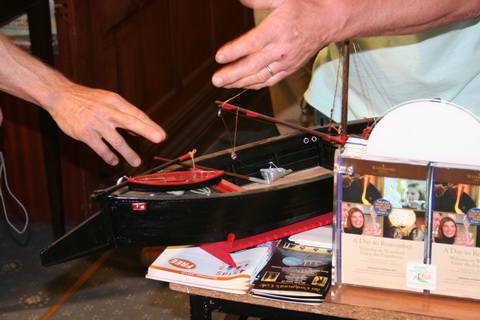
This yawl is equipped for sand-dredging
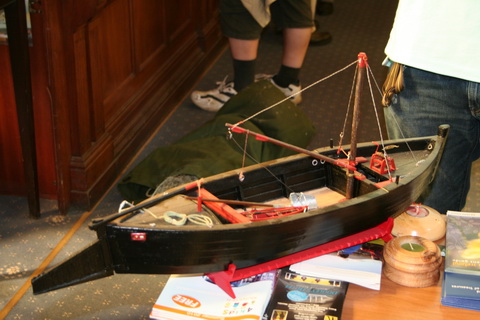
Note the large rudder
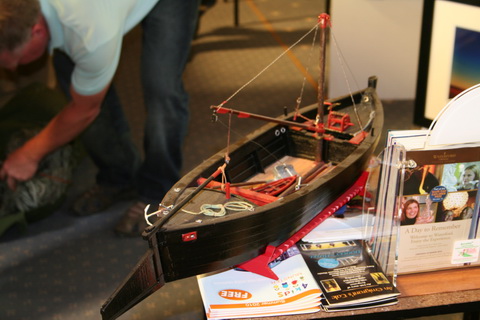
The yawl
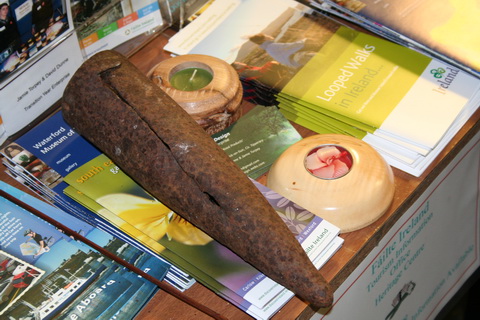
A steel shoe for one of the 30' poles used by Suir and Barrow boatmen
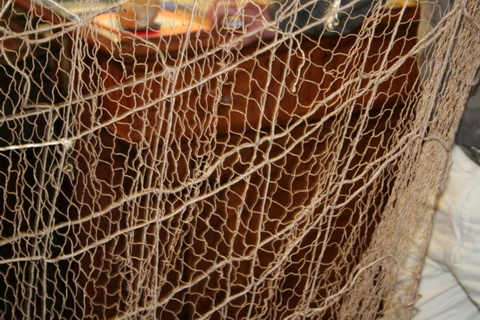
A hand-made net for snap-net fishing

After lunch, I was fortunate to be one of two people who got a trip in Ralph O’Callaghan’s canoe, from Kilsheelan upstream to the Anner bridge just downstream of Sir Thomas’s Bridge, which is itself downstream of Clonmel.

I have set up a small (approx 120-photo) slide show to give an idea of the conditions on the Suir at the time. The water level was low after several dry weeks, but the previous winter’s floods may have left more silt than usual. At any event, a successful passage required Ralph’s skills and his intimate knowledge of the river and its weirs. You can see some of the weirs, and the gorgeous scenery, in the show.

I am very grateful to both Ralph O’Callaghan and Fred Hamond for facilitating the boat trip and for sharing their immense knowledge of the Suir.

If you like interesting boats, you’ll like Ralph’s canoe.

Ephemera 4: John Martin’s bonus

John Martin, Chief Executive of Waterways Ireland, received a bonus of £8500 (€9628) in February 2010, as a reward for his performance in 2007.

Ephemera 3: heritage and the budget

Just in from the Heritage Council:

Ireland’s Heritage Sector Decimated by Punitive Cuts

Heritage Council warns of job losses and tourism setback

Punitive cuts, announced in last Tuesday’s Budget, will decimate the heritage sector and close many small enterprises that are dependent on it. This will have detrimental effects on both our national heritage and the quality of our tourism offering, according to the Heritage Council.

The Department of Environment, Heritage and Local Government’s Heritage Unit, which has responsibility for protected structures, including world heritage sites, suffered a 77% budget cut. National Parks and Wildlife, whose remit includes the protection of our natural heritage and running all our national parks, suffered a 56% cut. The Heritage Council, whose role is to protect, preserve and enhance Ireland’s national heritage, suffered a 47% cut. This is on top of a 30% cut in 2010.
Speaking about the situation, Chief Executive of the Heritage Council, Michael Starrett commented, “We are extremely concerned about the disproportionate nature of the cuts to the Heritage sector. While the heritage sector recognises that it must share the burden of the cuts required to tackle the country’s economic crisis, the cuts announced last Tuesday are completely disproportionate in comparison to other Departmental cuts. As a result, the future of heritage initiatives nationwide which have created hundreds of jobs, empowered local communities and enhanced the value of heritage as a tourism resource, are severely threatened”.

Declaration of interest: I have occasionally done work for the Heritage Council or for other bodies that received Council funding.

The interesting thing about this is that the budget for the Department of Environment, Heritage and Local Government as a whole is down 23.0%: 30.1% on capital and 7.3% on current. Staff numbers are down 4.6% and those in local authorities down 4.7%.

Within the department, housing is down 31%, water services down 10%, environment down 66%, waste management down 75%, local government down 31%, heritage overall down 60%, planning down 14% and other services down 22%. However, administration is up 2%.

The Ulster Canal and WI assets

I’ve received a partial response (described as a full release, but actually ignoring several of my questions) from Waterways Ireland to some questions about the Ulster Canal. You can read about it here; it includes interesting information about the current valuation of sites in Dublin that might have raised money for the construction of the canal to Clones.

I’m writing this in advance of the Irish budget, due on 7 December 2010; it will be interesting to see whether Ajai Chopra gives the Department of Community, Equality and Gaeltacht Affairs enough capital to pay for the first year’s proposed work on the canal.

Lough Tap railway bridge

This site has some great photos of the replacement of the railway bridge over the Shannon Navigation at Lough Tap, near Drumsna, on 31 October 2009.

Arthur’s Day

I spent today helping the skipper of a barge to carry a cargo of Guinness by water to Limerick, fifty years after the last Grand Canal Company commercial cargo, which was of Guinness to Limerick. (Actually, my help was minimal, confined mostly to acting as ballast, a role I fill very well, and taking 1,439 photographs.) There will be a ceremony at Dolan’s in Limerick tomorrow at the appropriate time.

Folk in other parts of the country may find it easier to undertake a pilgrimage to Uncle Arthur’s final resting place.  Here are links to some maps:

in relation to the Grand Canal. Towards the top right of the page, you can see a little castle symbol, which is roughly where the graveyard is. Notice that the road to the right of the symbol has a sharp bend; the entrance to the graveyard is just north of that bend. It’s a narrow country road, so be careful
– in relation to the N7. The orientation is slightly different on the Google map but you’ll recognise the shape of the area enclosed by the roads
– with the path into the graveyard on the OSI map.

The Ulster Canal: the supposed benefits

Here is the latest (and almost the last) in this series of posts: an examination of the expected benefits of the canal to Clones. My conclusion is that the benefits cited are higher than those likely to arise in current conditions.