
Category Archives: People

For the record

The Limerick Leader article about a proposed Limerick river bus has some statements that do not accord with my understanding.

The venture will see the river bus depart Guinness Pier – across from Athlunkard Boat Club at O’Dwyer Bridge – every two hours, bound for the power station […].

As far as I know, the pier in question was the Ranks jetty and was not used by Messrs Guinness. The Eclipse Flower, and other vessels owned by Ranks and their predecessors, sailed up the Shannon from there rather than attempt the stretch from Baal’s Bridge to Custom House Quay.

The boat will follow the route taken by barges of old – both passenger and commercial – some of which historically transported Guinness to the city up until the mid-1960s.

“It is a tried and tested route,” said Mr Flynn, stressing the viability and safety of the route, which passes Long Pavement – the edges of which have been repaired and grassed over – and finishes at the hydro-electric plant.

“Every passenger and commercial barge that came to Limerick for 50 years used that stretch of water. It is very safe. It was navigated by all the barges,” he said.

The route to Limerick through Ardnacrusha came into use only after the construction of the power station in the 1920s and was used for a little over thirty years. To the best of my knowledge, there were no passenger services in those years: passenger carrying stopped in the first half of the nineteenth century, when traffic was still using the old Limerick Navigation. There have been some trip-boats in recent years, but they did not (and do not) use “barges of old”. Some old barges, now converted and with more powerful engines, have safely navigated that stretch, but they do it when conditions are right.

During the final phases of Ardnacrusha’s construction, both old and new navigations were closed; the Grand Canal Company (GCC), the main commercial carrying company, ran to Killaloe and had its cargoes carried onward by rail to Limerick. When the new route through Ardnacrusha was opened, the GCC thought it was so dangerous that it refused to use it for about a year. It resumed operations only when a boom was put across the river above Baal’s Bridge and posts were provided upstream of O’Dwyer Bridge to which barges could tie while waiting for suitable states of the tide.

I accept that the proposed river bus will not be going downstream as far as Baal’s Bridge, but it will still be navigating on a stretch of water where Waterways Ireland advises that boats should not navigate when more than one turbine is running at Ardnacrusha. The ESB can run up to four turbines, each of which is said to add a knot to the current, and it can switch them on immediately, with no warning to any boat using the river.

Other pages on this site make it clear that I share the promoters’ enthusiasm for Ardnacrusha and the canal and river thence to Limerick. I do not say that the difficulties of that stretch cannot be overcome, but I do not think that they should be dismissed.
 

That Limerick “river bus” …

… from the (presumably artificially created) photograph in the Limerick Leader seems to be the Cailín Turána, formerly part of the Aran Islands Fast Ferries fleet at Doolin and seen here out of the water at Cork Dockyard in 2004. The vessel has not been on the Dept of Transport’s List of Certified Passenger Ships since 2007 (and may have come off the list before that: I have not kept copies of the lists earlier than 2007). It could of course have been used in Ireland for purposes other than carrying fare-paying passengers, or outside Ireland for any purpose, after 2004.

And it may be that the vessel shown in the photo is not that which is to be used in Limerick.

The end of a ghost

In the UK, the Statute Law Repeals Bill is working its way through the House of Lords. You can download a PDF list of the bills being repealed. In amongst the turnpikes, Indian railways, benevolent institutions and lotteries, we find Part 4: Ireland (Dublin City). Within that, Group 1 sees the repeal of these statutes:

  • 3 & 4 Will.4 c.cxv (1833) (City of Dublin Steam Packet Company Act)
  • 6 & 7 Will.4 c.c (1836) (Dublin Steam Packet Act)
  • City of Dublin Steam Packet Company’s Act 1860 (23 & 24 Vict. c.xcviii)
  • City of Dublin Steam Packet Company’s (Consolidation of Shares) Act 1861 (24 & 25 Vict. c.iii)
  • City of Dublin Steam Packet Company’s Act 1868 (31 & 32 Vict. c.xxx)
  • City of Dublin Steam Packet Company’s Act 1876 (39 & 40 Vict. c.xi)
  • City of Dublin Steam Packet Company’s Act 1884 (47 & 48 Vict. c.cxxx)
  • City of Dublin Steam Packet Company’s Act 1895 (58 & 59 Vict. c.cxxiii)
  • City of Dublin Steam Packet Company’s Act 1910 (10 Edw.7 & 1 Geo.5 c.vii)
  • City of Dublin Steam Packet Company’s Act 1916 (6 & 7 Geo.5 c.viii)
  • City of Dublin Steam Packet Company’s Act 1920 (10 & 11 Geo.5 c.i).

In a Consultation Paper published in 2008, the Law Commission explained:

The City of Dublin Steam Packet Company was founded by Charles Wye Williams in 1822. From 24 January 1839, the Post Office contracted the company to run the mail service from Dublin to Holyhead. This service was later extended such that the company ran both the day and night service.

During the First World War the company suffered heavy losses, including the sinking of its ship the R.M.S. Leinster by a German submarine on 10 October 1918, resulting in a loss of over 500 lives. A further two ships were sunk during this period. The company never fully recovered from its wartime losses and, in 1924, an order for the winding-up of the City of Dublin Steam Packet Company
was petitioned for and granted by the High Court at Dublin Castle.

In Ireland, the Statute Law Revision Act 2009 repealed the 1833 and 1836 Acts and the Statute Law Revision Act 2012 repealed all the rest — except the 1895 Act. I don’t know where to get a copy of that Act, so I don’t know why it was specifically retained. But, with that exception, it seems that the ghost of the CoDSPCo has been laid to rest.


The Munster Blackwater …

… from water level: an account of a swim down the river.

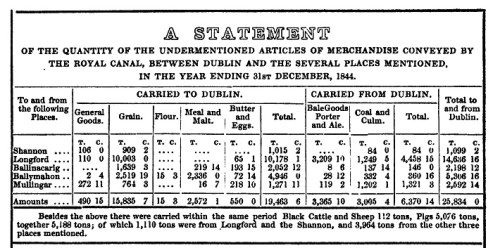
Royal Canal traffic in 1844

Royal Canal traffic in 1844 (Salt)

That table is extracted from Samuel Salt’s Statistics and Calculations essentially necessary to persons connected with railways or canals; containing a variety of information not to be found elsewhere 2nd ed Effingham Wilson and Bradshaw & Blacklock, London 1846, available from Messrs Google here.

The interesting point is how little of the Royal’s traffic travelled the whole way from the Shannon to Dublin or vice versa: only about 5% of the Dublin-bound traffic and less than 3% of the traffic westward.

Another point of interest is that traffic to Dublin was three times the traffic from Dublin.

Amongst the livestock, pigs were the dominant animals: they lost too much condition if they were walked long distances, which was the only alternative to canal transport before the railways came. Even there, I suspect that much of the tonnage described as “from Longford and the Shannon” was actually from west of the river, in Counties Mayo and Roscommon.

Portadown Foundry Ltd

I am grateful for a copy of Portadown Foundry Ltd: a history of the foundry 1844–1983, by Cardwell McClure and Wilson Steen, published by the authors in October 2012. It is available from five shops in the Edenderry (Portadown) area; the Edenderry Cultural and Historical Society may be able to assist.

The book’s breadth of coverage is very impressive. It may be thought of as having three main sections. The first provides five chapters covering the five main eras of control of the foundry. The second has four chapters covering employees, surviving artefacts, sporting history and Foundry Street, where many employees lived. The final section has six chapters providing the essential contest that is often omitted in local history books. These six chapters cover:

  • Portadown and the economy of Ulster
  • Foundry-built barges and lighters (of particular interest on this site)
  • The evolution of flax and linen processing in Ulster
  • The evolution of engineering in Ulster
  • The evolution of power plant in Ulster
  • The evolution of transport in Ulster.

It is richly illustrated throughout and is well worth a fiver (sterling) of anyone’s money.


All sheugh up

Thinking about the exciting news from the North South Ministerial Council plenary session about the Clones Sheugh, I was reminded of the even more exciting news of the first meeting of the North/South Inter-parliamentary Association.

Strangely, its meeting received little publicity in the great world. I asked Messrs Google to search for it but to omit links from the Oireachtas and the Northern Ireland Assembly, as well as those from politicus.org and flickr.com. It found only 42 hits, of which the first seven were links to the site of a Labour senator called Mary Moran. (I won’t provide a link to her site as she’s obviously perfectly capable of generating all the links she wants.)

Anyway, the first meeting of the North/South Inter-parliamentary Association seems to have passed almost unnoticed. You can read about it on InsideIreland.ie, which seems to be a news site run by an advertising agency.

From Ciarán Hanna’s account, I deduce that the North/South Inter-parliamentary Association is an entirely pointless body. I note that it won’t meet again until April 2013. And perhaps the Irish government’s support for the Clones Sheugh is because it gives this pointless body something to discuss, thus keeping it from commenting on anything important.

Grand trumps Royal

A victory today for St James’s Hospital, close to the former harbour of the Grand Canal, over the Mater Hospital, close to the former harbour of the Royal Canal at the Broadstone.

Perhaps, if St James’s needs space to expand, it could take over the former canal harbour; work on its latest development seems to have ceased.

Boating off piste

Coast Guard rescue between O’Briensbridge and Clonlara.

Divided by oceans, linked by a canal

Last Monday the erudite and sapient Póló wrote about a photo he took in Armagh on a school trip in the 1950s. He put a copy of the photo on a web page in 2004 and, eight years later, he got an email from the person who now lives in a house that was shown in the photo. Póló was able to supply a better copy, pleasing his correspondent, and (as Póló said)

[…] he learned something new and I got a better dating on my trip and photos.

But it was his next paragraph that rang a bell with me:

I am always telling people, particularly those who are following up their family history, that they should have a presence, however minimal, on the web. That way people can find you and you never know what they might be bringing to the table.

Just before reading that, I’d had a message from a correspondent in Australia. He had seen my page about the old Athlone canal and reckoned that he was probably related to a previous, British, visitor to the page; I put them in touch and it seems that they are cousins. You can read the correspondence on my Athlone canal page. So a reference to an abandoned canal on an obscure Irish website has helped two folk to get in touch — and I, and other visitors to the site, have learned a bit more about the canal.

But there is more to learn. Does anyone know anything about Canal Lodge? The AthloneLive forum has disappeared, so I can’t ask there, and I have no other information to hand. I am making enquiries, but if anyone has any information about the building I would be glad to receive it and I’ll make sure it’s passed on.