
Well, canoes, but better than nothing.
PS for “upstream” read “downstream”, as far as I can see.
The Royal Canal water supply applications have been approved by An Bord Pleanala. There were two separate applications [see here and here] but they were in effect treated as one. There are five PDFs available on each page and I haven’t read all of them yet. However, on a first glance, I note that:
2. The proposed development shall be operated as follows:
(a) Rates of abstraction from Lough Ennell to the Royal Canal shall be as specified in the public notices and, in particular, shall not exceed 43,636 cubic metres of water in any 24 hour continuous period and subject to a total maximum abstraction of 6,586,363 cubic metres per annum.
(b) Abstraction from Lough Ennell to supply the Royal Canal shall cease when the lake level reaches 79.325 mOD Malin Datum, being the crest level of Clonsingle weir, measured at Clonsingle weir by continuous monitoring.
(c) The fish pass at Clonsingle weir shall incorporate a minimum flow of 0.29m3/second.
(d) A minimum flow of 682 m3/day (0.5MGD), taken directly from Lough Owel, and excluding water from the fish farm, shall be retained in the original canal feeder.
Reason: In the interest of protecting the integrity of the Lough Ennell Special Area of Conservation and the ecological interest of the River Brosna and the canal feeder, and in the interest of protecting material assets at Lough Ennell and the River Brosna.
If I remember correctly, the amount of water available from Lough Ennell will not always provide enough (eg in a dry season) to keep the canal full. Still, this is a significant advance for Waterways Ireland and for Royal Canal enthusiasts.
Posted in Built heritage, Charles Wye Williams, Economic activities, Engineering and construction, Extant waterways, Industrial heritage, Ireland, Natural heritage, Operations, Restoration and rebuilding, Scenery, Sources, Water sports activities, waterways, Waterways management
Tagged boats, canal, floods, flow, Ireland, Lough Ennell, Lough Owel, Operations, Royal Canal, water level, waterways, Waterways Ireland
I wrote here about the Park Canal and why it should not be restored. I did not include, because I had not then seen it, a link to this report in the Limerick Post. It shows why the gates on the second lock were not replaced. The core problem is that the banks in the upper section of the canal slope too steeply to be stable.
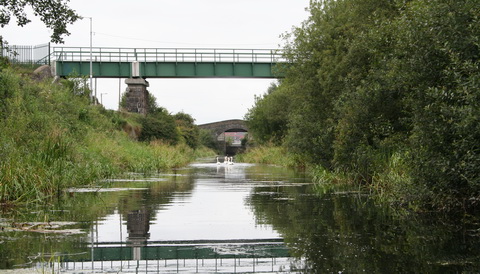
The slope of the banks above the railway bridge (from a boat)
Happily, this deficiency in the original construction has saved us from another foolish restoration.
Posted in Ashore, Built heritage, Charles Wye Williams, Drainage, Economic activities, Engineering and construction, Extant waterways, Forgotten navigations, Industrial heritage, Ireland, Operations, People, Politics, Rail, Restoration and rebuilding, Scenery, Shannon, Sources, The cattle trade, waterways, Waterways management
Tagged boats, bridge, canal, Clare, Guinness, Ireland, Limerick, Limerick City Council, lock, Operations, Park Canal, Shannon, slope, turf, vessels, water level, waterways, Waterways Ireland
An example I hadn’t come across before.
Posted in Economic activities, Extant waterways, Ireland, Irish inland waterways vessels, Operations, Scenery, Sources, Tourism, Water sports activities, waterways
Tagged Azul, boats, charter, Clare, Dromineer, Ireland, Killaloe, Limerick, Lough Derg, Mountshannon, Operations, Shannon, skippered, Tipperary, waterways
IndustrialHeritageIreland has found a local newspaper that thinks that river buses on the Grand Canal could provide commuters from west Dublin with fast transport to Google HQ at Grand Canal docks. IHI points out that the journey from Hazelhatch can take eight hours; even Dublin traffic moves faster than that.
Posted in Built heritage, Economic activities, Engineering and construction, Extant waterways, Industrial heritage, Ireland, Irish inland waterways vessels, Operations, Restoration and rebuilding, Sources, waterways, Waterways management
Tagged boats, bridge, canal, commuting, Dublin, google, Grand Canal, Ireland, vessels, water bus, waterways, Waterways Ireland, workboat
In April 2012 I wrote about the proposed supply of water from Lough Ennell to the Royal Canal. I said that
[…] the Lough Ennell proposal had to go to An Bord Pleanála. At any rate, two applications had to be made, one for the water abstraction and the other for the physical works. In practice, the two are being handled as one.
An Bord Pleanála asked Westmeath County Council for some more information; that has now been supplied and a decision is expected by 11 June 2012.
I have just checked An Bord Pleanála’s website for the two applications PW3005 (lodged 9 December 2011) and JA0030 (lodged 7 October 2011); both say:
Proposed decision date not available at this time.
I do not know why decisions are taking so long.
Posted in Drainage, Economic activities, Engineering and construction, Extant waterways, Ireland, Irish waterways general, Natural heritage, Non-waterway, Operations, Politics, Restoration and rebuilding, Sources, Tourism, waterways, Waterways management, Weather
Tagged An Bord Pleanála, boats, bridge, canal, Ireland, Lough Ennell, Lough Owel, Operations, Royal Canal, water level, water supply, waterways, Waterways Ireland, Westmeath County Council

 Irish waterways history