Category Archives: The cattle trade

CWW bridge

Paul Quinn’s photos showed the new Marlborough Street Bridge being constructed across the Liffey. Last Saturday’s Irish Times reported that Dublin City Council would soon be advertising to seek suggestions for naming the bridge; it said that a body called Labour Youth [whose members may be socialists, I fear] wanted it named after one Rosie Hackett, who went on strike  many years ago. It did not report that there is another campaign to have the bridge named after E T S Walton, a physicist.

The north-eastern corner of the bridge features the site of the offices of the City of Dublin Steam Packet Company, whose crest still adorns the walls. I suggest that the bridge be named after the company’s founder, the remarkable Irish entrepreneur Charles Wye Williams: the father of the Shannon, the master of scheduled steam shipping, the founder of the CoDSPCo and a founder director of the Peninsular and Oriental Steam Navigation Company, godparent of the Irish livestock industry, innovator in marine safety, promoter of the turf industry, writer and experimenter on steam technology, tireless campaigner ….

Apart from his company’s crest on Eden Quay, and his name on a bridge he caused to be built in Limerick, there is no monument to this remarkable man. Name the bridge after him and move the plaque to it (and protect it adequately).


The corncrake and the decline of religion

On 13 February 2013 the Irish Times reported that a farmers’ representative had told politicians that

Farmers in the Shannon callows are facing extinction along with the corncrake and wading birds […].

He wanted taxpayers’ money to be spent on stopping the river flooding its flood plain.

Back in the days when people believed in gods, they would have known what a flood meant: it was a message from a deity, telling them to stop whatever they were doing. On the Shannon, either people have stopped believing in gods or they are having some difficulty in interpreting the message, despite its having been delivered over and over again for hundreds of years. If it were interpreted properly, or even if landowners had a modicum of common sense, they would realise that they should either cease trying to earn a living along the banks of a river that floods regularly or adapt their expectations or their activities to take account of the floods (one thinks of rice paddies …).

In the years 2009–2011 net subsidies to agriculture in the Midland region were 114.4% of the operating surplus. For the Border, Midland and Western region as a whole, the figure was 110.4%. In other words, agriculture in those regions is, on balance, a form of outdoor therapy for landowners: it is not an economic activity, and there is no point in taxpayers’ spending any more money on it.


Canal Boat No 279

There is a mystery about Canal Boat No 279, which sank in the entrance to Spencer Dock, on the Royal Canal, in December 1873. Actually, there are several mysteries, and readers’ comments, information and suggestions would be welcome. Read the story here.

Newcomen Bridge again

Last month I wrote about the lock at Newcomen Bridge on the Royal Canal:

Industrial Heritage Ireland has created a page giving the history of the railway crossing at Newcomen Bridge. However, it would be nice to have some documentary evidence about the resiting of the lock — and about the headroom under the bridge before the lock was moved.

Here it is, from the Freeman’s Journal of 12 April 1873, in an article about the new Spencer Docks:

Above the new metal bridge there is a basin for Canal boats, with a quayage of 450 feet at either side and a depth of six feet. In connection with the new works, the lowering of Newcomen-bridge on the Clontarf-road must be alluded to. To effect this the old lock had to be moved higher up, and the old bridge replaced by one suited for the requirements of the tramway traffic. The arch of the bridge crossing the Canal was lowered five feet, and a new girder iron bridge crosses the railway at the same level. The Main Drainage Board wisely took advantage of the opportunity of the Canal being drained to make a main sewer under the canal and the railway above Newcomen-bridge at the low level required.

Happy, Mick?

One for the Phizzers

Quite a few visitors to this site come to read about the Broadstone. Here is a piece about the pontoon bridge used at the Broadstone between (AFAIK) 1847 and 1877. It was designed by Robert Mallet and it is interesting to see how an inventive engineer solved the peculiar problems of the Broadstone site.

The Fergus estuary

I have a page about the Fergus estuary here with links from that page to others about places on the estuary (including Paradise).

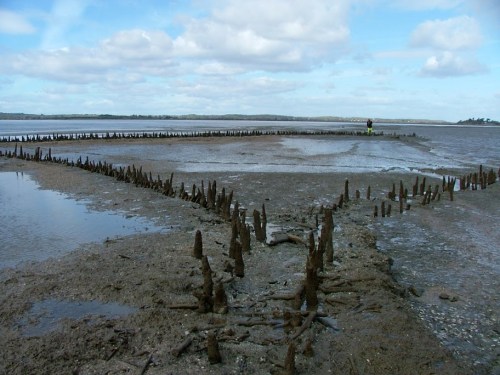
Mediaeval fishweir at the Boarland Rock in the Fergus Estuary © Dr Aidan O’Sullivan, UCD 2008

Mediaeval fishweir at the Boarland Rock in the Fergus Estuary © Dr Aidan O’Sullivan, UCD 2008

The UCD School of Archaeology has, for many years, been investigating the Fergus estuary and has found remarkable evidence of settlement and activities on the estuary stretching back to the Iron Age (about 100 BCE) and the Bronze Age (almost 800 BCE). Read about the project here and see more photos of mediaeval fishweirs and earlier artefacts here.

The photo above is used in accordance with the terms set out here.

Mountshannon

In the Foreword to his latest book, Portraits of Mountshannon (East Clare Heritage, Tuamgraney 2012), Ger Madden writes of the changes to Mountshannon since 1993:

The Aistear, the children’s playground, the pre-school building, the floating jetties at the harbour, additional restaurants and shops have been hugely positive and successful. The same cannot be said for housing. Ten years of reasonable prosperity for some, has resulted in new private holiday homes built on the fringes of the village and others planned. They are not associated with the needs of the community. The majority of the owners have not the slightest interest in the history, culture or welfare of the community they have chosen to display their wealth.

Any such owners wishing to develop an interest in the history of Mountshannon could not do better than to start with Ger’s book. It’s A4 landscape, with an aerial colour photo of Mountshannon on the front and a map on the back. Inside, the foreword gives a brief overview of Mountshannon’s history. Then follow 52 pages, each with a black and white photo and each covering a building, a tree or a place of interest in and around Mountshannon. Their locations are shown on the map on the back cover.

But, although architectural information is provided, the book is not about the buildings per se. Each page is a window into Mountshannon’s history and, together, they provide a rich account of the place and its people over the centuries. Part of the interest is in the fact that buildings you might pass by without noticing turn out to have interesting stories attached to them. Nor are they all about the distant past: I was glad to see that Mountshannon’s more recent claim to fame, as the last telephone exchange in the country to be automated, was recognised here (although I suppose that too may seem like the distant past to younger readers).

I highly recommend the book. If you’re in the area, you’ll probably know better than I where to get copies; if you’re not, you might ask East Clare Heritage.

Ger runs boat trips to Holy Island during the summer.


Melancholy loss of life on the River Shannon

Last Wednesday we were witness to a most melancholy spectacle. We saw three bodies floating on that part of the river Shannon which lies opposite to Castle Lough, in this county. Having rowed in to shore, we gave notice to some persons there, who, without hesitation, prepared themselves, and joined in the sad task of snatching from the watery element the livid bodies of three unfortunate fellow creatures. When we stretched them on the bank they were recognised by one of the Steam Packet Company to be the bodies of Thomas Minshoe, George Halbert, and Robert Williams, three of the unfortunate five that were drowned some few days ago, while on a party of pleasure. The bodies were far advanced in a state of putrefaction and were a revolting spectacle to look on.

A messenger being despatched to Nenagh for the coroner, James Carroll, Esq, that officer, with his usual promptness, reached here in a short time; and having empanelled a jury, “Accidentally drowned during a squall” was the verdict.

It appeared from evidence that the deceased, with others, left Killaloe on Sunday, the 20th ult, for the purpose of having a day’s amusement on the Upper Shannon. They put in at Castle Lough to take refreshment; during the time they were on shore, the wind freshened and blew a gale, upon which they determined to leave the boat at anchor, and proceed home by land, which they accordingly did. On the following morning they returned and found that the ropes, which were for the purpose of lowering the sails, had been stolen. The day being fine and the weather not likely to change, they made light of the inconvenience, and ventured homeward.

After hoisting sails and reaching the centre of the river (which, at this point, is not two miles broad), a squall came on. Having endeavoured in vain to lower sails, which was completely impracticable, on account of the loss of the ropes, the boat suddenly ducked beneath the weight of canvass, and consigned the poor fellows to an early grave. Thomas Minshoe and George Halbert are natives of Liverpool, and Williams from Wales.

No coffins being convenient, three fishermen were appointed to watch the bodies on the shore until the next day. When we saw them coffined, we observed that the ear had been eaten off Williams by, we suppose, a dog, and a part of Minshoe’s left leg. They were interred at Killaloe on the afternoon of Thursday.

1 September 1837

Carrying on the Royal Canal

This is a point I’ve come across in passing. It’s not central to my main concerns so I won’t pursue it further for the moment, but I’m posting it here in case it helps anyone else researching the subject.

It will be recalled that, until the passing of the Canal Carriers Acts 1845 and 1847, most canal companies carried passengers but not freight on their own canals. After the passing of those acts, the Grand Canal Company set out to take over the bulk of the freight business on their own canal (and, in consequence, on the rivers connected thereto). But what of the Royal Canal, which had been taken over by the Midland Great Western Railway in 1845?

Ruth Delany, in Ireland’s Royal Canal 1789–2009 [with Ian Bath; The Lilliput Press, Dublin 2010], says on page 192:

In 1871, despite its failure to show a profit on the Grand Canal lease, the MGWR decided to try acting as carriers on the Royal, which had been permitted by legislation since 1845. Horse-drawn boats were used until 1875 when five steamers were purchased: Rambler, Rattler, Mermaid, Conqueror and Pioneer.

In a note, she says

For this period, 1849–1906, the principal source of information is found in the minutes of evidence to the Shuttleworth Commission, HC 1907 (Cd 3717), XXXIII, Part 1, 9.

Peter Clarke, in his The Royal Canal: the complete story (ELO Publications, Dublin 1992), says:

It is important to recall that at this time, the carriage of goods on the canal was undertaken by a number of boat owners who paid tolls to the railway company. The failure to have these tolls increased was what most probably prompted the railway company to establish themselves as carriers on the canal in 1870. […] Until 1876 an unknown number of railway owned horse drawn barges were used. In that year, the service was expanded when four new screw propelled boats were purchased at a cost of £5000.

His source is the Waterways Commission of 1923, Minutes of Evidence nineteenth day, p13.

Ernie Shepherd in The Midland Great Western Railway of Ireland: an illustrated history (Midland Publishing Ltd, Leicester 1994), says

The MGW decided to operare its own carrying trade in 1871 and this lasted until 1886. Horse drawn boats were used until 1875 when steamers were purchased.

On 15 August 1853 The Freeman’s Journal and Daily Commercial Advertiser of Dublin carried this notice in the Railways column.

Midland Great Western Railway (Ireland) Company — Royal Canal

Haulage of boats

The Directors will receive Proposals for the Haulage of their Trade Boats to and from Dublin and Longford and the River Shannon, from and after the 12th November next. Parties are at liberty to tender for a part or the whole of the work. Security will be required for the fulfilment of the Contract; and further particulars may be had on application at this Office.

Tenders to be sent in on or before 10th September next.

By order, Henry Beausire, Secretary.
Dublin Terminus, 10th August, 1853

This suggests that, in 1853, the MGWR had its own trade boats (lumber boats, freight-carrying barges) at work on the Royal Canal. It would be nice to know more. I have said before that we do not know anything like the full history of the Royal Canal.

Where is this?

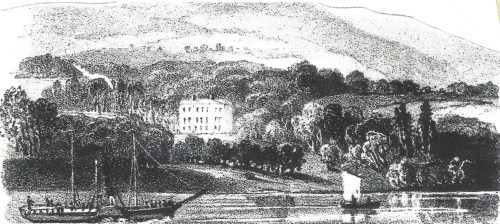
Paul Gauci's 1831 drawing of a Shannon steamer

Paul Gauci’s 1831 drawing of a Shannon steamer

This drawing of a steamer is from an 1831 book called Select Views of Lough Derg and the River Shannon by Paul Gauci. I haven’t seen the book myself, but this illustration is used in a couple of places, including Ruth Delany’s book The Shannon Navigation [The Lilliput Press Ltd, Dublin 2008]. Andrew Bowcock, in his article “Early iron ships on the River Shannon” in The Mariner’s Mirror Vol 92 No 3 August 2006, says of the steamer shown that

The funnel looks to be almost over the paddle shaft, which is artistic license.

But my question is not about the vessel but about the house in the background. If it is drawn without artistic licence, where is it?

It is a very large house, seven bays by three storeys, quite close to the water. Using the Historic 6″ Ordnance Survey map [~1840], I have followed the banks of the Shannon from Shannon Harbour down Lough Derg to Killaloe, then from Limerick down the estuary as far as Tarbert, across the estuary to Doonaha and back up on the Clare side to Limerick, then from Killaloe up the Clare and Galway shores back to Shannon Harbour. Anywhere I found a large house within what seemed the right distance of the shore, I looked it up in the Landed Estates Database and in the National Inventory of Architectural Heritage, with some supplementary googling.

I haven’t been able to find images of all the houses marked on the OSI map, but I found enough to show that houses of the size shown by Gauci were very rare. Within those few, I ruled out some (like Tervoe) because they didn’t seem to match Gauci’s drawing (although alterations could have accounted for that). I ended up with only one house that looked at all like Gauci’s, but the background may not match.

If you can identify the house, I would be glad if you could leave a Comment below.