WI pay

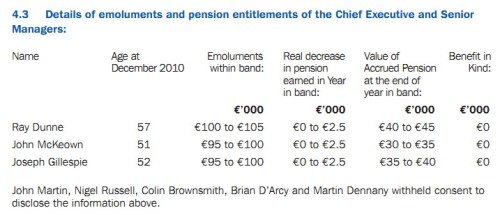
In my post about WI finances I referred to Robin Evans, chief executive of the Canal & River Trust, which runs many waterways in England and Wales. A commenter mentioned Evans’s salary. Here is what WI’s Annual Report for the year ended 31 December 2010 [PDF] says about the salaries of senior WI managers.

WI salaries

More mooring locations on the canals

From a WI presser received this afternoon:

The second set of locations offering the E.M.P include the Floating Moorings on the Grand Canal Dock beside the Waterways Ireland Visitor Centre on which a permit will be offered until March 2013. Additionally extended mooring locations will also be opened on the Grand Canal near Lock 34 in Co Offaly, Pike Bridge in Co Kildare and Abbeyshrule in Co Longford. The full details of the locations including the GPS co-ordinates, the Application Form and Guidance Notes will be available on www.waterwaysireland.org from the 3rd December.

Update 4 December 2012: the press release is now on the WI site.

Ireland’s most popular waterways artefact?

The search term most often used to find this site is Ardnacrusha, which scores 1655, almost twice as many as the next term, the generic Waterways (875). But other variants occur too: Ardnacrusha Lock is at position 3 (768), Ardnacrusha power station 18 (274), ESB Ardnacrusha 21 (225), Ardnacrusha ESB 33 (169), Ard na Crusha 43 (140), Ardnacrusha hydroelectric power station 58 (120), Ardnacrusha dam 86 (89); Parteen Weir is at 14 (369).

Thus I deduce that Ardnacrusha is by far the most popular artefact on Irish inland waterways.

Here is the full top twenty.

1 Ardnacrusha 1,655
2 Waterways 875
3 Ardnacrusha lock 768
4 Wooden boat 728
5 Skies 613
6 Athlone 573
7 Strancally castle 483
8 Lough Erne 480
9 Homemade boat 460
10 Wooden boats 453
11 Irish waterways history 451
12 Boats 448
13 Irish waterways 393
14 Parteen Weir 369
15 Flying Fifteen 344
16 Homemade boats 333
17 Pioner Multi 301
18 Ardnacrusha power station 274
19 Johnstown Co Kilkenny 247
20 Ormond Castle 237

Most hits on this site come from searches rather than links.


Shannon traffic

This chart shows the numbers of Shannon lock and bridge passages for the first ten months of the year for ten years from 2003 through 2012.

Figures courtesy of Waterways Ireland

These figures take no account of boats that do not use locks and bridges, eg those that remain on lakes.

The decline continues.

Software licence agreements

A universal translation:

All your base are belong to us.

WI finances

Robin Evans, chief executive of the Canal & River Trust, was interviewed in the December 2012 issue of Waterways World. CART, a charitable trust, has taken over from British Waterways in England and Wales, but not in Scotland.

Robin Evans pointed out in the interview that, whereas waterways in Scotland get 98% of their funding from the state, CART’s English and Welsh waterways get only 35%. Amongst other things, CART is seeking donations and getting people to volunteer as lockkeepers and in other roles.

I’ll bet the Irish government is looking on with interest.

Boats to return to Corbally Branch

Well, canoes, but better than nothing.

PS for “upstream” read “downstream”, as far as I can see.

Waterways Ireland and the cuts …

WI’s tree-cutting on the Barrow.

Royal water (current status)

I have updated my page about Royal Canal feeders with some information provided by Nigel Russell of WI to the An Bord Pleanála oral hearing on the Royal water supply scheme.

Incidentally, the Department of Arts, Heritage and the Gaeltacht, WI’s parent department in RoI, was among the (few) objectors to the proposed abstraction of water from Lough Ennell, although it was in favour of ceasing to abstract water from Lough Owel [Inspector’s report pp11–12]. Indeed it seemed to have some reservations about the reopening of the Royal Canal, not on economic grounds but because “some important nature consideration issues need to be fully addressed”.

Royal water

The Royal Canal water supply applications have been approved by An Bord Pleanala. There were two separate applications [see here and here] but they were in effect treated as one. There are five PDFs available on each page and I haven’t read all of them yet. However, on a first glance, I note that:

2. The proposed development shall be operated as follows:

(a) Rates of abstraction from Lough Ennell to the Royal Canal shall be as specified  in the public notices and, in particular, shall not exceed 43,636 cubic metres of water in any 24 hour continuous period and subject to a total maximum abstraction of 6,586,363 cubic metres per annum.

(b) Abstraction from Lough Ennell to supply the Royal Canal shall cease when the  lake level reaches 79.325 mOD Malin Datum, being the crest level of Clonsingle weir, measured at Clonsingle weir by continuous monitoring.

(c) The fish pass at Clonsingle weir shall incorporate a minimum flow of 0.29m3/second.

(d) A minimum flow of 682 m3/day (0.5MGD), taken directly from Lough Owel, and excluding water from the fish farm, shall be retained in the original canal feeder.

Reason: In the interest of protecting the integrity of the Lough Ennell Special Area of Conservation and the ecological interest of the River Brosna and the canal feeder, and in the interest of protecting material assets at Lough Ennell and the River Brosna.

If I remember correctly, the amount of water available from Lough Ennell will not always provide enough (eg in a dry season) to keep the canal full. Still, this is a significant advance for Waterways Ireland and for Royal Canal enthusiasts.