Tag Archives: Dublin

Another description of the Dublin City Bason

From the Rev G Hansbrow’s 1835 publication An Improved Topographical and Historical Hibernian Gazetteer; describing the various boroughs, baronies, buildings, cities, counties, colleries, castles, churches, curiosities, fisheries, glens, harbours, lakes, mines, mountains, provinces, parishes, rivers, spas, seats, towers, towns, villages, waterfalls, &c &c &c, scientifically arranged, with an appendix of ancient names. To which is added, an introduction to the ancient and modern history of Ireland Richard Moore Tims; William Curry, Jun and Co; John Robertson and Co, Dublin; King and Co, Cork; Marks, Waterford; Simms and Mairs, Belfast; Campbell, Derry; M’Kerin, Limerick; Wheelock, Wexford; Collins, Drogheda; Dunlap, Coleraine; Purcel, Tralee; Kyte, Cashel; Blackham, Newry; Bole, Castlebar; Devir, Westport; and other booksellers:

The City Bason is the pleasantest, most elegant and sequestered place of relaxation the citizens can boast of; the reservoir, which in part supplies the city with water, is mounded and terraced all round, and planted with quickset hedges, limes and elms, having beautiful green walks between, in a situation which commands a most satisfactory prospect of a vast extent of fine country to the south. The entrance is elegant, by a lofty iron gate, and the water that supplies it, is conveyed from the neighbouring mountains.


The Broadstone in 1821

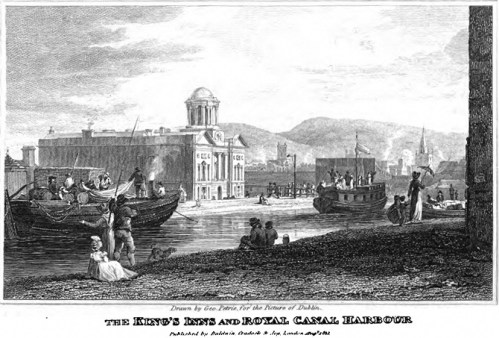
The Broadstone Harbour with King’s Inns in the background, early 1820s

This is a drawing by George Petrie, made for J. J. McGregor’s New Picture of Dublin of 1821. The details of the vessels are interesting. More on the Broadstone here.

Arthur’s Day

There is quite a modern branch of trade risen up in Ireland — I mean the exportation of Dublin porter. I am not a proprietor in the brewery, and, in praising the beverage, which I consider most excellent, I cannot be considered to be actuated by interested motives. But, it is a curious fact, that, a few years ago, Ireland was an importing country of porter, while, at the present moment, a very considerable export trade is growing up in Dublin.

In this point, and, perhaps, in this point only, I fully expect the learned member for Dublin [Daniel O’Connell MP] to concur with me. I only venture to entreat hon. Members opposite, who wish to give some activity to the trade of their country, to encourage the fermentation of the vat, rather than the fermentation of politics. By so doing, they may greatly improve our trade and our internal condition; and, if they will but take my advice, I, for one, shall be ready, most heartily, to drink their healths in their own porter.

Thomas Spring Rice, MP for Cambridge (and previously for Limerick), Joint Secretary of the Treasury, in a House of Commons debate on the repeal of the Act of Union on 23 April 1834. On this site, you’ll find more on Daniel O’Connell here and on Uncle Arthur here.

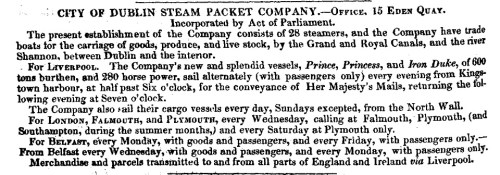
Theatre steam

The Abbey Theatre has announced that it has bought Nos 15–17 Eden Quay, Dublin 1. No 15 was the address of the main offices of the City of Dublin Steam Packet Company.

From the Dublin Almanac of 1845

The company crest is said to be still on the wall. Abbey Street Old seems to run between the two premises; no doubt there will be some means of avoiding any problem.

I wish the Abbey Theatre well in its extension, but I hope it will find some way of honouring the memory of the City of Dublin Steam Packet Company and of the underrecognised Charles Wye Williams.

Kilgarvan Quay

On 3 October 1906 Mr Hugh Delaney of Borrisokane, Co Tipperary, gave evidence to the Royal Commission appointed to enquire into and to report on the canals and inland navigations of the United Kingdom. Tipperary (North Riding) County Council had asked him “to give evidence on behalf of the quay at Kilgarvan.”

His evidence became rather confused, as he and his interlocutors misunderstood each other. The source of the problem seems to have been his using the term “the canal” to refer both to the Grand Canal Company and to the canal itself. The main points of his evidence were these:

  • Kilgarvan Quay was “only of recent date: it was only opened in [October] 1891 and it has had an extraordinary effect on the traffic of the district and brought down the railway rates [from Cloughjordan] very considerably”
  • there had been no quay at Kilgarvan before that; there was deep water at the quay
  • the grand jury of the North Riding of Tipperary gave £230 towards the cost and the Grand Canal Company paid the rest, about £579
  • although it was only 104 miles from Kilgarvan Quay to James Street harbour, it took five or six days for barley to reach Dublin
  • he felt that the trip should be done in two days, using steam launches
  • he thought that transhipment at Shannon Harbour caused undue delay
  • people at Terryglass had built a quay and it made a port of call for the Grand Canal Company.

The present quay at Kilgarvan is not on the ~1840 OSI map (though there is a smaller quay near the bend in the road) but it is on the ~1900. I have a photo of the crane on my page about Shannon cranes; I’m no expert, but I wonder whether the crane might be older than the quay.

Canal mooring rules

Waterways Ireland issued two press releases about moorings today. The first was the usual one about winter moorings on the Shannon and the SEW; the second was about the canals. Here, unedited, is the text of the second.

Canal Mooring Rules Coming into Force

Waterways Ireland announced in June 2012 that the Canal Bye-laws on the Grand & Royal Canal and Barrow Navigation are to be enforced from autumn 2012, with an accompanying change in the permit system allowing for year-long mooring permits and locations.

Part of bringing in this new location-based permit has been the identification of locations suitable for extended mooring. This process is now completed and work has begun in some areas to improve accessibility.

Waterways Ireland will roll out Extended Mooring Permit applications by area, rather than giving a date when applications for the permit will open. For boat owners this will mean that enforcement of the maximum stay rule will not commence in an area until after boat owners have had the opportunity to purchase an Extended Mooring Permit.

The initial 12 month Extended Mooring Permit will cost €152 and will only be available to boats already holding a valid annual Mooring and Passage Permit.

Boats that cruise and move (staying at a mooring for up to 5 days) will not be in breach of the Bye-laws or require an Extended Mooring Permit.

Waterways Ireland has proposed a small number of draft amendments to the current Bye-laws which date from 1988. These include proposals to provide a range of charges for mooring permits that reflect the location and services provided throughout the canals and also will take into account the size of boat. These proposals include low cost rural moorings on soft banks to ensure the canals are accessible for everyone who owns a boat and requires a mooring. Boat owners allocated an extended mooring location in key areas in villages or towns or with services should be aware that if the new Bye-laws are approved Waterways Ireland will increase the charges for moorings in the future to reflect the location, services, and size of boat.

Waterways Ireland recognises the current situation whereby a small number of boat owners use their boats as their sole or permanent residence. Proposals to make provision for this use of the navigation property have been included in the Bye-law changes.

Furthermore Waterways Ireland intends to work towards the provision of a small number of serviced house boat moorings on the canal network. Such provision will be subject to finance, land availability and compliance with requisite statutory approvals.

Waterways Ireland recognises that a transition period of a number of years will be required to implement this. In the interim these boat owners should apply for an Extended Mooring Permit.

The draft Bye Law amendments are currently being considered by Waterways Ireland’s sponsor Departments. When Waterways Ireland has Ministerial consent, it will proceed to public consultation on the proposed Bye-law amendments.

Waterways Ireland will continue to contact permit holders regularly to ensure they are kept up to date with the roll-out of the new permit. All queries about the enforcement of the current bye-laws or the Extended Mooring Permit should be directed to Shane Anderson, Assistant Inspector of Navigation: Tel no +353 (0)87 286 5726, Email shane.anderson@waterwaysireland.org . Queries about houseboats should be directed to Property & Legal Section Tel no +44 (0)28 6632 3004.

These changes are necessary steps to improve the management of the canals and waterway amenities for both the navigational and recreational user, so that investment in the new infrastructure and facilities which Waterways Ireland has undertaken is maximised for every user.

Big it up for the National Library …

… which is seeking a commercial partner to help it to digitise its collections. O si sic omnes.

Hunting Newbury

In his A Tour in Ireland with Meditations and Reflections [S Highley, London 1844], James Johnson MD describes a flyboat trip on the Grand Canal from Dublin. He says:

At Newbury, a station near Edenderry, I debarked, and spent two or three days at the hospitable mansion of Newbury Hall, with my excellent friend Mr Wolstenholme and family, where I also met my amiable friend, Mrs Evans, of Portrane.

I have been trying to find Newbury. So far, the most likely candidate seems to be Newberry Hall, in Carbury, Co Kildare; the spelling Newberry is given on the ~1840 [Historic 6″] OSI map whereas the ~1900 [Historic 25″] map gives Newbury.

The Hall is indeed fairly close to Edenderry, but if Johnson got off the boat in Edenderry I’d have expected him to refer to it as Edenderry harbour. Looking at the OSI map (link above), the only other sensible point of debarkation would (I think) have been at Ticknevin Bridge, from which there was a road towards Newbury, but I have no evidence that it was Newbury station.

I would welcome enlightenment.

Wordling Repeal

On 22 April 1834 Daniel O’Connell, MP for Dublin but a native of Kerry, argued in the House of Commons at Westminster for, IIRC, five hours in favour of the repeal of the Act of Union. Here is what Wordle makes of his speech.

Daniel O’Connell Wordled

On the following day Thomas Spring-Rice, MP for Cambridge but a native of Limerick, responded for six hours. Here is what Wordle made of it.

Thomas Spring-Rice Wordled

Dublin’s canals in 1801

Grand Canal

The formation of canals was scarcely known in Ireland until the year 1765, when the Grand Canal was begun by a company of enterprising men, who were incorporated in 1772 by an act of parliament; boats began to ply to Sallins in 1783, to Athy in 1791; it is a cheap and pleasant mode of travelling, at the rate of 3½ miles an hour. This Canal is carrying on to Philipstown, Banagher, and Birr. From the first lock at Kilmainham, a cut has been made to the river Liffey at Rings-end, extending 3 miles, having 12 neat bridges to accommodate the different roads to Dublin. At the seventh lock on this line, the great basons and docks are, 4000 feet long, and 330 feet average breadth, capable of containing 400 sail of square-rigged vessels. On the 23rd of April 1796, it was opened at high tide; when his excellency Earl Camden in the Dorset yacht, commanded by Sir A. Schomberg, with a number of barges from the canal, cutters, and boats highly decorated, were admitted under a discharge of 21 pieces of cannon, and had room to sail in various directions. There were 60,000 people present; it was the best aquatic fête ever seen in this kingdom. John Macartney Esq addressed his Excellency, and was knighted.

Royal Canal

The Royal Canal is another proof of national spirit and national industry. The subscribers were incorporated in 1789; it is now finished beyond Kilcock, 14 miles, and is proceeding rapidly to Kinnegad. On Sunday the 20th of December 1795, the first excursion was made in a barge to Kilcock, with the Duke of Leinster and Marquis of Kildare, amidst the acclamations of the people.

J S Dodd, MD The Traveller’s Director through Ireland; being a topographical description not only of all the roads but of the several cities, towns, villages, parishes, cathedrals, churches, abbeys, castles, rivers, lakes, mountains, harbours, the seats of noblemen and gentlemen on those roads: their antiquities and present state respecting parliamentary representation, patronage, trade, manufactures. commerce, markets, fairs, distances from each other, and natural curiosities; with an account of their foundations, vicissitudes, battles, sieges, and other remarkable events that have occurred at them — insomuch, that this work comprehends in itself, an accurate Irish itinerary, an extensive Irish gazetteer, an Irish chronological remebrancer [sic], and an epitome of the ecclesiastical, civil, military and natural history of Ireland, from the earliest accounts to the present year, and every information necessary for the resident, or the stranger. Embellished with  two elegant maps; one of the roads and post towns in Ireland, the other of the city of Dublin, compiled from the most authentic authorities Dublin 1801