Tag Archives: Ireland

Charging Waterways Ireland for water

Nice PQ from Éamon Ó Cuív here:

Éamon Ó Cuív (Galway West, Fianna Fail). Question 446: To ask the Minister for the Environment, Community and Local Government if Waterways Ireland will have to pay for the abstraction of water for use in the Royal Canal, the Grand Canal, the Shannon-Erne Waterway and other man-made waterways as a result of the reasoned opinion from the European Union in November 2011; the reply sent by him regarding same to the Union; and if he will make a statement on the matter. [8122/12]

Here is the European Commission’s press release on the subject.


Riasc report …

… in today’s Irish Times.

Big it up …

… (comme on dit) for Waterways Ireland, which seems to have started improving its website (after many years).

Tax-dodging boat-owners redivivus

In December I posted a piece suggesting that the amount of money received by the Revenue Commissioners in Mineral Oil Tax was far below what it should be. New readers may wish to know that, under an insane system introduced by the Irish government to give the impression of complying with a European Union ruling, owners of private pleasure-craft are allowed to buy cheap green (rebated) diesel (marked gas oil) but are supposed to pay to the Revenue the difference between the amount they paid at the pumps and the amount that would have been paid without the rebate. This difference is called Mineral Oil Tax.

Having discovered the total amount received by the Revenue, and deduced from that the number of litres on which the tax was paid, I wrote:

Let us suppose, for the sake of argument, that the average pleasure craft has a 40hp diesel engine (which is what my 1960s cruiser had). That would use two gallons or nine litres per hour. So the 313,748 litres of diesel on which Mineral Oil tax was paid [for the year 2010] would have kept one cruiser going for 34,861 hours.

On the other hand, if there are 10,000 pleasure craft in Ireland, with diesel engines averaging 40hp, then they are claiming to have cruised for an average of three and a half hours each in the whole of the year 2010.

I suspect therefore that there is significant underpayment of the Mineral Oil tax and I suggest that the system should be abolished: boat-owners should pay the full (auto diesel) price.

I later converted that post into a page, to give it more permanence. On that version, I added the suggestion that the inland hire fleet probably accounted for the vast majority of the diesel on which Mineral Oil Tax was paid. Note that the owner of a hire fleet would make a single return covering the entire fleet.

Some folk objected to my mentioning this matter at all; others suggested that I was wrong and that most boat-owners were undoubtedly law-abiding taxpayers. Accordingly, I asked the Revenue for the number of returns received in each of the two full years for which the scheme has operated. The response:

[…] the number of returns for 2009 (received in 2010) was 38 and for 2010 (received, near end of 2010 or in 2011), the figures was 41.

Most boat-owners have been dodging the tax. I rest my case.


You don’t often see …

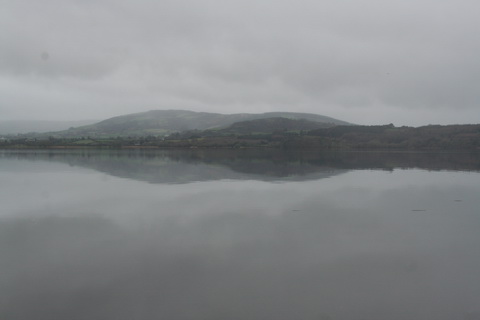
… a completely calm Lough Derg.

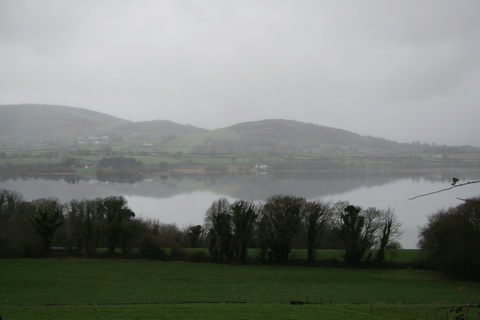
From Castlelough

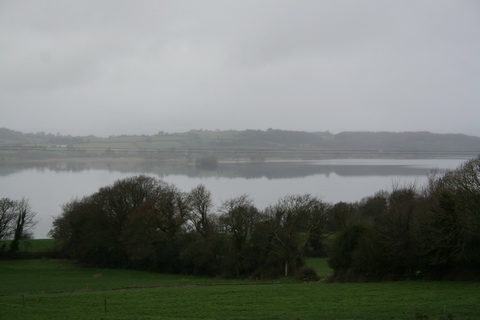
From The Lookout 1

From The Lookout 2


Of engineers

He did not mean to deny the fitness of the [Shannon] Commissioners to execute the task which had devolved upon them, but he considered that five engineers of such eminence as those named in the Commission were too many to appoint for such a purpose, and the only result to be looked for would be that some plan of great magnificence and grandeur would be suggested, which the House of Commons would never feel itself authorised to grant money to execute, and then the projected improvement of the river would be altogether dropped and lost sight of.

Lord Clements, House of Commons 17 February 1836

Boat sabotaged at Sallins

At night, a lumber-boat belonging to Messrs. Daley and Carney was maliciously sunk in the Grand Canal, near Sallen’s, by some person or persons, who bored holes in the keel and sides.

From  Chief Constables’ Reports for January 1833, cited in the House of Commons on 27 February 1833

Killaloe bridge

More on the new bridge here with the full public notice here [PDF]. Interesting to see how many of the names of landowners are known to me.

I see on page 6 of the notice that the ESB owns two rivers, which are occupied by the ESB, Waterways Ireland, the Inland Waterways Association of Ireland and other unknown persons. There is a canal, whose owners are unknown, which is occupied by WI, IWAI and the persons unknown, as is an island. I do hope that the council will return the canal, rivers and island when they’ve built the bridge.

WI privacy

Waterways Ireland has revised its policy document on website privacy [.DOCX file]. Nothing startling in it; the chief item of note is that it’s a clear, well-written document.

A note for a councillor

Councillor Pat Treanor is a Sinn Féin member of Monaghan County Council. According to the Clones Regeneration Partnership’s website,

Cllr Treanor referred to the recent economic appraisals carried out by Fitzpatrick Associates on behalf of the Government and made reference to the large job creation and physical regeneration that would flow from the [Clones] canal proposal.

As far as I know, the most recent Fitzpatrick study was published in 2007. It said (Ch 10):

In terms of formal quantified economic appraisal, all restoration options involve significant net costs over benefits.

In other words, the Clones canal is a waste of money.

Clones folk might like to have a large wodge of public money spent in their area; Waterways Ireland might like to be able to keep engineers in employment. But neither of those wishes should weigh with those charged with the care of the state’s finances. If proposals like this are seriously considered by Irish government departments, then the sooner Angela Merkel appoints an official to run the place, the better.

Perhaps, though, a household tax in Monaghan could be used to pay for this, er, investment?