Tag Archives: lock

Rockville navigator elected to Dáil

Ming Flanagan was the first to be elected a TD in the Roscommon South Leitrim constituency in the 2011 general election.

Ming launching himself on the Rockville Navigations

His sterling qualities were shown when, in September 2010, he kayaked down the Rockville Navigations, with a companion, to check this tourism and recreational resource (which I had brought to his attention in his capacity as Mayor of County Roscommon).

Another person on the side of righteousness is Paudie Coffey of Portlaw, mentioned favourably here; he was first home in Waterford, where he stood for Fine Gael.

WI’s Lakelands and Inland Waterways Strategy

Some thoughts here. Overall conclusion: must try harder. Why no mention of the Royal Canal? Why nothing about industrial, transport or waterways heritage?


Consultancy fee? No, it’s OK, thanks ….

How A N Other and I saved the Irish waterways … or at least suggested how Waterways Ireland should approach British narrowboaters.

Rowing

Big it up for the Irish Amateur Rowing Union (aka Rowing Ireland), which will be descending the Lower Shannon in May. Good to see that they’ll be doing the estuary, as fas as Bunratty, and are not confining themselves to non-tidal waters.

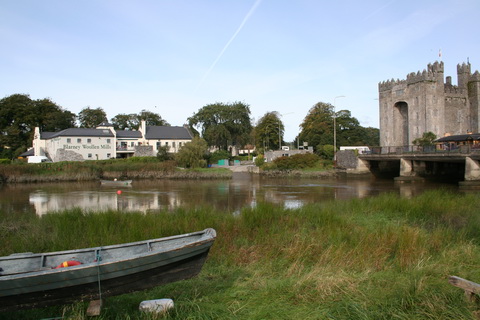
Bunratty

F E Prothero would be proud of them: he himself thought it best to see the estuary from the deck of the steamer to Kilrush.


Old photos of Parteen Villa Weir and barges

Thanks to Sam and Brian Grubb, I have been able to put up some photos, taken in 1930, of Parteen Villa Weir. The scanning of the photos was done at such high resolution that it is possible to see several vessels moored in the headrace below the weir.

Waterways restoration? No thanks

An article in the Irish Times about railway restoration has prompted me to set out my views on waterways restoration. Essentially, I don’t believe public funds should be spent on projects that won’t provide a decent return, but I do favour small-scale conservation, opening up walking and cycling routes along waterways and marketing them to industrial heritage enthusiasts (and others).


Nineteenth-century Irish canal boats

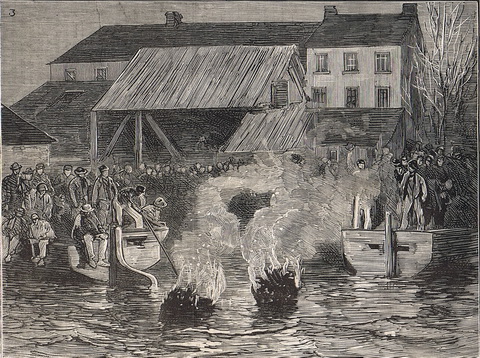
Illustrations of early Irish inland waterways vessels are relatively scarce. The drawing below shows the sterns of two of them.

Portobello Harbour 1882

This is from The Graphic of May 13, 1882, and shows the lighting of tar-barrels in Portobello Harbour, on the Grand Canal in Dublin, to celebrate the release from prison of Charles Stewart Parnell and two colleagues.

The layout of the harbour in around 1900 can be seen on the OSI Historic 25″ map. Where were the vessels tied? What are the buildings in the background? What can be said about the vessels? Presumably wooden horse-drawn barges, but they look rather narrow to me. Comments welcome.

The harbour itself is, alas, no more.


Ephemera 9: the flash lock at Killaloe

As part of its new mooring scheme at Killaloe, Waterways Ireland has commissioned contractors (L&M Keating Ltd) to carry out various works including the installation of a lock at the upper end of the canal, beside the Phoenix boathouse and just downstream from the Pierhead. The lock is to control access to the canal; presumably the stop planks in the existing lock chamber will be removed, allowing boats to pass down under the bridge.
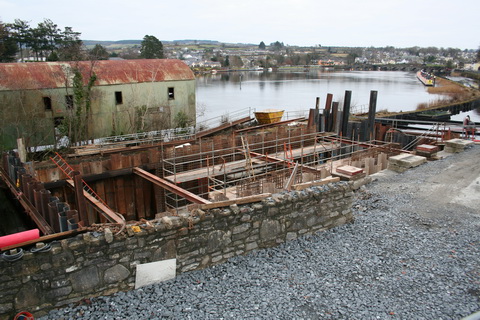
The lock under construction

As I understand it, this lock is to have a single pair of gates. Boats wishing to pass through will tie up temporarily and use a squawk-box (or similar technological marvel) to communicate with the bridge-keeper at Portumna, who will cause the gates to be opened and then, presumably, closed after the boat has passed through. This system will prevent the use of the canal by cads and bounders using jetskis, speedboats and other excrescences.
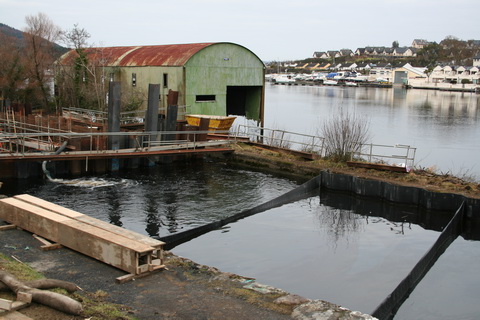
Stanked off and pumped out

However, the water through Killaloe Bridge has a gradient or slope, especially in flood and when Ardnacrusha power station is running. The canal above the lock will be at the higher level; the canal below the lock will be fed from the bottom end, where it rejoins the river. So is there not likely to be a difference in height at the lock? Is this the equivalent of a flash lock?

I’m sure there is an engineering answer to this; I would welcome enlightenment.


Locks at locks

Here‘s a thing.

Clondra Lock

The lock at Clondra may be the only one on the Shannon that is in the same place, and doing the same job, since the days of the Commissioners of Inland Navigation in the middle of the eighteenth century. The lock itself has been refurbished several times, and in recent years the lock furniture has been altered to make it impossible for boaters to work their own boats through it. But it has a very interesting collection of gear and it is well worth using, even if you’re not going to the Royal Canal at Richmond Harbour.